New IKEA cabinets with third-party fronts: compare the complete kitchen
Buying boxes from one supplier and fronts from another can deliver the appearance you want. Compare that coordinated package with a complete cabinet system before treating a door price as a kitchen saving.
New cabinet boxes with separately purchased fronts can make sense when you want a particular exterior that the chosen cabinet system does not offer. They are less compelling when the attraction is only a low box subtotal. The useful comparison is the finished kitchen: usable interiors, approved fronts, visible stationary parts and the work needed to bring them together. Decide whether the different exterior is worth managing a separate purchase.
This is a new-kitchen decision. Refacing an existing kitchen starts with the condition and arrangement of boxes already in the house. Here you can still choose the whole cabinet system. Do not lock into boxes merely because a favorite front collection has been found; check that those boxes can provide the storage and room arrangement you actually need.
Compatibility belongs to a named system
Semihandmade describes its IKEA-compatible parts as aftermarket and says it is not affiliated with IKEA. Its FAQ distinguishes standard predrilled fronts from undrilled lift-up doors, panels, trim and custom pieces. That is a specific supplier example, not blanket compatibility among cabinet brands.
Record the exact cabinet system supported by the selected front, not just the retailer's name. A kitchen system, bathroom system and older discontinued system from the same retailer should not be treated as one family of interchangeable parts. Obtain confirmation for the actual components in the order. A door with an apparently familiar width does not establish the drilling, front arrangement or moving-hardware interface.
Keep the intended drawer arrangement visible. A broad outer front covering an inner drawer arrangement is not the same order as several exposed drawer fronts. Show the actual elevation and interior plan together so each supplier can identify what is being purchased. Do not convert the design to a stack of standard fronts solely because those are easier to add to a cart.
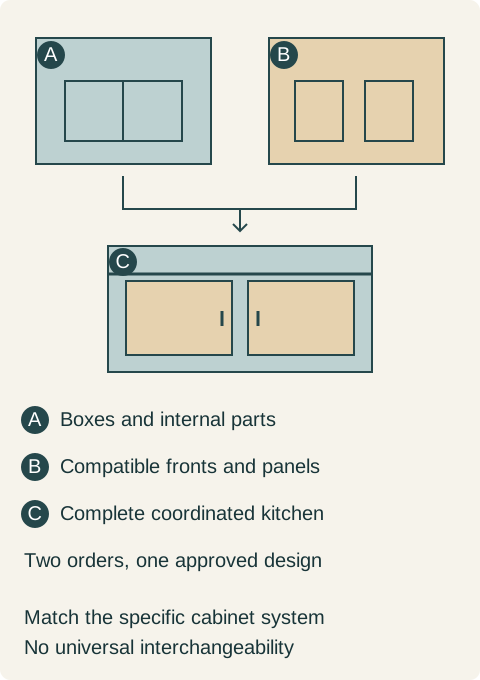
Teaching example Conceptual new-kitchen purchase: A supplies cabinet boxes and selected internal parts; B supplies compatible fronts and selected finishing pieces; C is the coordinated installed kitchen. Arrows describe purchasing responsibility, not a claim that parts from arbitrary brands fit.
The exterior includes more than moving fronts
Walk around the proposed kitchen in the drawing. Identify the island back, exposed ends, underside of wall cabinets, fillers, toe-kick finish and any visible interior. Choose the source and treatment for each. The doors can match beautifully while a stationary end remains a different material or color that was never discussed.
A decorative panel's finished position affects the whole run. Establish whether it finishes at the front, extends beyond it or returns around an end. Show its actual specified thickness where it consumes room or meets an appliance opening. Do not copy the panel dimensions from another system into the combined design without checking the selected component and installation detail.
Consider what happens when a door opens. The box interior and the back of the front may differ from the decorative face; that can be entirely acceptable. Review it consciously. If the project needs a display cabinet with a coordinated interior, include that treatment instead of assuming the separate front order changes every visible surface inside the box.
Divide supply and installation without leaving gaps
Mark the source for boxes, internal fittings, fronts, hinges or mounting parts, decorative hardware and stationary finish pieces. Determine what is included in each selected product and what must be ordered separately. A supplier's statement that a front works with a system does not mean the front shipment contains that system's hinges, runners or other internal parts.
Give the installer both sets of relevant instructions before accepting an installation price. Establish who assembles the boxes, fits the fronts, prepares any undrilled pieces, finishes exposed cuts where required and adjusts the completed installation. These are scope questions, not directions to modify a part in a way its manufacturer has not accepted.
Custom appliance panels need a separate documented connection to the appliance. An IKEA-compatible door description is not an appliance-panel specification. Use the selected appliance requirements and an approved panel order, including the attachment provisions and any additional parts the installation needs. The installer should not discover an unsupported panel arrangement after the rest of the kitchen is in place.
Compare one complete set with another
Price the combined package through the same endpoint as the alternative cabinet offer. Include the boxes and interiors, decorative exterior, finishing pieces, delivery and agreed assembly and installation. If a quoted front is unfinished, show the chosen finishing work as well. Do not compare its purchase price with a finished door and call the difference a completed saving.
Also compare the layout you are getting. A complete cabinet line may offer a width or internal arrangement different from the selected modular system. That can change the filler allocation, drawer storage or appliance relationship. Show the actual finished plans rather than pretending equal overall wall length means identical useful cabinetry.
Keep purchase terms attached to the respective seller. Ask who handles each component if something arrives wrong, and what information that seller needs. Do not assume the box supplier takes responsibility for another maker's front, or that choosing separate fronts automatically voids every possible protection. Read the actual terms and obtain answers for the proposed combination instead of making either blanket claim.
A separate-front choice that is worth the coordination
Imagine a household planning an entirely new kitchen. It likes a particular wood-look front from an aftermarket supplier and is satisfied with the chosen modular boxes and drawers. A complete cabinet-line alternative also fits the room, so the choice is not being forced by a cabinet already installed.
The first hybrid estimate includes moving fronts but omits the island back and an exposed tall-cabinet end. Once those are added, the installer also identifies fitting and finishing tasks that were absent from the box-assembly quote. The corrected comparison is more expensive than the household's initial estimate. It is still acceptable because the household values the approved exterior and the useful interior arrangement.
Before ordering, the buyer has both suppliers' selections tied to the same cabinet labels. The island end detail is checked against the passage and appliance arrangement. An unnecessary decorative feature is removed from the design to keep the complete purchase within the household's chosen spending limit. The household keeps the hybrid approach for a specific desired result, not because the boxes alone seemed inexpensive.
A buyer who is equally happy with the complete-line exterior may reasonably choose that alternative instead. Fewer separate purchasing relationships can be valuable. The point is to buy the coordination only when its result matters to the project, rather than discovering the coordination work after the first order is irreversible.
Release the two orders as one design decision
Before release, reconcile quantities, front arrangements and all visible finishes with the installer and relevant suppliers. Identify which components must be onsite before particular work can proceed. Different delivery dates are not automatically a problem, but the actual sequence should work without unsupported assumptions about adding a piece later.
Retain the combined schedule alongside both order acknowledgments and the final installation notes. If the design changes, check both orders before approving the revision. A separate-front kitchen can be a coherent, considered purchase. Its success depends on deliberately selecting the complete result rather than treating a compatible door as the last decorative item in an otherwise finished kitchen.
Pure White
Cream White
Light Warm Gray
Gray
Navy
Black
Oak Tone
Dark Walnut Tone
Design study These finish studies are design references, not a list of currently orderable colors. Screens and lighting change the appearance; compare a physical sample before choosing.See all finish options →
The sample shows the door frame, a separate center panel, the face frame and the cabinet box. Each component has its own place in this Shaker construction.
Shaker construction: door frame, center panel, face frame and cabinet box. The cutaway helps locate these parts; confirm each material in the specifications for the selected cabinet.
01 / Door frame
The Shaker door has rails and stiles around a separate center panel. The frame and center panel are different components; confirm their materials in the specifications for the selected cabinet.
02 / Face frame
The face frame surrounds the opening at the front of the cabinet box and sits behind the doors. The face frame, door frame and cabinet box are separate parts.
03 / Cabinet box
The sample exposes the cabinet sides, interior surfaces and layered edges. The image does not establish the wood species or material specification of a selected cabinet.