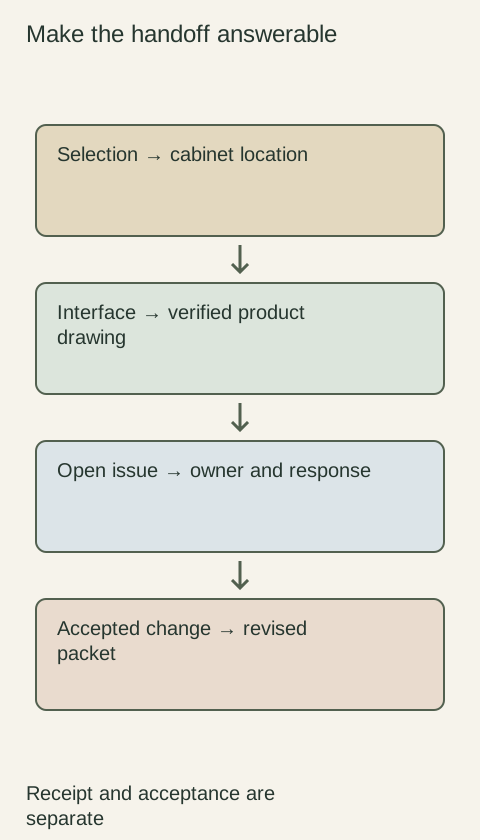
Buying the cabinets yourself can work with a separately hired installer when the handoff is explicit. Agree who confirms the product list, receives the shipment, contacts the seller about missing parts and decides whether installation can proceed. Purchasing the product does not automatically assign these tasks to the installer. An installation price also does not explain which purchasing or coordination work, if any, the installer has agreed to provide.
Diagram Assign review, receiving and supplier follow-up explicitly. This diagram does not define any provider’s contracted scope.
Have the installer review the actual product information
Before ordering, give the installer the proposed cabinet list, relevant specifications and assembly state. Ask whether the quoted installation work covers these products and what further information is needed. Do not substitute a photograph for product details or assume experience with a similar cabinet establishes familiarity with every attachment, panel or hardware arrangement in the selected package.
Identify who confirms the measurements used for purchasing and which selections depend on site conditions. The installer may offer a review service or may expect the owner to supply accepted information; obtain the actual answer. Keep that review separate from the owner's appearance choice. Approval of a finish does not establish that the product dimensions or required finishing components have been checked.
Decide who completes the receiving work
Assign the person who will meet delivery, compare the shipment with the order and document visible exceptions. Also identify who moves the goods to suitable protected storage. If the installer is not present that day, do not assume it will later reconstruct the receiving condition from unopened cartons or a general statement that everything appeared to arrive.
IKEA presents purchase, installation booking and delivery as separate preparation steps and advises checking received product identities against the list. That is a useful handoff concept, not a description of usaKT's or your installer's included services. Agree the receiving work specifically for your project.
Name who sends shortage, damage or wrong-item questions to the seller. If the homeowner holds the account, the installer may provide photographs or measurements while the owner submits the request. Ask what assistance is included and how additional diagnostic work would be discussed. Neither party should assume the other has already contacted the supplier merely because the problem was mentioned onsite.
Keep the seller response attached to the affected item and share it with the installer. A replacement request, an accepted replacement and a dispatched part are different statuses. Decide who will follow up and who will check the replacement when it arrives. This avoids an installation date being arranged around a part that has only been requested, not confirmed available.
Agree how incomplete supply affects the work
Imagine the owner receives the cabinet boxes, but a required finished panel is absent. Before the installer arrives, send the current inventory and ask what work can proceed and what must wait. A visually small missing item can affect a particular installation step; the actual installer should assess that dependency rather than the buyer assuming it can simply be added afterward.
Ask how a return visit or an owner-requested substitution would be scoped and priced if needed. Do not assume every delay produces an extra charge, or that every later visit is already included. If an alternative part is proposed, obtain the seller's product information and the installer's assessment before accepting it. Keep a convenience substitution from silently changing the agreed appearance or installation method.
Close the product-to-installation handoff
Before the scheduled start, provide the accepted order, product instructions, receiving inventory and a concise list of open supplier issues. Ask the installer to confirm readiness for the work it will perform. Identify who supplies any separately required accessories or consumables. The handoff should show what is onsite, what is missing and which outstanding decisions affect the work sequence.
At completion, retain the installer observations, remaining parts and product documents together, with unresolved product requests still assigned to a contact. Separate a product question from a question about installed workmanship so it reaches the right person. The arrangement works best when the owner and installer share an understood task list, rather than expecting the act of buying or installing cabinets to include every related responsibility.
Pure White
Cream White
Light Warm Gray
Gray
Navy
Black
Oak Tone
Dark Walnut Tone
Design study These finish studies are design references, not a list of currently orderable colors. Screens and lighting change the appearance; compare a physical sample before choosing.See all finish options →
The sample shows the door frame, a separate center panel, the face frame and the cabinet box. Each component has its own place in this Shaker construction.
Shaker construction: door frame, center panel, face frame and cabinet box. The cutaway helps locate these parts; confirm each material in the specifications for the selected cabinet.
01 / Door frame
The Shaker door has rails and stiles around a separate center panel. The frame and center panel are different components; confirm their materials in the specifications for the selected cabinet.
02 / Face frame
The face frame surrounds the opening at the front of the cabinet box and sits behind the doors. The face frame, door frame and cabinet box are separate parts.
03 / Cabinet box
The sample exposes the cabinet sides, interior surfaces and layered edges. The image does not establish the wood species or material specification of a selected cabinet.