Reading remodeling cost recovery before buying kitchen cabinets
Read estimated resale contribution separately from the amount due for the project. A published kitchen recovery percentage does not establish a return for a particular cabinet order.
A reported remodeling cost-recovery percentage is not a rebate, a cabinet discount or money that becomes available when you order. It describes a relationship between project cost and an estimated contribution to resale value. Use that distinction before treating a new cabinet package as something that will partly pay for itself. The seller still charges the accepted purchase price, and the household still needs a way to pay the complete project cost.
The practical question is whether the cabinet purchase makes sense at that full cost. Its effect on a later home sale may be relevant, but it cannot be settled by multiplying a national report percentage by a cabinet quote. A cabinet order and a kitchen renovation are also different scopes: the latter may include work and materials outside the cabinet supply.
What the published figure measures
The NAR/NARI 2025 report lists 60% estimated cost recovery for a complete kitchen renovation. It compares REALTORS' estimated resale contribution with NARI members' estimated project cost; homeowner satisfaction is a separate survey measure.
Those are different observations with different uses. A professional's estimate of added resale value is not a recorded sale of your house. A homeowner's satisfaction is not a dollar amount returned to an account. Neither should be subtracted from the supplier's invoice. Read the report's methodology alongside the chart, and keep the edition identifiable when discussing a number with a designer or real estate professional.
The distinction also prevents an unsupported leap from the room to a particular feature. The report cannot tell you what a premium drawer organizer, wood species or decorative end panel will add to your sale price. It evaluates project categories. A seller would need separate evidence for a claim about the value of the specific upgrade being offered.
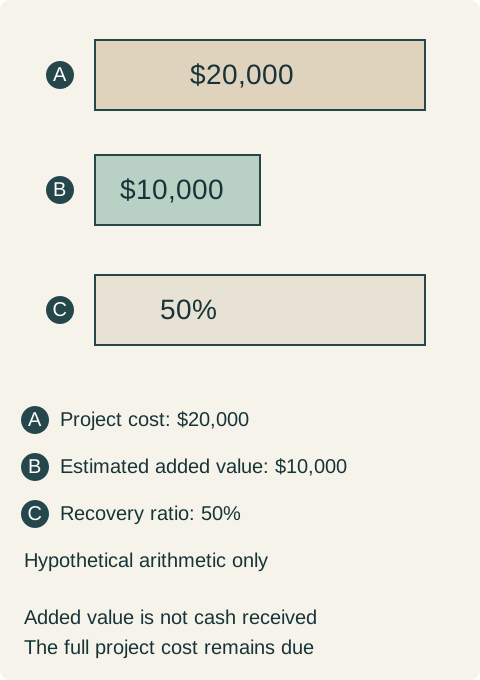
Teaching example Invented arithmetic only: A is a hypothetical $20,000 project cost; B is a hypothetical $10,000 estimated added resale value; C is the resulting 50% recovery ratio. These are not the report’s project amounts, a sale result or a usaKT quote. The full project cost still has to be paid.
Work through the ratio without turning it into profit
Use an invented example, unrelated to any quoted project or reported market result. Suppose a project costs $20,000 and its estimated added resale value is $10,000. Dividing $10,000 by $20,000 gives 50% cost recovery. The arithmetic does not mean the owner earns a 50% profit. The estimated added value is smaller than the spending by $10,000, even before considering any other costs or the uncertainty of that estimate.
Nor does this hypothetical example reduce the amount needed to buy the project to $10,000. The owner still pays $20,000. The possible contribution to a later sale remains an estimate, not a refund or a second source of purchasing funds. These invented amounts explain the calculation only; they do not estimate a cabinet package, a property value or an appropriate renovation budget.
It is equally important to distinguish added value from the home's total sale price. If a home later sells for more than it was bought for, the entire difference cannot automatically be credited to its new kitchen. The sale concerns the whole property at that time. Attributing an amount to one improvement requires more than comparing the two headline prices.
A cabinet quote needs its own scope
Begin with the kitchen the household actually needs: usable storage, the intended appliances, necessary work surface and acceptable finish. Obtain the full supply and installation scope for that design. Keep counters, site work and other separately supplied items visible. Do not apply a room-level ratio to a cabinet subtotal and describe the remainder as the final project cost.
Then price a controlled alternative. For example, keep the useful drawer arrangement and required finished ends while replacing a decorative display section with ordinary enclosed storage. The alternative should show a real change in the delivered kitchen. A quoted saving is something the buyer can evaluate now; a claimed future resale premium needs its own support.
An option can be worth buying for daily use without a demonstrated resale premium. Equally, a feature that the household will scarcely use should not become essential merely because someone calls it an investment. Ask what the extra payment buys in this home and whether the owners want that result at the full price.
This household declines the decorative upgrade
Consider a hypothetical family planning to remain in its home. Its current cookware storage is awkward, so the accepted base design provides the required drawer interiors while keeping an otherwise useful room layout. A more elaborate offer adds decorative cabinet work and a display section. Both offers include the necessary panels and installation scope; this is not a comparison between a complete quote and a cabinet-only headline.
The family initially considers the elaborate option because it expects to recover part of the extra expense at resale. On review, nobody has property-specific evidence connecting those decorative additions to an added sale value. The family does not need the display space enough to choose it at its full cost, so it buys the simpler complete package and keeps the drawers that motivated the renovation.
The purchase proceeds within the funds available for the actual contract. No anticipated resale amount is entered as a discount. This does not prove that the decorative work has no value; it means its uncertain future value is not being used to justify an upgrade this household does not otherwise want.
If a sale is approaching, change the question
An owner preparing to sell should discuss the property's condition, local competing homes and the proposed work with a real estate professional familiar with that market. Ask whether the contemplated cabinet scope addresses a specific obstacle to selling, rather than assuming every attractive replacement deserves the same expected recovery. Compare a scoped repair or limited update with a complete replacement where both are feasible.
For an owner staying, daily function can be the principal reason to buy. For an owner selling, the local sale plan may weigh more heavily. In both cases, keep the cabinet quote, the reason for the improvement and any resale estimate distinct. That leaves a decision the household can explain without turning a report's ratio into money it has not received.
Pure White
Cream White
Light Warm Gray
Gray
Navy
Black
Oak Tone
Dark Walnut Tone
Design study These finish studies are design references, not a list of currently orderable colors. Screens and lighting change the appearance; compare a physical sample before choosing.See all finish options →
Looking for kitchen cabinet prices? Prepare your cabinet types, sizes, quantities and finish preferences, then contact usaKT.com for a project quote. Freight is separate.
The sample shows the door frame, a separate center panel, the face frame and the cabinet box. Each component has its own place in this Shaker construction.
Shaker construction: door frame, center panel, face frame and cabinet box. The cutaway helps locate these parts; confirm each material in the specifications for the selected cabinet.
01 / Door frame
The Shaker door has rails and stiles around a separate center panel. The frame and center panel are different components; confirm their materials in the specifications for the selected cabinet.
02 / Face frame
The face frame surrounds the opening at the front of the cabinet box and sits behind the doors. The face frame, door frame and cabinet box are separate parts.
03 / Cabinet box
The sample exposes the cabinet sides, interior surfaces and layered edges. The image does not establish the wood species or material specification of a selected cabinet.