How much shelf space do mugs need when you include the handles?
The body diameter is only part of a mug’s footprint. Test handle direction, finger access and rear-row retrieval before deciding how many belong on the shelf.
Mugs can appear to fit across a shelf until their handles occupy the gaps you intended for your hand. Measure the complete footprint in the orientation you plan to use, then test how each mug comes out. A close-packed display and a shelf used every morning have different requirements. The useful capacity is the group that remains easy to identify, grasp and return.
Measure the body and handle together
Place the mug upright and measure to the farthest points, including the handle. Do this for the largest regularly used mug and any different shapes. A tapered body, wide base or unusually high handle may create another limiting dimension. Keep the orientation with the measurement; turning the handle can move the space requirement from shelf width to depth.
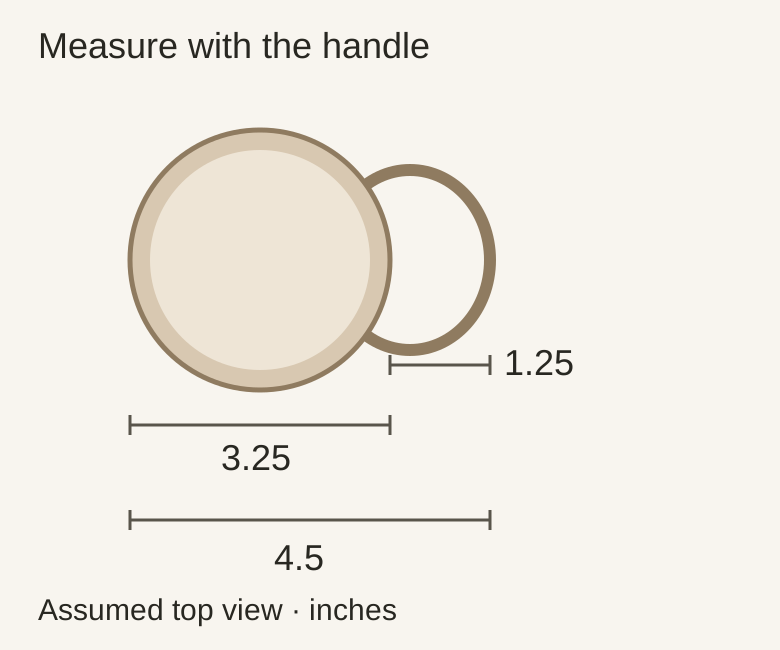
In a hypothetical example, a mug body is 3.25 inches across and the handle projects another 1.25 inches beyond it. That orientation occupies 4.5 inches. Placing 4 such footprints across an 18-inch clear shelf uses the entire width before any additional hand space. The arithmetic explains why body diameter alone overstates practical capacity; it does not establish how many mugs your shelf should hold.
Diagram Hypothetical dimensions in inches. The handle projection is measured beyond the body, not added as the full handle width.
Choose a handle direction for the actual reach
Try handles facing forward, sideways or slightly angled while the neighboring mugs are present. The best arrangement is the one your hand can use without hooking a neighboring handle. Interlocking handles may reduce apparent shelf space but can require moving several mugs to remove one. Test the middle mug, not just the one at the open end.
If another person uses the same shelf, have them try their usual reach too. You need not force every handle into an exact decorative angle. A forgiving arrangement that works after ordinary put-away is more useful than one that depends on careful alignment every time. Leave room for the grips people actually use rather than a hypothetical fingertip access.
Test the rear row without emptying the front
A deeper cabinet can hold another row, but that row needs a retrieval plan. Identify which mugs belong there and whether they can be seen and reached without moving the front group. If the daily favorite sits at the back, its nominal storage position may create unnecessary work each morning. Move frequently used mugs to the easier reach and keep the rest identifiable.
Check shelf height while taking a mug out, not only while it stands still. You may lift slightly before moving it forward. Do not assume mugs are stackable unless their product information supports that use; fitting one inside another is not itself a stable-storage specification. Different sets may need different arrangements instead of one shared stacking rule.
Allow for the collection you really keep
Separate everyday mugs from occasional or display pieces if that makes the working shelf easier to use. Give the extras a known location rather than letting them crowd the daily group gradually. When clean mugs return, check whether the layout still works with a different one missing or a larger mug in its intended place.
Record the complete footprint, required hand access, row arrangement and lifting clearance for the cabinet discussion. Include the shelf and organizer load information where relevant. A usable mug shelf does not need to be packed to its geometric limit; it needs to let the ordinary collection move through a normal morning without catching handles or shifting half the row.
Pure White
Cream White
Light Warm Gray
Gray
Navy
Black
Oak Tone
Dark Walnut Tone
Design study These finish studies are design references, not a list of currently orderable colors. Screens and lighting change the appearance; compare a physical sample before choosing.See all finish options →
The smallest stack is not always the easiest storage. Choose which bowls belong together by the retrieval steps, attachments and ordinary return routine.
A glass that stands on the shelf may not have room to come out. Check its widest point, lifting movement and the hand that has to pass through the opening.
The sample shows the door frame, a separate center panel, the face frame and the cabinet box. Each component has its own place in this Shaker construction.
Shaker construction: door frame, center panel, face frame and cabinet box. The cutaway helps locate these parts; confirm each material in the specifications for the selected cabinet.
01 / Door frame
The Shaker door has rails and stiles around a separate center panel. The frame and center panel are different components; confirm their materials in the specifications for the selected cabinet.
02 / Face frame
The face frame surrounds the opening at the front of the cabinet box and sits behind the doors. The face frame, door frame and cabinet box are separate parts.
03 / Cabinet box
The sample exposes the cabinet sides, interior surfaces and layered edges. The image does not establish the wood species or material specification of a selected cabinet.