Nesting mixing bowls without burying the one you use most
The smallest stack is not always the easiest storage. Choose which bowls belong together by the retrieval steps, attachments and ordinary return routine.
Nesting mixing bowls reduces the space they occupy, but it can put the most useful bowl underneath several others. The better arrangement depends on which bowl you reach for and what you must remove to get it. Before assigning a cabinet, build the proposed nested group and take out the bowl used for an ordinary meal. The extra movements you notice are the planning problem to solve.
Identify the bowl that interrupts the stack
Put bowls in the order they naturally nest, then mark the one used most often. If it is in the middle, its position creates a retrieval sequence: remove upper bowls, set them down, take the selected bowl and restore what remains. That sequence may be acceptable for occasional baking equipment but irritating for a bowl used repeatedly during the week.
Try separating that frequently used bowl from the nested reserve group. The arrangement may take a little more footprint while saving repeated handling. Keep the change specific; you do not need to give every bowl its own compartment. Compare the space required by the revised groups with the time and movements involved in the original stack.
Nest the complete stored pieces
Handles, pour spouts, nonslip bases and lids can change how bowls settle together. Test actual combinations rather than assuming that smaller diameter means a reliable fit. A bowl perched on another bowl’s rim can look nested from above while remaining awkward to lift as a group. Use the product’s instructions if it specifies how pieces are intended to stack or store.
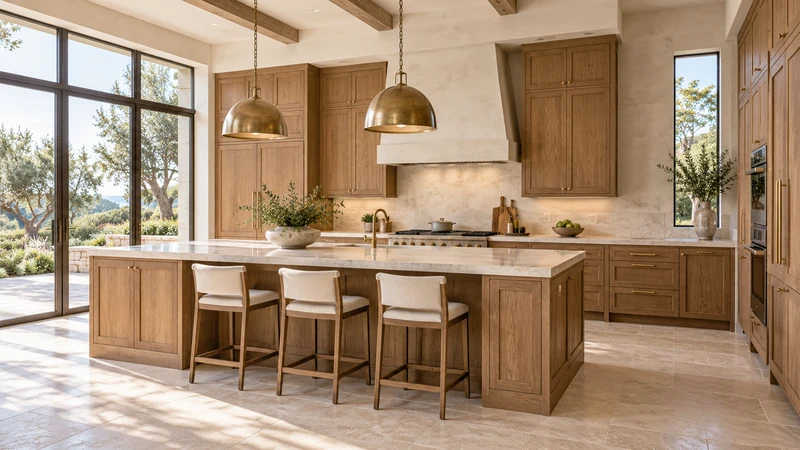
Design study A nearby surface can provide a temporary landing place when separating a nested group. The image does not show bowl dimensions or a fitted organizer.
Decide whether matching lids stay with their bowls or use a separate identified location. If a lid changes the top height or prevents the next bowl from settling, include that in the storage test. Do not plan a tidy bare-bowl stack and then leave the ordinary lids without a place. Likewise, keep any accessory used for preparation distinct from loose parts that could catch while removing the stack.
Provide a place to separate the group
When some nesting remains, identify where the temporarily removed bowls will go. The cabinet can be physically suitable but inconvenient if you must carry the whole group across the kitchen to separate it. Test the action with the nearby counter in its normal occupied state, not completely cleared for a demonstration.
Also check the grip when the group is inside the cabinet. Taking the nested set off a countertop can be easier than lifting it through a low opening or reaching over a drawer front. For a heavy set, divide the group into manageable parts rather than making the routine depend on carrying all the bowls together. Confirm applicable shelf or drawer loading for the actual stored collection.
Leave an obvious place for a missing bowl
Look at the arrangement while the daily bowl is in use. Can someone return the other clean bowls without filling its intended location? A dedicated everyday position works only if the remaining group does not gradually expand into it. The household should be able to see where each group belongs without reconstructing a precise nesting puzzle.
Before selecting the cabinet, test removal and return with the normal lids and neighboring items present. Record the footprint and height of the groups you actually prefer. A compact stack is useful when its retrieval sequence suits your habits. When it does not, spending a small amount of storage space on a separate daily bowl can make the whole arrangement easier to maintain.
Pure White
Cream White
Light Warm Gray
Gray
Navy
Black
Oak Tone
Dark Walnut Tone
Design study These finish studies are design references, not a list of currently orderable colors. Screens and lighting change the appearance; compare a physical sample before choosing.See all finish options →
A stack can fit in a drawer and still be hard to grasp. Separate everyday access, extra place settings and the organizer space before choosing the drawer.
The body diameter is only part of a mug’s footprint. Test handle direction, finger access and rear-row retrieval before deciding how many belong on the shelf.
The sample shows the door frame, a separate center panel, the face frame and the cabinet box. Each component has its own place in this Shaker construction.
Shaker construction: door frame, center panel, face frame and cabinet box. The cutaway helps locate these parts; confirm each material in the specifications for the selected cabinet.
01 / Door frame
The Shaker door has rails and stiles around a separate center panel. The frame and center panel are different components; confirm their materials in the specifications for the selected cabinet.
02 / Face frame
The face frame surrounds the opening at the front of the cabinet box and sits behind the doors. The face frame, door frame and cabinet box are separate parts.
03 / Cabinet box
The sample exposes the cabinet sides, interior surfaces and layered edges. The image does not establish the wood species or material specification of a selected cabinet.