Mitered or cope-and-stick cabinet doors: buy the whole profile family
The corner joint determines how the frame detail turns and which profile combinations can be ordered. Compare finished doors and drawer fronts, not a claim that one joint name always means better quality.
Choose a mitered cabinet door when its complete frame profile and corner treatment deliver the appearance you want. Choose a cope-and-stick design when its rail, stile and edge combination suits the order better. Both describe assembled frames. Neither name alone establishes wood grade, finish quality or the strength of an unspecified product.
The visible corner is only part of the joint
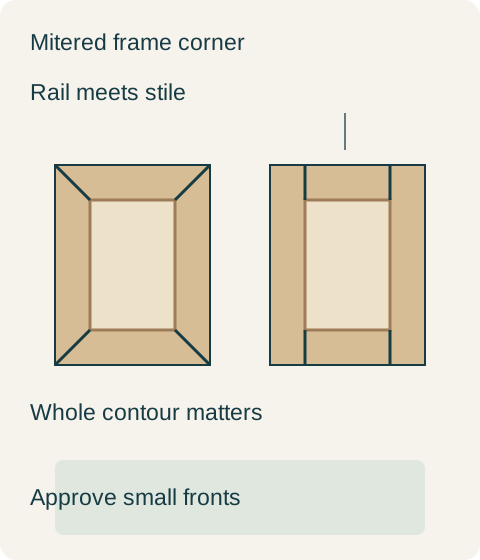
A conventional mitered frame presents a diagonal meeting line; a traditional cope-and-stick frame joins the shaped rail end to the stile profile. Do not infer that the miter has nothing inside it beyond a glued diagonal face. WalzCraft describes a true-blind mortise-and-tenon connection in its mitered doors. Its example makes “mitered versus mortise-and-tenon” an unreliable shortcut for comparing hidden reinforcement.
WalzCraft’s traditional door documentation treats the cope-and-stick detail as the inside frame profile, with separate center-panel and outside-edge choices. Its mitered program includes fully molded frames whose contours are not available in traditional construction. The practical purchase question is whether the complete profile can be supplied in the chosen construction, rather than whether two small samples share an approximate inner groove.
For WalzCraft’s MP700 family, stiles and rails on a door must use the same profile and width, and the outside edge is integrated. Its MP600/MP6000 family offers other edge and width options, but standard mitered outside frame members still share the specified width. The manufacturer identifies French-miter construction as an option for some unequal-width combinations. These are family-specific rules, not universal dimensions for every mitered door.
Diagram Conceptual face-view comparison of a diagonal miter and a rail-to-stile joint. Hidden joinery and exact profiles vary by product; this is not a strength test or machining drawing.
Keep the contour, change the short drawer front
In a hypothetical order, the buyer wants a fully molded mitered contour on tall doors. A short drawer cannot accommodate that contour with the intended center appearance. The shop offers a slab drawer front in the same finish or a traditional door family with a different contour. The buyer approves the slab drawer sample beside the mitered door and purchases that deliberate mixed family, rejecting the proposed traditional replacement because preserving the door contour matters more than framed drawers.
The alternative is not defective because it looks different. It changes the selection. For a buyer who values framed drawers more, adopting the compatible traditional family throughout could be the better decision. Price comparison should therefore identify the actual door and drawer designs, their construction and finishing work. A quote that keeps the style label while replacing the contour has not priced the same appearance.
Review small fronts before approving the family
WalzCraft notes that a drawer front may need a smaller center-panel reveal or a reversed flat panel when the door’s wider reveal cannot fit. That is a separate design change from making the outside frame narrower. Review the actual treatment for the smallest front alongside the main door; a large showroom door does not show every consequence of the profile selection.
Record the construction, frame profile, member widths, center treatment and outside edge for each front type. Include a finished corner in the approved sample so the diagonal or rail-to-stile seam is intentional. This makes a later substitution visible: the buyer can accept a different profile family knowingly instead of discovering it when the small drawers arrive.
Pure White
Cream White
Light Warm Gray
Gray
Navy
Black
Oak Tone
Dark Walnut Tone
Design study These finish studies are design references, not a list of currently orderable colors. Screens and lighting change the appearance; compare a physical sample before choosing.See all finish options →
Compare the actual countertop products, heat-source routine and fabrication proposal. A fired porcelain slab and resin-bound quartz are different materials, but neither label replaces a complete kitchen specification.
The sample shows the door frame, a separate center panel, the face frame and the cabinet box. Each component has its own place in this Shaker construction.
Shaker construction: door frame, center panel, face frame and cabinet box. The cutaway helps locate these parts; confirm each material in the specifications for the selected cabinet.
01 / Door frame
The Shaker door has rails and stiles around a separate center panel. The frame and center panel are different components; confirm their materials in the specifications for the selected cabinet.
02 / Face frame
The face frame surrounds the opening at the front of the cabinet box and sits behind the doors. The face frame, door frame and cabinet box are separate parts.
03 / Cabinet box
The sample exposes the cabinet sides, interior surfaces and layered edges. The image does not establish the wood species or material specification of a selected cabinet.