Media cabinet doors: sound transparency must suit the speaker inside
An acoustic front is useful only when the cabinet arrangement suits the actual speaker. Check the sound path, door backing and equipment access before choosing a closed-front media cabinet.
Start with the equipment you intend to keep, not the pattern you want on the cabinet. A door designed to pass sound toward the room may suit one arrangement while the cabinet roof blocks another speaker’s upward output. A decorative grille, a fabric-covered door and a glass front also do not establish the same acoustic function. Choose a media cabinet by matching its complete enclosure to the actual equipment; the fact that a soundbar fits through the opening is only the first check.
Trace the sound path in section
Draw the speaker in its intended position and mark where its sound-producing faces are located. Then include the cabinet top, sidewalls, shelf, door frame and any backing behind the decorative face. A front elevation hides several of these obstructions. This simple section review prevents a common purchasing error: approving an open-looking front while leaving a solid panel immediately behind it or an unsuitable enclosure around the device. The equipment instructions should determine which paths must remain clear.
BDI describes its Interval door as hardwood backed by fabric-covered perforated metal, designed to allow an enclosed soundbar’s sound to pass. That is a specified assembly; an arbitrary textile, grille or decorative slatted door does not inherit its claimed function.
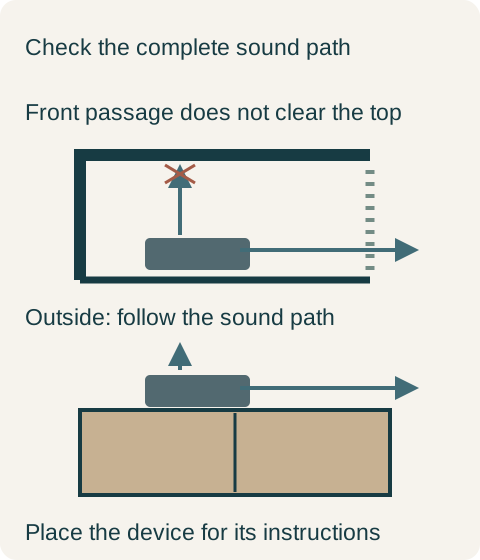
A transparent front does not remove the cabinet roof
Bose’s placement guidance for the Smart Ultra Soundbar warns that a recessed cabinet or shelf can intercept output from its upward-firing drivers. This is a reason to review the enclosure around the selected device, not only the material directly in front.
Teaching example Conceptual hypothetical section: an acoustic front cannot remove a solid overhead obstruction. Arrows show direction only, not measured sound levels, universal clearances or a product test.
For such a device, changing a solid door to mesh leaves the overhead obstruction in place. Conversely, a cabinet sold with acoustic doors may be intended for equipment whose arrangement is compatible with that enclosure. Neither product description needs to be false for the proposed combination to be unsuitable. The cabinet and equipment have to be considered together. Avoid solving the mismatch by choosing a finer fabric or assuming an attractive slat pattern will redirect sound into the required path.
Keep the soundbar outside; use the doors for storage
In a hypothetical living room, the owner intends to retain an upward-firing soundbar and first considers hiding it behind an acoustic cabinet front. The proposed drawing still places a solid cabinet top above the speaker. The owner instead selects a cabinet whose top arrangement accommodates the soundbar externally in a position consistent with its instructions, while the closed compartments store compatible equipment and ordinary items. The decorative door choice is then made for those contents. The acoustic-front upgrade is omitted because concealing this soundbar is no longer part of the cabinet’s job.
That decision is more useful than buying acoustic doors and leaving them open whenever the television is used. Open doors may also occupy circulation space or expose the contents the owner wanted to hide. If a fully concealed system is essential, choose the equipment and suitable cabinet as a coordinated package before fabrication. A later equipment change can alter that compatibility even if its overall dimensions look similar. Preserve the equipment model and intended position with the cabinet design.
Test the actual closed-door arrangement
For a compatible enclosed speaker, compare normal listening with the intended door open and closed, using the actual or representative approved equipment at ordinary listening levels. Include spoken dialogue and familiar music, then listen from the usual seats. This can reveal an objectionable change for the buyer; it is not a laboratory transmission rating. Do not use a loose fabric swatch as a substitute for the complete door, because its frame, support and backing remain part of the sound path.
Test control separately. A phone controlling a network-connected device does not demonstrate that an infrared remote will work through the door. Use the actual control method from the usual seating positions, and verify access to the buttons that still require direct use. A successful sound demonstration does not answer those questions. If the seller demonstrates a different device or an open door, record the difference rather than treating the demonstration as acceptance of your own closed-cabinet arrangement.
Plan access behind the attractive front
The intended equipment must fit with its connected cables and be accessible for service, not merely fit as an unconnected rectangular object. Review the back access, shelf arrangement and the equipment’s ventilation requirements independently of acoustic appearance. A fabric-covered door is not permission to ignore the rest of the enclosure. Likewise, a removable rear panel is useful only if the completed room arrangement lets someone reach and remove it without dismantling unrelated work.
Before purchase, identify the full door assembly, its stated acoustic purpose and the equipment configuration used to judge it. A replacement insert should preserve that construction rather than imitate only the visible pattern. If sound is to remain outside the cabinet, say so and choose the front for its storage role. If it is to remain behind the front, accept the complete compatible arrangement, with its actual controls and access, rather than an unsupported promise attached to the word acoustic.
Pure White
Cream White
Light Warm Gray
Gray
Navy
Black
Oak Tone
Dark Walnut Tone
Design study These finish studies are design references, not a list of currently orderable colors. Screens and lighting change the appearance; compare a physical sample before choosing.See all finish options →
Choose the construction behind the slats. Fixed open louvers provide passages, operable louvers change position, and false louvers can be decorative moldings on a solid panel.
A decorative grille changes visibility, touch and the finished door assembly. Review the actual mesh with stored objects and lighting before ordering a pattern by name.
Compare the actual countertop products, heat-source routine and fabrication proposal. A fired porcelain slab and resin-bound quartz are different materials, but neither label replaces a complete kitchen specification.
The sample shows the door frame, a separate center panel, the face frame and the cabinet box. Each component has its own place in this Shaker construction.
Shaker construction: door frame, center panel, face frame and cabinet box. The cutaway helps locate these parts; confirm each material in the specifications for the selected cabinet.
01 / Door frame
The Shaker door has rails and stiles around a separate center panel. The frame and center panel are different components; confirm their materials in the specifications for the selected cabinet.
02 / Face frame
The face frame surrounds the opening at the front of the cabinet box and sits behind the doors. The face frame, door frame and cabinet box are separate parts.
03 / Cabinet box
The sample exposes the cabinet sides, interior surfaces and layered edges. The image does not establish the wood species or material specification of a selected cabinet.