Should kitchen appliances be a matching suite or a mix of brands?
Buy a coordinated suite when every included appliance earns its place. Mix brands when a specific everyday task justifies the difference, after comparing the visible fronts and the complete installed purchase.
The suite is worthwhile only if its individual appliances work for you
Choose a matching appliance suite when its refrigerator, cooking equipment, dishwasher and other included pieces meet the household's important tasks, and the coordinated appearance is worth the complete price. Mix brands when a particular appliance solves a recurring need better in the actual comparison and you accept how the finished group looks. Neither strategy removes the need to choose each appliance.
A package can make shopping feel settled sooner than the kitchen is settled. The refrigerator may be exactly right while the dishwasher is merely the one included. Alternatively, a shopper can spend weeks assembling individual favorites without noticing that their handles and controls produce a room they dislike. Evaluate the useful group and the visible group together.
Know whether you are buying a visual family or a particular bundle
Café's package page lets buyers select refrigerator, dishwasher, microwave and range finishes and hardware. It provides a concrete example of a coordinated appliance offering whose individual selections still matter. The page does not establish another brand's package contents or compatibility.
A manufacturer family, a retailer's fixed bundle and a custom list of products from one brand are not necessarily the same offer. Identify the exact appliances and selected versions behind the package name. A photograph can show the desired look without representing every component on the quotation. Resolve differences between the pictured group and the actual list before comparing prices.
Make a place in that list for ventilation and any separately required kits or visible components. If the kitchen needs a separate hood, a package organized around an over-range microwave does not automatically satisfy that plan. The issue is not whether the bundle contains many appliances; it is whether it contains the right equipment for the approved kitchen.
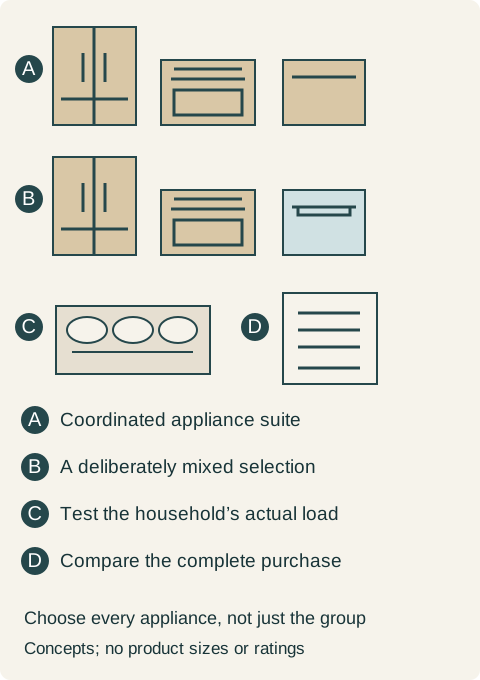
Teaching example Conceptual purchase comparison, not a product lineup or installation layout. A groups coordinated appliance fronts. B retains the cooking and refrigeration choices but uses a different dishwasher front. C represents the household load that drives the dishwasher choice. D represents the complete itemized purchase, including required components and installation. Colors identify options; they do not promise a finish match or any brand capability.
Give each appliance a job it must perform
Start with the tasks that would make a purchase disappointing if they failed. For refrigeration, this might be the retained tall containers and the way the household divides fresh and frozen storage. For cooking, it could be the accepted cookware group and oven vessels. For dishwashing, it may be the combination of bowls, glasses and serving pieces routinely washed together. Name actual objects and actions rather than copying feature labels.
Compare the suite's candidate in each category with the alternative that interests you. A promising dishwasher should be evaluated with the relevant load and operating routine, not selected only because another shopper likes its brand. Likewise, a preferred range should not force a refrigerator arrangement that the household has already found inconvenient. Record which compromises are minor and which affect repeated use.
Do not rank an entire brand from a single product trial. The decision concerns the offered candidates and their specific configurations. A different model within the original family might resolve the problem while preserving the coordinated suite. Include that option when it is genuinely available, rather than assuming the choice is either the first bundle or a completely mixed kitchen.
Coordinate visible differences instead of demanding identical labels
Look at the appliances that will be seen together from the room's normal viewpoints. Compare their actual front finishes, handle shapes, control panels and trim. A shared word such as stainless does not itself approve the relationship. Nor does a common logo settle the appearance of pieces drawn from different collections. Use identified samples or actual display products where possible.
Decide which differences you are willing to see. A deliberately separate cooking focal point may tolerate a different handle shape; neighboring exposed fronts may invite closer comparison. The goal can be coordinated contrast rather than an exact-looking match. Establish the goal before repeatedly changing the cabinet hardware to compensate for an appliance choice that remains unsettled.
A panel-ready appliance is an option only where the selected model supports the proposed furniture front. It is not a general way to cover any unwanted appliance finish. Include the actual panel, handle and attachment arrangement in that alternative's cost and cabinet scope. Do not add decorative coverage over required controls or ventilation merely to make a mixed selection look uniform.
Compare complete prices without treating a promotion as a design decision
Place the viable itemized offers beside each other. Include the selected accessories, panels or trim, delivery scope, installation work, removal where required and the surrounding cabinet or countertop work that differs. A package subtotal and an installed mixed-brand total answer different questions. Bring them to the same defined scope before deciding which costs less for this project.
If an offer depends on a promotion, identify its actual eligibility and timing in the current written terms. Separate a confirmed price reduction from a later benefit that still requires conditions to be met. This guide adopts no advertised savings amount. Do not buy an unnecessary appliance solely to count another qualifying item without comparing the extra equipment and project cost it creates.
Also establish how the proposed order will reach the completed kitchen. Who confirms each appliance's availability, receives and checks it, coordinates installation and resolves a mismatch with the cabinet plan? Buying one brand does not by itself answer those responsibilities, while buying several brands does not prevent them from being assigned clearly. The order needs named responsibilities rather than an assumption about the logo.
A household keeps most of the suite and changes the dishwasher
Consider a hypothetical remodel whose owners like a coordinated exposed-appliance group. Its refrigerator accommodates their retained containers and storage pattern, and its cooking appliance works with their accepted pans and oven vessels. Those choices fit the cabinet proposal. The dishwasher trial, however, does not accommodate their ordinary bowl-and-serving-piece group in a way they are willing to use repeatedly.
They check another available dishwasher within the same family before expanding the search. That candidate also fails their accepted loading arrangement. A different-brand candidate accommodates the actual group, and the owners accept its controls and routine. They do not claim that its brand washes better in general; it solves the demonstrated loading problem in this selection.
The proposed mixed group keeps the refrigerator and cooking choices. The owners compare the alternate dishwasher's exposed front beside the cabinet and appliance samples, accept the visible handle difference and keep the already selected cabinet pulls. They do not add a furniture panel to an appliance that is not specified for one, or order new cabinet hardware merely to imitate the alternate handle.
Both offers are brought to a complete installed scope. The mixed selection costs more in their actual quotations, and they accept that difference for the everyday load. The approved dishwasher model is carried into the cabinet opening and connection review before production. The final order retains the useful parts of the suite while replacing the component that would have caused a repeated compromise.
A matching suite can also be the strongest final choice
If every appliance in a coordinated offer passes the household's important tasks, mixing brands has no automatic advantage. The buyer may reasonably value the consistent visible family and accept that package at its complete price. There is no need to manufacture a functional objection simply to make the purchase appear more individually researched.
Keep the future replacement question realistic. Decide whether a later replacement with a different visible front would be acceptable, and preserve each installed model's opening and required arrangement. Do not rebuild today's cabinets around an unsupported promise that all matching products will remain available indefinitely. Replacing one appliance later is its own selection, even when the rest of the group is retained.
The order should state the exact equipment, chosen front treatments, full project scope and any unresolved conditions. Manufacturer package examples do not establish USA KITCHENS & TOPS inventory or a sales relationship with those brands. A useful suite is a set of individually accepted appliances; a useful mixed group is a deliberate set with its differences and coordination already understood.
Pure White
Cream White
Light Warm Gray
Gray
Navy
Black
Oak Tone
Dark Walnut Tone
Design study These finish studies are design references, not a list of currently orderable colors. Screens and lighting change the appearance; compare a physical sample before choosing.See all finish options →
Separate cabinet seams, appliance trim and installation boundaries before choosing an alignment. A clean elevation can use deliberate differences instead of forcing every line through the appliance.
The sample shows the door frame, a separate center panel, the face frame and the cabinet box. Each component has its own place in this Shaker construction.
Shaker construction: door frame, center panel, face frame and cabinet box. The cutaway helps locate these parts; confirm each material in the specifications for the selected cabinet.
01 / Door frame
The Shaker door has rails and stiles around a separate center panel. The frame and center panel are different components; confirm their materials in the specifications for the selected cabinet.
02 / Face frame
The face frame surrounds the opening at the front of the cabinet box and sits behind the doors. The face frame, door frame and cabinet box are separate parts.
03 / Cabinet box
The sample exposes the cabinet sides, interior surfaces and layered edges. The image does not establish the wood species or material specification of a selected cabinet.