A heavier handle can change the lift mechanism a cabinet front needs
For Blum AVENTOS HK top, the US selection formula counts handle weight twice. Keep the front, handle, cabinet height and table units together when comparing options.
Do not choose a lift mechanism from cabinet width or the appearance of the door alone. A change in handle weight can alter the selection input even when the door size stays the same. For an AVENTOS HK top proposal, keep the cabinet height, door weight, handle weight and the specific regional selection table on one calculation sheet.
The handle is part of the calculation
Blum's US HK top ordering information uses cabinet height in inches multiplied by door weight including double handle weight in pounds. Follow that model-specific definition. It is not a universal formula for every lift system, and a bare door weight omits a required input.
Keep the door without its handle and the handle weight separately identified. If a scale reading already includes the handle, note that before adding anything. Otherwise the same hardware can accidentally be counted too many times. Include the actual front construction in the measurement record; replacing a solid panel with a framed insert changes what is being weighed even if the outside dimensions are unchanged.
Compare a light pull and a heavier pull
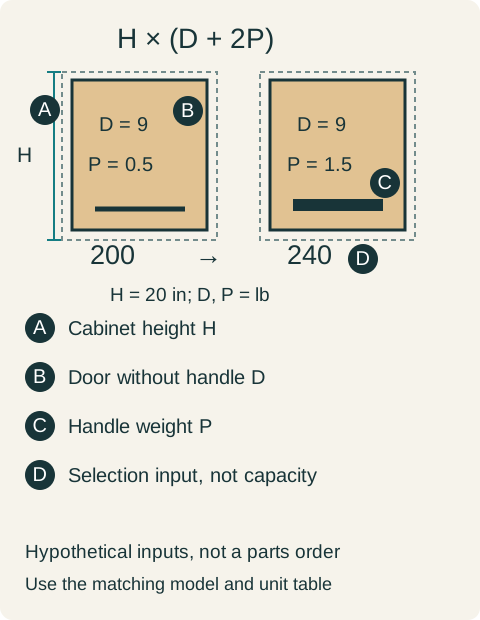
In a hypothetical inch-and-pound example, cabinet height H is 20, the door without its handle D weighs 9, and handle P weighs 0.5. Applying the stated HK top definition gives H × (D + 2P) = 20 × (9 + 2 × 0.5) = 200. These invented inputs demonstrate arithmetic, not a product configuration or a mechanism recommendation.
Now suppose the same hypothetical door receives a handle weighing 1.5 instead. The calculation becomes 20 × (9 + 2 × 1.5) = 240. The selected formula input increases by 40 although the door panel did not change. The example explains why a decorative-hardware substitution belongs in the lift review; it does not mean the cabinet gained or lost 40 pounds of capacity.
The comparison rules out reusing the first calculation for the heavier handle. If the household keeps the lighter pull, retain that exact pull in the approved front specification. If it chooses the heavier one, the revised input belongs in the mechanism selection and trial. Do not record both handles as interchangeable finish choices when the associated mechanical review covered only one.
Diagram Hypothetical HK top calculation in inches and pounds: H = 20, D = 9 and P = 0.5 produce 200. Changing only P to 1.5 produces 240. These are selection inputs, not lifting capacities.
A unit label is part of the number
A power-factor value without its formula and units is incomplete. Do not place a result calculated from inches and pounds into a table expecting millimeters and kilograms. Converting only the height leaves a mixed-unit result. Use all inputs and the table from the same planning system, including the manufacturer's definition of handle allowance.
Also distinguish cabinet height from door height. The selected instructions name the required dimension; using the visible panel height simply because it is easier to measure may change the calculation. A formula printed for a folding front may define its input differently from a single stay-lift front. Keep the exact system name with the measurements so a later reviewer does not silently transfer the result to another mechanism.
Finish the comparison with a complete specification
The formula narrows a product selection; it does not verify ceiling clearance, mounting, front attachment or the user's ability to close the door. Those are separate checks on the same proposed assembly. A larger calculated input is not a reason to buy the strongest mechanism available, and adjustment is not permission to ignore the documented selection range.
Retain the measured front and pull details, calculation, selected mechanism reference and representative trial together. If the final pull changes after the door finish is approved, revisit the input rather than assuming the earlier demonstration still applies. This keeps a visual substitution from changing the opening behavior without anyone noticing.
Pure White
Cream White
Light Warm Gray
Gray
Navy
Black
Oak Tone
Dark Walnut Tone
Design study These finish studies are design references, not a list of currently orderable colors. Screens and lighting change the appearance; compare a physical sample before choosing.See all finish options →
A soft-close upgrade starts with identifying the existing hardware. Closing assistance and opening assistance solve different tasks and may require different parts.
Hinged, lift-up and pocket fronts move the obstruction to different places. Compare the full opening sequence, parked front, usable interior and the appliance’s actual operating location.
The sample shows the door frame, a separate center panel, the face frame and the cabinet box. Each component has its own place in this Shaker construction.
Shaker construction: door frame, center panel, face frame and cabinet box. The cutaway helps locate these parts; confirm each material in the specifications for the selected cabinet.
01 / Door frame
The Shaker door has rails and stiles around a separate center panel. The frame and center panel are different components; confirm their materials in the specifications for the selected cabinet.
02 / Face frame
The face frame surrounds the opening at the front of the cabinet box and sits behind the doors. The face frame, door frame and cabinet box are separate parts.
03 / Cabinet box
The sample exposes the cabinet sides, interior surfaces and layered edges. The image does not establish the wood species or material specification of a selected cabinet.