Choose an appliance-garage door by where it goes while the counter is in use
Hinged, lift-up and pocket fronts move the obstruction to different places. Compare the full opening sequence, parked front, usable interior and the appliance’s actual operating location.
Choose the door by the space it occupies while the appliance is being accessed and used, not only by the closed elevation. A side-hinged leaf, a lifted front and a door retracted into a pocket reserve different working areas. The best choice leaves a usable route from stored appliance to its intended task and allows the front to close again after the routine is complete.
Establish where the appliance may operate first
List the actual appliance and read its instructions for operating, moving and storing it. A cabinet opening does not establish a permitted operating location. For example, the cited Breville Barista Pro manual prohibits operating that machine in an enclosed space or cupboard. Treat that as an instruction for the named appliance, not a clearance formula for other machines.
If the appliance must be moved to a suitable surface, include the whole transfer and return according to its instructions. Retain required access to controls, removable parts and replenishment points. An appliance garage may be a storage home rather than the working position. Make that distinction before deciding that a particular door provides enough counter space.
A hinged leaf needs both a swing route and a parking place
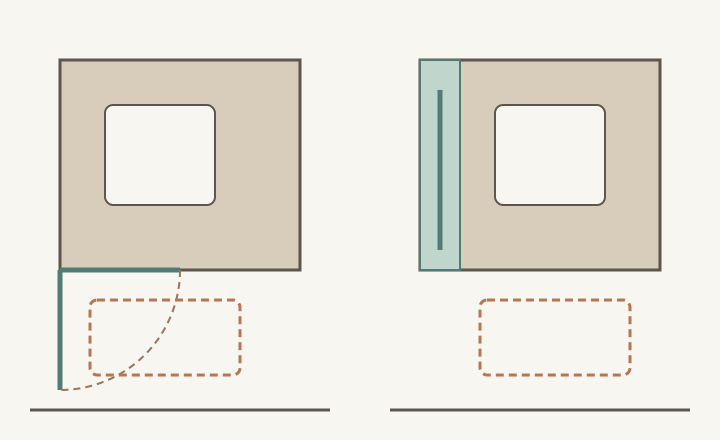
Show each leaf through its actual hinge movement and in the intended open position. Include handles and adjacent fronts. A parked leaf may sit beside the appliance without blocking it, while the opening sweep still passes over the place where cups or a mixing bowl normally wait. Those objects must have a practical location during opening and closing.
Test approaching from the side as well as straight ahead. A door that is convenient for the appliance may divide it from the neighboring prep surface or another storage group. Check whether the usual user must reach around the leaf, and whether closing requires clearing items that were placed on the counter during the task.
Lift-up and pocket choices trade different spaces
For a lift-up front, use the selected mechanism’s complete motion and open position in section. Check the space above and in front, the person’s approach and their ability to reach the closing control. A front raised off the worktop can still project into the user’s task space or interfere with another element overhead. The word lift-up does not define its exact path.
For a pocket option, include its reserved side space. Blum’s US REVEGO description says the fronts retract into a dedicated narrow cabinet, or pocket. This illustrates why retracted doors still occupy construction space; verify the selected system’s actual configuration rather than assuming a universal pocket size.
Diagram Only an illustrative hinged leaf is shown on the left; the right image is a conceptual pocket, not a product construction drawing. Dashed rectangles represent counter tasks. The figure compares space reservations, not equivalent products, permitted appliance operation or installation dimensions.
A
The illustrated hinge anchors the leaf.
B
Its opening sweep crosses a proposed task area even though the parked leaf is beside it.
C
A retracted door still needs reserved side space.
D
The counter task remains separate from that pocket reservation.
After accounting for the pocket, check the appliance and its access inside the remaining opening. A clear countertop beside the enclosure is not a gain if the narrower interior prevents the intended appliance from being removed or serviced as instructed. Compare complete assemblies with the same retained appliance and accessories.
Run the morning task with the cups already present
In a hypothetical setup, a hinged front parks neatly to the side, but the user places cups in its opening sweep before retrieving the stored appliance. Moving the cups adds a step. A pocket proposal clears that counter sequence but reserves side space needed by the appliance’s access. A lift-up proposal must be tested for the user’s reach and the actual raised position.
None wins from a closed rendering. Try another cup landing, a supported enclosure arrangement or a different verified storage home. Keep the appliance’s permitted working location and all accessories in every alternative. Do not solve the comparison by leaving a troublesome door permanently open while continuing to count the benefit of a closed, concealed counter.
Keep the operating sequence with the door selection
Record the chosen mechanism, its required construction, opening and parked states, usable appliance opening and complete task layout. Include the transfer surface if the appliance moves out, and the steps that allow its instructed return and door closure. Recheck after changing the machine or counter routine. A successful garage door supports the actual task from first opening to final reset.
Pure White
Cream White
Light Warm Gray
Gray
Navy
Black
Oak Tone
Dark Walnut Tone
Design study These finish studies are design references, not a list of currently orderable colors. Screens and lighting change the appearance; compare a physical sample before choosing.See all finish options →
A low drawer is useful when its actual interior, opening route and floor-level access suit a specific group. A thin object on paper may become a thick stack or an awkward daily retrieval.
A tower can change appliance access while removing a prep surface and dividing what remains. Test the same cooking task and retained contents in both complete layouts.
The sample shows the door frame, a separate center panel, the face frame and the cabinet box. Each component has its own place in this Shaker construction.
Shaker construction: door frame, center panel, face frame and cabinet box. The cutaway helps locate these parts; confirm each material in the specifications for the selected cabinet.
01 / Door frame
The Shaker door has rails and stiles around a separate center panel. The frame and center panel are different components; confirm their materials in the specifications for the selected cabinet.
02 / Face frame
The face frame surrounds the opening at the front of the cabinet box and sits behind the doors. The face frame, door frame and cabinet box are separate parts.
03 / Cabinet box
The sample exposes the cabinet sides, interior surfaces and layered edges. The image does not establish the wood species or material specification of a selected cabinet.