Laundry sorting cabinets: how many compartments will you actually use?
Permanent bins should follow the way your household separates and moves loads. Equal-size compartments are not automatically the most useful arrangement.
Choose laundry sorting compartments from the groups you actually keep separate before washing. Do not start with the maximum number of bins a cabinet can hold. Too many small compartments can split useful capacity, make loading confusing and create a need to combine bins before a load is ready.
Observe the decisions your household already makes
For a normal stretch of laundry, note which items wait together and why. Follow garment care instructions and the selected appliance guidance when making washing decisions; cabinet labels cannot replace them. The storage question is which of those real groups needs a separate place while it waits.
Distinguish sorting before washing from dividing clean clothes by person or destination. A household may need a few waiting groups but several temporary piles afterward. Installing a permanent bin for every person can use valuable cabinet space without helping the actual prewash process.
Let capacity follow accumulation, not symmetry
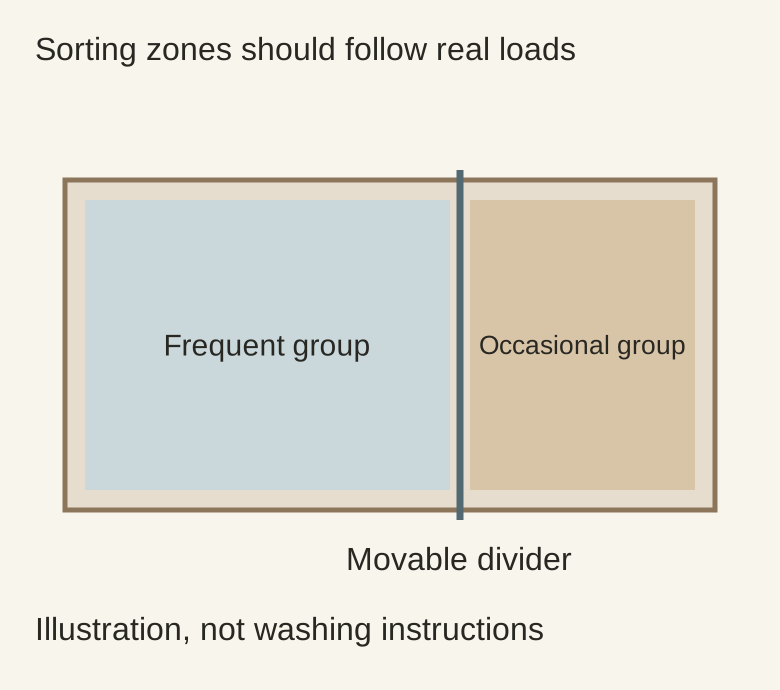
Check which group fills fastest and which stays nearly empty. Equal-width bins look tidy but may be the wrong allocation. A frequently used container can overflow while the adjoining one holds only a few items. Compare a larger frequent-use compartment plus a smaller flexible container with a row of identical permanent bins.
Diagram The groups are examples of storage demand, not directions for combining or washing particular fabrics.
Imagine that everyday laundry fills one bin well before the occasional group is ready. A larger cabinet is not the only answer. A removable divider or a separate occasional-use basket may let the frequent group use more of the existing volume. Check whether that change still keeps the required groups distinct; sharing volume must not silently undo the sorting decision.
Keep the group intact on the way to the machine
Decide whether the container travels to the washer or the contents move by hand. If a bag lifts out, make sure its opening, handles and normal load can leave the cabinet. If the bin stays in place, check whether clothing can be removed without dragging across a divider or repeatedly reaching into a narrow rear corner.
Labels should be visible at the moment someone puts laundry away, not only after opening several fronts. Use household language that explains the intended group. Avoid labels that promise a washing method without regard to item care instructions. For shared use, a simple arrangement people follow is more effective than an elaborate classification they routinely bypass.
Leave room for the routine to change
Before fixing permanent partitions, try the arrangement with removable containers in a suitable existing area. Watch where items land when the intended compartment is full and whether the layout helps or adds a sorting step. A change in household size, clothing or laundry frequency can alter the useful division even when the room dimensions stay the same.
Specify the cabinet from that trial: useful compartment sizes, removable components, access and the handling route. Give each fixed division a clear job. Keep occasional exceptions flexible rather than building a permanent cubby for every possible category. The result should reduce decisions during an ordinary load, not require the family to maintain a complicated storage system.
Pure White
Cream White
Light Warm Gray
Gray
Navy
Black
Oak Tone
Dark Walnut Tone
Design study These finish studies are design references, not a list of currently orderable colors. Screens and lighting change the appearance; compare a physical sample before choosing.See all finish options →
Choose a suitable storage location first, then make it convenient for the adult doing laundry. A neat row of decorative jars is not the starting point.
The sample shows the door frame, a separate center panel, the face frame and the cabinet box. Each component has its own place in this Shaker construction.
Shaker construction: door frame, center panel, face frame and cabinet box. The cutaway helps locate these parts; confirm each material in the specifications for the selected cabinet.
01 / Door frame
The Shaker door has rails and stiles around a separate center panel. The frame and center panel are different components; confirm their materials in the specifications for the selected cabinet.
02 / Face frame
The face frame surrounds the opening at the front of the cabinet box and sits behind the doors. The face frame, door frame and cabinet box are separate parts.
03 / Cabinet box
The sample exposes the cabinet sides, interior surfaces and layered edges. The image does not establish the wood species or material specification of a selected cabinet.