Choose a pull-out hamper cabinet around the basket you will remove and carry, not only the width of its decorative front. The useful test has two stages: the carrier opens fully, and the basket comes out with its normal load. A layout can pass the first stage while failing the second beneath a counter or beside another open door.
Ask which pieces are included in the cabinet
Find out whether the proposal includes the cabinet box, pull-out mechanism, carrier and removable basket or only some of those pieces. Identify the model of the insert and the basket it accepts. A product photograph that shows a container does not establish that an interchangeable replacement will fit later.
Use the insert’s required cabinet dimensions, mounting conditions and stated load limit. Those are different from the outside cabinet dimensions. Include the basket and everything on the mechanism when checking its documented capacity; a large volume of empty space does not establish how much weight the assembly can support.
Trace the basket past the counter and front
Open the pull-out to its designed position. Locate the basket’s handles and check whether they can be gripped without scraping the counter or pinching against the carrier. Then follow the complete removal motion. A basket that has to tilt may need room beyond its resting width, particularly when it is filled.
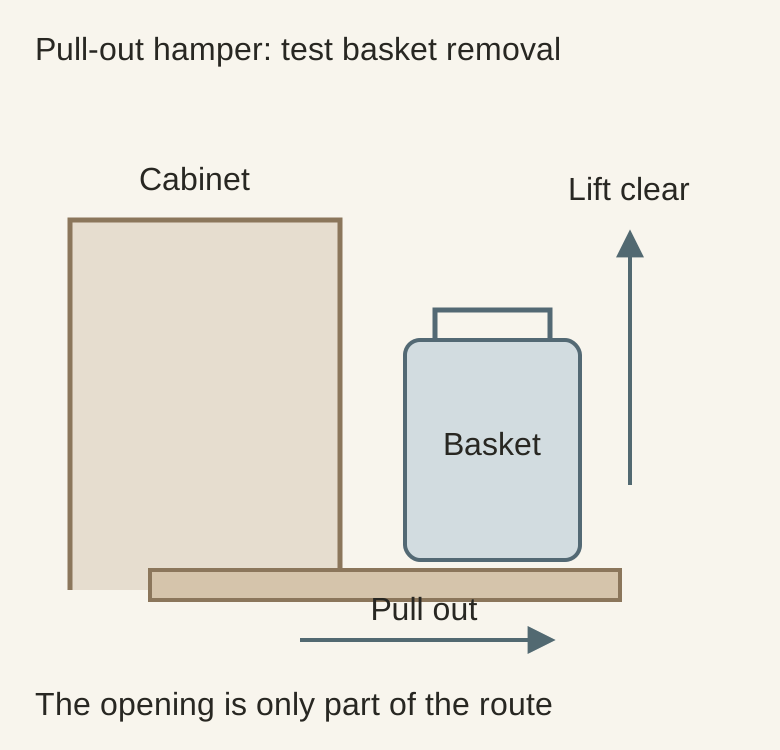
Diagram Two different motions need checking. This drawing does not establish extension, load capacity or the removal method of a particular insert.
Suppose an illustrative basket is 15 inches wide and its carrier has 16 inches of clear width. The 1-inch difference answers only whether the body fits in that direction. It does not prove that the handles can be gripped, the basket can tilt clear or a full bag can be lifted past the counter. These are separate checks using the chosen hardware; the numbers are not a recommended cabinet size.
Compare carrying a basket with carrying a bag
Test the intended handling method with a manageable representative load. Will the whole basket be carried, will an inner bag lift out or will clothes be transferred by hand? Each approach leaves a different object inside the cabinet. Avoid buying a large basket only to discover that the person using it cannot comfortably move it when full.
Include the route from the extended cabinet to the washer. A door, projecting handle or parked basket can interrupt the turn even if the hamper opens correctly. If users need to pull out two bins together, check that state rather than testing each alone. Do not infer that a mechanism tolerates leaning or sitting from its ability to carry laundry.
Leave a way to clean and replace the working parts
Check how the basket and carrier are removed for cleaning, and follow the component care instructions. A removable liner does not make the surrounding cabinet waterproof or suitable for damp items left inside. Decide where items that are not ready for enclosed storage will go instead of assuming the hamper solves every laundry condition.
Request the basket and insert identifiers with the cabinet order, plus any replacement information available. Record the usable opening, removal method and actual handling decision. The finish can then match the room without hiding an inconvenient storage system behind an attractive cabinet front.
Pure White
Cream White
Light Warm Gray
Gray
Navy
Black
Oak Tone
Dark Walnut Tone
Design study These finish studies are design references, not a list of currently orderable colors. Screens and lighting change the appearance; compare a physical sample before choosing.See all finish options →
Permanent bins should follow the way your household separates and moves loads. Equal-size compartments are not automatically the most useful arrangement.
Raising a washer changes the loading position, the space below it and the reach above it. It does not automatically establish a comfortable folding counter.
The sample shows the door frame, a separate center panel, the face frame and the cabinet box. Each component has its own place in this Shaker construction.
Shaker construction: door frame, center panel, face frame and cabinet box. The cutaway helps locate these parts; confirm each material in the specifications for the selected cabinet.
01 / Door frame
The Shaker door has rails and stiles around a separate center panel. The frame and center panel are different components; confirm their materials in the specifications for the selected cabinet.
02 / Face frame
The face frame surrounds the opening at the front of the cabinet box and sits behind the doors. The face frame, door frame and cabinet box are separate parts.
03 / Cabinet box
The sample exposes the cabinet sides, interior surfaces and layered edges. The image does not establish the wood species or material specification of a selected cabinet.