A laundry room can organize pet supplies, but a single deep cabinet labeled pet storage is rarely a complete plan. Food, walking gear and used towels have different destinations. Start with the activity that actually brings each item into the room, then decide whether it belongs there. This is a storage plan, not a proposal to turn a laundry sink into a pet-washing station.
Keep the food package in the fit test
FDA recommends keeping pet food in its original packaging; when using an outer container, place the bag inside it. That preserves product identification. Its storage guidance also requires a cool, dry location. Check the full guidance and the particular product’s directions.
For cabinet selection, test the bag inside the intended container instead of measuring an empty tub. A fresh bag may hold its shape differently from a nearly empty one. Folded packaging, the lid, hands and the scoop all need working room. A tub can fit behind a closed door yet be impossible to open comfortably on its shelf.
Choose the action before the shelf height: scoop from the container while supported, slide it out on an appropriate rated accessory, or carry it to a suitable surface. Do not quietly change from supported scooping to lifting a full supply just because the selected cabinet is too low inside. If the laundry location cannot meet the food’s storage requirements, use another location.
Give walking gear a route to the door
Keep the everyday leash and the supplies used with it where they can leave together. A spare harness stored behind a large food container may be acceptable if rarely needed; the leash used every day usually deserves a shorter route. Review the person holding the gear and the path out while a laundry basket is already present.
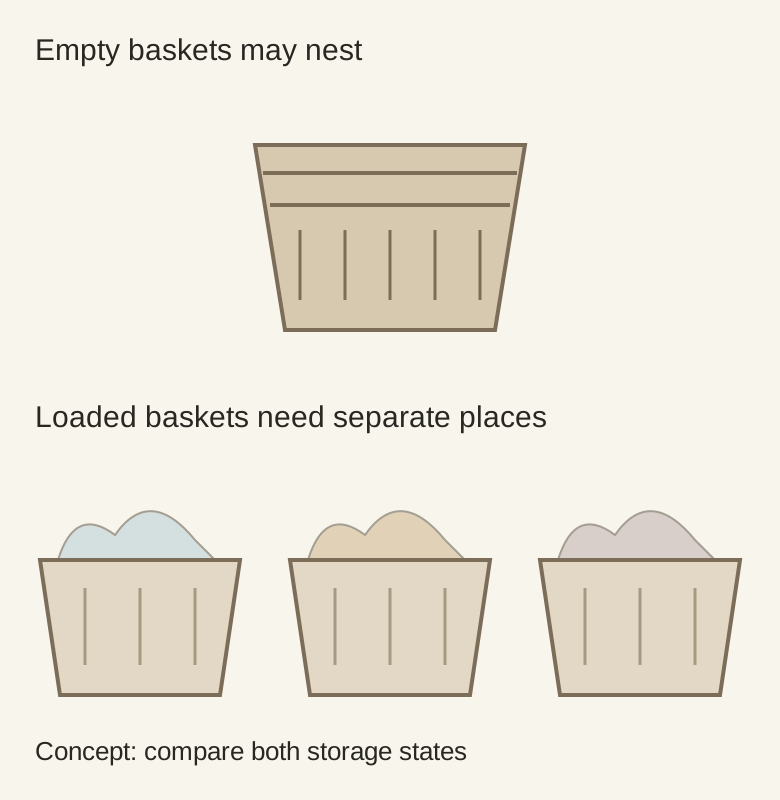
Diagram Pet supplies share a working room with active laundry. The drawing shows basket occupancy, not an approved pet-food storage compartment.
Consider a proposed pullout beside the dryer. It holds a food tub neatly, but when extended for feeding it occupies the same patch of floor as the clean-clothes basket. Moving the leash to a higher hook does nothing to resolve that conflict. Compare a different cabinet location or a feeding supply outside the laundry work area. The useful decision is where the food is accessed while laundry is active, not whether everything can be hidden afterward.
Separate used items from the ready-to-use kit
A towel returning from an outing is not ready to join clean folded pet towels simply because both belong to the same animal. Give used textiles a defined route into the household’s appropriate care process. Store them again only in the condition their care instructions require. Do not use the clean folding surface as an indefinite holding area.
Keep laundry products in their own suitable storage under their labeling, separate from the pet-food arrangement. A shared matching door style does not require shared containers, scoops or an interchangeable shelf assignment. Retain original product identities rather than decanting unrelated supplies into look-alike decorative jars.
Buy the cabinet for the working kit, not an imagined collection
Bring the full food package, its outer container dimensions, the daily walking kit and the clean-textile quantity into the layout discussion. Identify what stays elsewhere and how replacement supplies arrive. Adding a second unopened package may create a temporary overlap that the everyday container alone does not show.
Choose the cabinet after checking feeding access, departure and return with normal laundry underway. A modest dedicated storage position can be more useful than a large pet-themed cabinet that blocks the dryer or hides the daily leash. Keep any future washing fixture as a separate project with its own product and installation review.
Pure White
Cream White
Light Warm Gray
Gray
Navy
Black
Oak Tone
Dark Walnut Tone
Design study These finish studies are design references, not a list of currently orderable colors. Screens and lighting change the appearance; compare a physical sample before choosing.See all finish options →
Entry gear and clean laundry can share a room without sharing every surface. Assign the arrival, washing and departure tasks before choosing one continuous cabinet run.
Pocket items, unmatched socks and repair candidates need different next steps. Give each a visible temporary destination and a route back to its owner.
The sample shows the door frame, a separate center panel, the face frame and the cabinet box. Each component has its own place in this Shaker construction.
Shaker construction: door frame, center panel, face frame and cabinet box. The cutaway helps locate these parts; confirm each material in the specifications for the selected cabinet.
01 / Door frame
The Shaker door has rails and stiles around a separate center panel. The frame and center panel are different components; confirm their materials in the specifications for the selected cabinet.
02 / Face frame
The face frame surrounds the opening at the front of the cabinet box and sits behind the doors. The face frame, door frame and cabinet box are separate parts.
03 / Cabinet box
The sample exposes the cabinet sides, interior surfaces and layered edges. The image does not establish the wood species or material specification of a selected cabinet.