Washer pedestals and laundry cabinets: choose the heights separately
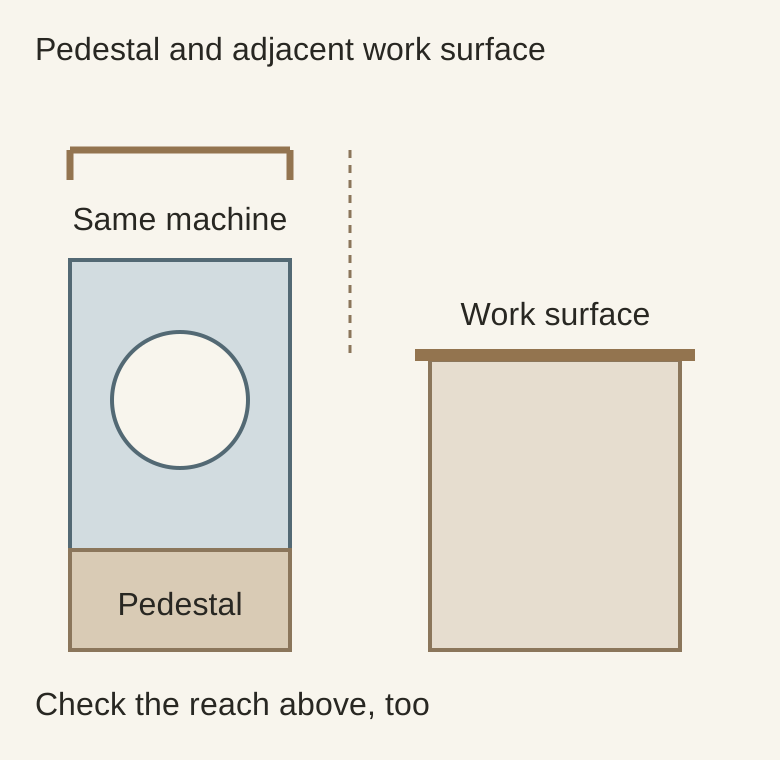
Raising a washer changes the loading position, the space below it and the reach above it. It does not automatically establish a comfortable folding counter.
Choose a washer pedestal for the selected machine and the person loading it, then set the adjacent cabinet and work-surface heights separately. Matching every horizontal line can make a room look orderly while putting the folding surface or supplies at an awkward height. A pedestal is an equipment decision with consequences for the surrounding cabinetry.
Confirm the pedestal before drawing cabinets around it
Whirlpool explains that pedestal compatibility depends on the appliance model and mounting arrangement. An older pedestal is not automatically suitable for a replacement machine. Use the actual model documentation to establish compatibility; a similar width or matching brand alone is not enough. Record the exact combination in the layout notes.
Do not treat a cabinet drawer box as a substitute pedestal. Supporting equipment, providing storage beside it and covering its sides are different jobs. Have the appliance installation requirements resolved before specifying surrounding panels or a countertop. The cabinet proposal should show which surfaces are independently supported and which parts belong to the appliance system.
Test loading and folding as different movements
For loading, notice the bend, reach and basket position at the machine opening. For folding, try spreading a shirt, bringing the far edge toward you and placing the folded stack into a basket. Use a temporary surface that is stable and suitable for the test. A higher loading opening may help one movement without improving the other.
Diagram Heights are illustrative. The drawing does not specify a pedestal, structural support or required installation clearance.
Consider a household choosing between a continuous surface above raised machines and a lower cabinet beside them. The continuous surface creates a larger uninterrupted area, but its far edge may be difficult for the shorter user to work across. The lower adjacent surface gives up that continuous line while keeping the folding task reachable. Test those two arrangements with the same basket and garments before choosing the appearance.
Recheck the upper cabinets after raising the machines
The distance from a raised machine top to an upper cabinet is not the same as a person’s useful reach into that cabinet. A deep machine can force someone to lean across it. Check the front and rear of the intended shelf with the actual user and suitable lightweight objects; do not use the appliance or pedestal as a step.
Place ordinary items according to how they will be retrieved, not merely where they fit while the doors are closed. If the proposed upper cabinet only works for seldom-used items, describe it that way in the storage plan. Supplies with storage or access restrictions need a suitable location regardless of the empty shelf space available above the machines.
A pedestal drawer does not replace all adjacent storage
Check the drawer’s usable opening and the movement needed to remove an item. Also test whether a laundry basket parked in front must be moved every time the drawer opens. Storage below the machine may suit some articles, but it should not be counted again as free floor space for baskets in the same working arrangement.
Before ordering cabinets, record the approved appliance and pedestal combination, the separate work-surface decision, upper-shelf reach and drawer route. Include how the machine can be serviced or replaced without trapping it behind permanent cabinetry. These checks let the pedestal serve its intended task while the cabinets serve the people using the room.
Pure White
Cream White
Light Warm Gray
Gray
Navy
Black
Oak Tone
Dark Walnut Tone
Design study These finish studies are design references, not a list of currently orderable colors. Screens and lighting change the appearance; compare a physical sample before choosing.See all finish options →
Place storage where the intended user can retrieve its contents while still operating both machines and completing the laundry transfer. Confirm the selected appliance arrangement and its installation and service requirements before fixing adjacent cabinets. Space saved on the floor does not automatically become useful storage at every height.
Check the selected washer's lid movement and the user's loading and retrieval activity before locating overhead cabinets. Include cabinet depth, lower trim, open doors and any objects below them. A lid that avoids collision does not by itself establish that clothes can be removed comfortably or that the cabinet is useful.
The sample shows the door frame, a separate center panel, the face frame and the cabinet box. Each component has its own place in this Shaker construction.
Shaker construction: door frame, center panel, face frame and cabinet box. The cutaway helps locate these parts; confirm each material in the specifications for the selected cabinet.
01 / Door frame
The Shaker door has rails and stiles around a separate center panel. The frame and center panel are different components; confirm their materials in the specifications for the selected cabinet.
02 / Face frame
The face frame surrounds the opening at the front of the cabinet box and sits behind the doors. The face frame, door frame and cabinet box are separate parts.
03 / Cabinet box
The sample exposes the cabinet sides, interior surfaces and layered edges. The image does not establish the wood species or material specification of a selected cabinet.