Should clean linens stay in the laundry room or go straight to their rooms?
Separate a temporary transfer shelf from permanent linen storage. Organize finished loads by destination so the laundry cabinet does not hold everyone’s unfinished return trip.
Store clean linens in the laundry room when that is their useful long-term home, not simply because that is where they become clean. If a sheet set belongs beside its bedroom and towels belong near a bathroom, the laundry cabinet may need a short transfer stage rather than permanent shelves for all of them. These are different cabinet requirements.
Follow the next use, not just the end of washing
List where each group is used: bedding for a particular bed, hand towels for a guest bathroom, or kitchen towels for the cooking area. Decide who normally puts it away and what happens when that person is unavailable. A destination that nobody reaches during ordinary routines may need a different handoff, even if its shelf is correctly sized.
Also identify linens whose real home is the laundry room. That can be a reasonable choice when the room is convenient and the storage conditions suit the textiles. Label the assignment as permanent storage so the same shelf is not counted again as empty space for every finished load.
Transfer a recognizable set instead of unrelated folded stacks
Imagine bedding sorted into separate piles of pillowcases, fitted sheets and covers. The bedroom owner must search the piles to assemble the needed set, so everything waits in the laundry room. Buying a taller cabinet expands the waiting area without removing that search. Grouping the clean, ready items by their actual bed or destination can make the return task easier to complete.
Try the proposed grouping before choosing the shelf spacing. A complete bulky set may require a different shape from the individually folded pieces shown in an inspiration photo. Keep destination identity readable from the normal approach, and avoid a package that must be unwrapped just to determine where it belongs.
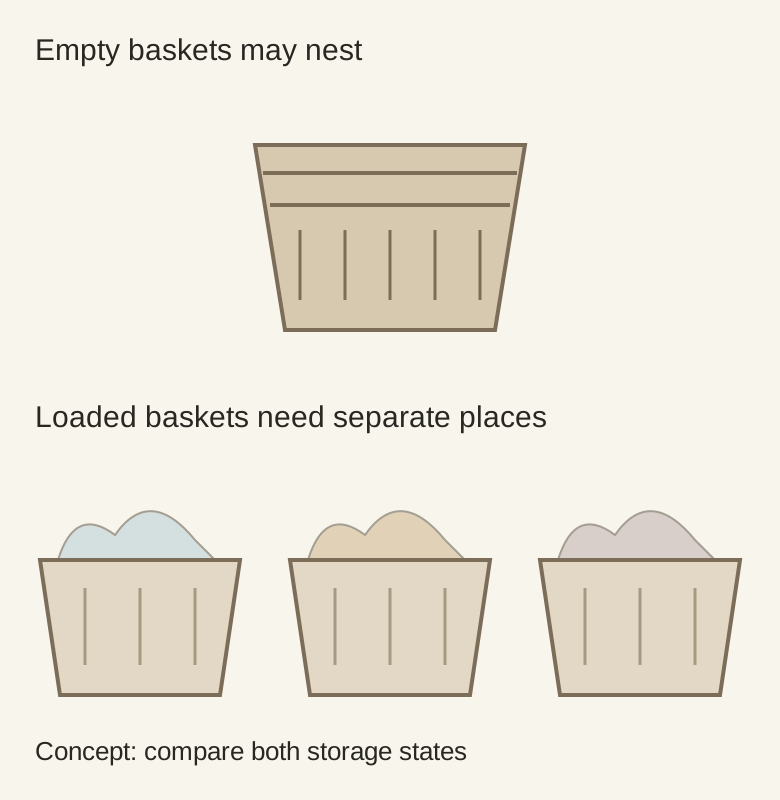
Diagram A finished load waiting to leave still occupies a position. This diagram illustrates temporary occupancy, not textile storage conditions or a required basket count.
Make the waiting stage finite and accessible
Choose an identifiable place for completed groups awaiting transfer. A removable tray, basket or open shelf can work if its actual contents, grip and route fit. Test carrying the full group through the room and into the destination cabinet. The container that fits the laundry shelf may be awkward to turn through the bedroom doorway.
Review the normal overlap: an earlier finished group is still waiting when another load is ready. Decide whether the earlier group moves, whether another suitable staging position exists, or whether the work sequence changes. Do not assume that an empty-basket nesting space also holds several loaded destination groups at the same time.
Check the receiving cabinet before enlarging this one
A transfer system stalls if the destination is already full. Compare the actual folded group with the receiving shelf and opening. If it does not fit, distinguish a folding issue from excess inventory or a genuinely unsuitable cabinet. Returning it to the laundry room indefinitely hides that unresolved decision.
Keep clean-linen storage separate from the room’s used-textile process. Items should be ready for their intended storage under their care requirements before being placed with finished sets. A cabinet door is not a substitute for completing that stage.
Give the planner two capacities with different purposes
Describe permanent laundry-room linens and temporary outbound groups separately. Show how the largest normal finished group is handled and where it goes next. Then choose cabinet space for the permanent inventory and a practical transfer position for the rest.
The result may be fewer enclosed linen shelves and a more useful accessible landing, or a dedicated linen cabinet because this room truly serves the household best. Either choice should follow the return route. The test is whether the next person can find and put away a complete group, not whether every folded textile can be hidden in the laundry room.
Pure White
Cream White
Light Warm Gray
Gray
Navy
Black
Oak Tone
Dark Walnut Tone
Design study These finish studies are design references, not a list of currently orderable colors. Screens and lighting change the appearance; compare a physical sample before choosing.See all finish options →
Pocket items, unmatched socks and repair candidates need different next steps. Give each a visible temporary destination and a route back to its owner.
Open storage removes a door-opening step; closed storage hides the collection. Neither solves poor reach, unsuitable storage conditions or a blocked work surface.
The sample shows the door frame, a separate center panel, the face frame and the cabinet box. Each component has its own place in this Shaker construction.
Shaker construction: door frame, center panel, face frame and cabinet box. The cutaway helps locate these parts; confirm each material in the specifications for the selected cabinet.
01 / Door frame
The Shaker door has rails and stiles around a separate center panel. The frame and center panel are different components; confirm their materials in the specifications for the selected cabinet.
02 / Face frame
The face frame surrounds the opening at the front of the cabinet box and sits behind the doors. The face frame, door frame and cabinet box are separate parts.
03 / Cabinet box
The sample exposes the cabinet sides, interior surfaces and layered edges. The image does not establish the wood species or material specification of a selected cabinet.