Adjustable laundry shelves: check the available steps, not just the label
A movable shelf still has limited positions, support requirements and neighboring compartments. Check the actual clear opening after each proposed move.
An adjustable shelf gives you choices among the positions allowed by its support system. It does not promise every desired opening height or unlimited load. When comparing laundry cabinets, ask which shelves move, where they can sit and what clear space remains after the contents and hardware are considered.
Request the position information, not only an adjustable label
Distinguish adjustable shelves from fixed members. A fixed divider can be part of the cabinet’s construction and is not a shelf to remove casually. For movable shelves, confirm the supplied support type, permitted positions and any retention requirements in the selected product’s instructions.
Measure clear height from the shelf surface to the lowest obstruction above. That may be another shelf, a frame member or installed hardware. A dimension taken between support holes does not automatically describe the usable opening, because shelf thickness and the actual support arrangement also matter.
A bottle that fits still needs a removal path
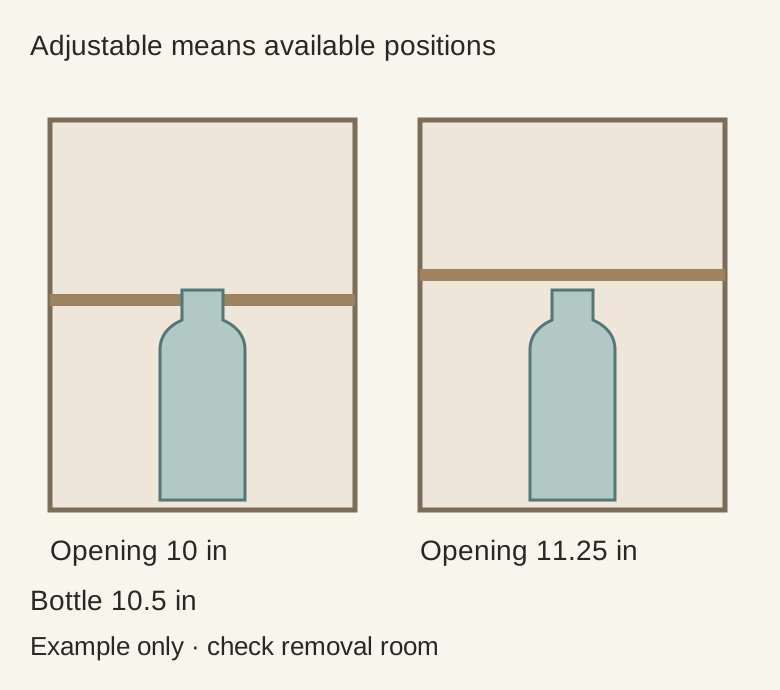
Consider a hypothetical measured opening of 10 inches and a bottle 10.5 inches tall. If the selected shelf system allows the upper shelf to move up 1.25 inches, the opening becomes 11.25 inches. The bottle then has 0.75 inch above it while standing. Those are assumed example dimensions, not a cabinet specification or a recommended hand allowance.
Diagram Hypothetical static fit only. The drawing is not to scale; test gripping, lifting and returning the actual package separately.
Try the intended action in that revised opening. Can the user grip the package, clear any front edge and return it upright? If not, the next available position, a different package location or another access arrangement may work better. Tilting a package for a fit trial is not a substitute for following its storage and handling directions.
Moving a shelf borrows space from the next compartment
Raising the shelf above a tall bottle reduces the compartment above. Check what already belongs there before calling the move a solution. A household can solve bottle clearance and accidentally leave its folded towels too compressed to retrieve normally.
Compare the whole vertical stack using the actual intended groups. Perhaps the tall product belongs in a lower open-height compartment and the smaller objects can share another shelf. That may use the cabinet better than adjusting every shelf to accommodate the tallest item in each mixed collection.
Height flexibility does not change reach or depth
An adjustable shelf can remain too deep for a small daily item at the back. Moving it upward may even make that rear item harder to see. Review visibility from the person’s usual position and test any removable tray with the door and hinges present.
Check shelf and support loading under the manufacturer’s instructions for the exact arrangement. Do not infer capacity from shelf thickness, the number of support holes or the fact that another cabinet holds similar bottles. Adding a heavy reserve quantity changes the load even when every package fits geometrically.
Keep a usable shelf map with the finished cabinet
Record the selected shelf positions, intended contents and the instructions for making an allowed change. When the household changes package sizes, reevaluate both the new opening and the space borrowed from adjacent storage. Avoid losing supplied retention parts during a casual reorganization.
Bring the tallest routine packages and the ordinary shelf groups to the selection process. Compare usable configurations, not maximum shelf counts. The better cabinet is the one that supports a practical arrangement with accessible contents, not simply the one with the largest number of adjustment holes.
Pure White
Cream White
Light Warm Gray
Gray
Navy
Black
Oak Tone
Dark Walnut Tone
Design study These finish studies are design references, not a list of currently orderable colors. Screens and lighting change the appearance; compare a physical sample before choosing.See all finish options →
Open storage removes a door-opening step; closed storage hides the collection. Neither solves poor reach, unsuitable storage conditions or a blocked work surface.
Separate daily supplies, reserve packages and objects that belong elsewhere. Cabinet size should reflect a usable inventory, not everything temporarily piled in the laundry room.
Separate a temporary transfer shelf from permanent linen storage. Organize finished loads by destination so the laundry cabinet does not hold everyone’s unfinished return trip.
The sample shows the door frame, a separate center panel, the face frame and the cabinet box. Each component has its own place in this Shaker construction.
Shaker construction: door frame, center panel, face frame and cabinet box. The cutaway helps locate these parts; confirm each material in the specifications for the selected cabinet.
01 / Door frame
The Shaker door has rails and stiles around a separate center panel. The frame and center panel are different components; confirm their materials in the specifications for the selected cabinet.
02 / Face frame
The face frame surrounds the opening at the front of the cabinet box and sits behind the doors. The face frame, door frame and cabinet box are separate parts.
03 / Cabinet box
The sample exposes the cabinet sides, interior surfaces and layered edges. The image does not establish the wood species or material specification of a selected cabinet.