

Buying cabinets
One waste center or several receiving points: which kitchen cabinet plan works?
Compare central sorting with waste collection near preparation, drinks and cleanup. Count simultaneous access, duplicate containers and the whole emptying round before buying the cabinet layout.
Buy the receiving points the household will actually maintain
Choose one central waste center when its location serves the recurring kitchen tasks and the household values a single sorting and emptying routine. Choose distributed receiving points when separate activities repeatedly need access at the same time, and the benefit justifies giving up storage and maintaining more containers. More points can shorten the first trip while lengthening the final collection round.
Start with the occasions that feel awkward now. Someone making drinks may cross the cook's position to discard packaging. A person clearing plates may need the same pullout that the cook holds open for preparation scraps. Record the actual interruption before adding another bin cabinet. A second container should solve a repeated conflict, rather than merely fill an empty-looking corner.
Map discards to their established destinations
Identify the groups the household already keeps separate under its actual collection arrangements. Then follow representative ordinary meals, groceries and drinks. Mark where each group first appears and where someone takes it out of the kitchen. Do not prescribe a local recycling rule from the cabinet plan.
Keep category and location separate. Several categories can share a central cabinet. Several locations can receive the same category. A preparation caddy that is emptied into the main container is also different from a second independent full-size collection point. Name the transfer instead of counting all these arrangements as equivalent extra capacity.
Use clean representative packaging for the layout exercise. Include the bulky item that appears regularly, without letting an unusual celebration determine every cabinet. Observe which category fills first in the current routine. Matching containers may look orderly while giving too much space to an infrequent group and too little to the daily one.
Central does not have to mean under the sink
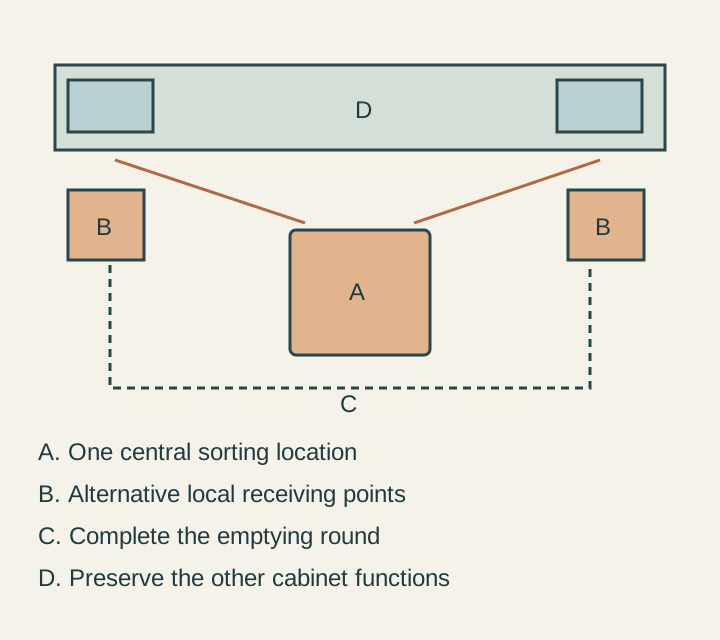
A central location is the agreed common destination. It may sit beside preparation, face a shared aisle or occupy another deliberate cabinet position. Its usefulness depends on the actual approaches, not its distance from the center of the room.
IKEA USA presents cabinet pull-out arrangements and freestanding bins as distinct forms. Those forms provide different placement possibilities; the category page does not establish that a particular fitting works in a particular cabinet.
Reading note: IKEA USA — Kitchen trash cans and bins, arrangement types.
Draw the complete selected center, including front movement and removal of each container. Preserve access to the sink equipment where relevant. A convenient drop-in position does not prove that the rear bin can be lifted out, or that the user can change a liner while another person unloads dishes.
Decide whether local points divide tasks or duplicate them
A small preparation receptacle can collect scraps beside the board while a main center receives other materials. That assigns different work to each point. By contrast, identical residual-trash bins at preparation and drinks may let people discard the same material in either place. Both can be useful, but the second arrangement creates an additional place to inspect.
Specify which users know each location and which categories belong there. A guest approaching the beverage counter should not have to discover a private sorting system hidden among several identical fronts. Clear identification and an obvious receiving position may solve that problem without another large cabinet.
Avoid multiplying every category at every point by default. Give the local point only the assignment that earns its space. If a nearby container is intended solely for drink packaging, establish where someone places another material that arrives there. An incomplete assignment often becomes an unplanned counter pile.
Test the busiest overlap
Act out a normal meal with the actual people or marked standing positions. Leave the preparation board, drinks supplies, occupied seats and open dishwasher where the plan expects them. Ask the second user to approach the central location while the first task continues.
Record the obstruction precisely. If the pullout itself blocks the route, rotating its face or moving the center may help. If the conflict is that two people need different categories on the same moving frame, separate receiving points may address it. If the users arrive at different times, more bins may buy little.
Repeat with the distributed proposal. A local bin behind the cook can still interrupt the cook, and a beverage-side front can collide with occupied seating. Count the real operating states. Do not credit a second location with access that exists only while its adjacent cabinet stays closed.
Walk the whole emptying round
Start the removal trial at the most remote point. Follow checking contents, gathering containers or bags, reaching the exterior destination and restoring the bins and liners. Include where a removed lid or empty receptacle waits. Multiple convenient receiving points can still make this round awkward for the person who performs it.
Agree who checks each point during the normal routine. A small local receptacle is not self-emptying simply because it feeds a larger one. If the plan depends on combining compatible contents, demonstrate that transfer with the selected containers and their instructions. Do not add an improvised pouring or stacking method to rescue the layout.
Compare cleaning and spare-supply storage as well. Duplicated containers may mean more separate lids, liners and pieces to handle. That is a household workload to accept, not a universal reason against distributed collection.
Count the cabinets surrendered at every point
For each proposal, show the actual fitting and the ordinary cabinet storage it replaces. A second small bin may displace the exact drawer that holds the drink tools; those tools still need a usable place. A central center may instead consume a wider continuous run that could have held pans. Compare both complete inventories.
Price fronts, mechanisms, containers, any separate freestanding piece, installation and the resulting storage changes. Keep common cabinetry constant. Do not compare one finished central cabinet with only the loose bin prices in the distributed proposal.
A second point earns a narrow assignment
In a hypothetical household, drink preparation regularly overlaps dinner preparation. The central sorting center suits cleanup, but beverage users repeatedly enter the cook's standing space to discard their assigned packaging. Moving the entire center would make plate clearing inconvenient.
They keep that center and add a modest receiving point beside drinks for the specific packaging group. They do not duplicate every category there. The proposed drink-tool drawer would be lost, so the selected cabinet arrangement keeps those tools in a checked adjacent compartment. The responsible user includes the local bin in the ordinary emptying round.
Another household may find that its conflicts disappear when the common center opens toward a shared approach. It can keep one maintained location and retain the extra drawer. Buy the arrangement that survives both the busy meal and the quiet collection round, with each sacrificed cabinet function accounted for.
Sources & further reading
- IKEA USA — Kitchen trash cans and bins, arrangement types