A higher hardwood lumber grade does not automatically mean a better finished cabinet
Lumber grades help describe recoverable clear cuttings. Match those cuttings to the actual parts, then evaluate the finished cabinet on its own construction and finish.
Do not read a hardwood lumber grade as a finished-cabinet quality score. The practical question is whether the purchased boards can yield the specified parts with their required appearance and dimensions. A board with marks outside the cut pieces can still provide acceptable clear components. Conversely, a high grade does not establish the cabinet’s joinery, finish or hardware performance.
The grade belongs to lumber before it becomes parts
The American Hardwood Export Council describes FAS in terms of long clear cuttings and explains why Number 1 Common is often used for cabinet-size parts. Its grading guide links grades to clear-cutting recovery from boards, rather than a ranking of complete cabinets.
That distinction matters because a finished frame rail is only part of the original board. A mark that remains in discarded material does not become a defect in that rail. Inspect the delivered component against its own requirement. Do not demand a visible knot merely because the raw material carried a lower grade, or assume that all of a higher-grade board will be used in the finished product.
Length and width are part of useful recovery, not just total clear area. Several separate short clear zones cannot produce a continuous long piece unless joining is explicitly part of the construction. Adding their areas may create an optimistic material estimate while leaving the required part impossible to cut. The purchase decision should begin with the rough-cut envelopes needed for the finished parts, including the shop’s fabrication allowances.
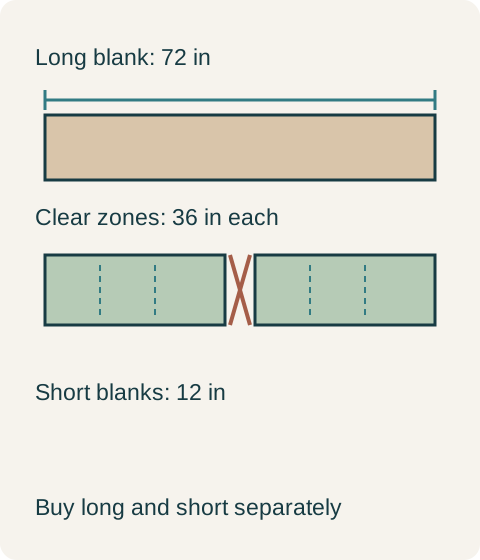
Teaching example Hypothetical cutting logic: separate 36-inch clear zones cannot produce an uninterrupted 72-inch blank. The 12-inch short blanks remain subject to the actual cut plan; the diagram assigns no lumber grade.
Match the lumber offer to the parts you need
Suppose a hypothetical order needs uninterrupted 72-inch rough blanks for long rails and 12-inch rough blanks for short components. One offered board has separate clear usable zones, each 36 inches long. Those zones may serve short blanks after the actual cut plan allows for cutting, but neither can supply an uninterrupted 72-inch blank. The buyer allocates that board to eligible short parts and purchases verified long clear blanks for the rails. The result is a split material order, not a lower-grade substitution in the long rail.
This hypothetical layout does not determine the board’s formal grade or calculate its complete yield. Width, faces, cutting rules and all fabrication allowances still matter. Nor does it authorize joining short pieces into the long rail. If the buyer wants a joined alternative, the construction and visible joint must be separately proposed and accepted. The original uninterrupted-part requirement remains unchanged until then.
Compare the cost of compliant parts, not only the board label
The useful shop comparison includes the boards needed to recover the specified components, sorting and cutting work, and the usable remnants. A lower unit price for raw lumber may be offset by lower recovery or additional handling; a higher grade may be unnecessary for an order dominated by short clear pieces. Without a cut list and an actual offer, neither price conclusion can be assumed.
Appearance selection can add a separate constraint. Clear wood does not automatically mean a narrow color range or a coordinated grain sequence across doors. If the project requires those features, include them in the part selection and sample approval. A grade description alone cannot silently carry requirements that concern how several finished pieces look together.
For a homeowner buying completed cabinetry, require a clear construction and appearance description for the parts that matter. The fabricator’s raw-material purchasing method is not a substitute for inspecting the result. For a trade buyer purchasing lumber or blanks, connect grade, cutting sizes and permitted appearance to the actual production list. These are different buying stages and should use different acceptance evidence.
When a supplier proposes a change of lumber grade, evaluate whether the same finished-part requirements remain achievable and whether the offer changes price, yield or scope. A substitution can be sensible without reducing the agreed appearance of the delivered parts. The decision becomes reviewable when the supplier shows the affected components and the buyer accepts the resulting package, rather than relying on the words premium or cabinet grade.
Pure White
Cream White
Light Warm Gray
Gray
Navy
Black
Oak Tone
Dark Walnut Tone
Design study These finish studies are design references, not a list of currently orderable colors. Screens and lighting change the appearance; compare a physical sample before choosing.See all finish options →
A ranked list can hide its comparison rules. Find the tested product, the scoring priorities and the missing conditions before applying the result to your cabinet order.
A painted door, a wood-grain side and a plywood cabinet box can belong to the same cabinet. Here is how to read those parts, what the sample photos actually show, and which details to put on a quote.
Locate and document a painted joint line, distinguish an appearance change from looseness or damage, and request an assessment before filling or repainting.
The sample shows the door frame, a separate center panel, the face frame and the cabinet box. Each component has its own place in this Shaker construction.
Shaker construction: door frame, center panel, face frame and cabinet box. The cutaway helps locate these parts; confirm each material in the specifications for the selected cabinet.
01 / Door frame
The Shaker door has rails and stiles around a separate center panel. The frame and center panel are different components; confirm their materials in the specifications for the selected cabinet.
02 / Face frame
The face frame surrounds the opening at the front of the cabinet box and sits behind the doors. The face frame, door frame and cabinet box are separate parts.
03 / Cabinet box
The sample exposes the cabinet sides, interior surfaces and layered edges. The image does not establish the wood species or material specification of a selected cabinet.