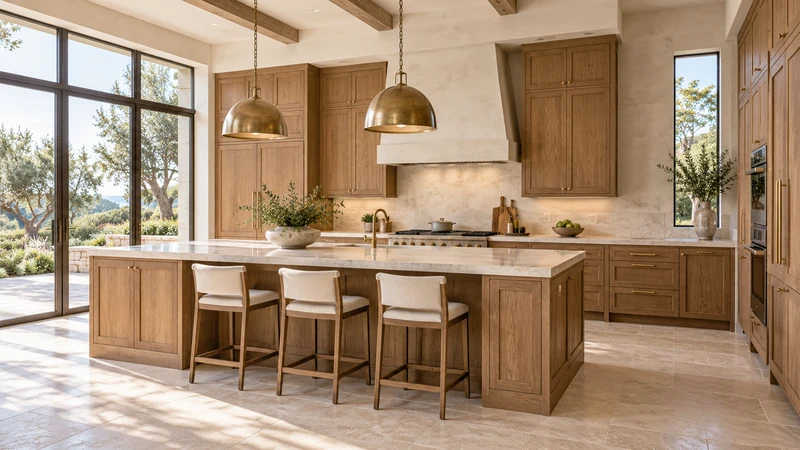
A sample kitchen price is a price for a particular cabinet list, finish and set of assumptions. Use it to begin comparing options, then request a quote for your actual layout. A room with a similar footprint can need different corner cabinets, taller wall cabinets, drawer bases or an island. Those changes alter the order even when the floor area stays the same.
Find the list behind the headline
Open the package details and identify the cabinet codes, quantities, sizes and included accessories. Kitchen Cabinet Kings, for example, publishes a sample-layout item list and distinguishes it from moldings and additional options. The useful lesson is to inspect the listed scope; that seller’s package does not define what every other seller includes.
Check whether the displayed amount refers to ready-to-assemble cabinets or assembled units, and which finish it covers. A photograph beside the price may show decorative details that are not part of the list. Match the written description to the pictured features instead of assuming that every visible panel, handle or trim piece has been priced.
Map the package to your actual layout
Place the advertised list beside your measured plan. Mark each cabinet that can remain, each one that must change and each missing part. A door base replaced by a drawer base is a substitution, not a free improvement just because the outside width matches. A different corner arrangement can also change the usable lengths of the adjoining runs.
Do not scale the sample amount by floor area. Open floor, windows and appliance spaces are not cabinets. Conversely, an island adds cabinet fronts and exposed surfaces without necessarily increasing the room footprint. Wall height, tall storage and finished ends can move the order in different directions. A cabinet-by-cabinet list captures those differences; a floor-area multiplier cannot.
Design study The island, tall units and exposed ends in this design study require their own specification. A sample-package headline cannot establish the cost of the pictured room.
Compare equivalent subtotals before choosing
In a hypothetical dollar comparison, package A shows a cabinet subtotal of $4000. Bringing it to the agreed cabinet-and-trim scope adds $700, and the assumed freight is $300, giving a comparison subtotal of $5000. Package B starts at $4500, needs $200 to reach that same scope and carries the same assumed $300 freight, also giving $5000. These figures are invented, not market estimates or usaKT prices. They illustrate why the lower starting number may disappear after equivalent scope is included.
That arithmetic still does not compare material specifications, assembly work or service terms, and it is not a complete installed-project total. Keep the scope of the subtotal written beside it. If an item remains unpriced, name it as an omission instead of treating it as a zero. A comparison can be useful while still showing what must be resolved.
Separate necessary completion from optional upgrades
A filler required to make the layout work differs from an organizer you would simply enjoy having. Finished panels required by an exposed cabinet side also differ from a decorative treatment you can choose to omit. Ask the designer to separate parts that complete the selected arrangement from optional enhancements. Otherwise, removing a line to reach a budget may leave an unfinished or incompatible assembly.
Carry finish changes through the entire cabinet list. Repricing only the visible door fronts may miss matching panels or trim. If you change assembly format, identify the labor and handling assumptions that change with it. Use the same proposed layout when requesting alternatives, so the price difference can be traced to an actual selection.
Request a quote that can become an order
Provide the measured layout, appliance information, desired interior functions and known exposed surfaces. Ask for an itemized cabinet list with quantities, finish identification, assembly state, included trim and the delivery scope. Keep the sample-package reference as a starting point, but approve the final list and drawings together. The amount that matters is the one attached to the cabinets and services you actually intend to buy.
Pure White
Cream White
Light Warm Gray
Gray
Navy
Black
Oak Tone
Dark Walnut Tone
Design study These finish studies are design references, not a list of currently orderable colors. Screens and lighting change the appearance; compare a physical sample before choosing.See all finish options →
Compare the same samples in the same position before judging color. Then change the lighting or surroundings deliberately, so you know what changed the impression.
Separate product, delivery, installation and service experiences. Look for comparable details and repeated mechanisms, not just repeated adjectives or an overall star rating.
The sample shows the door frame, a separate center panel, the face frame and the cabinet box. Each component has its own place in this Shaker construction.
Shaker construction: door frame, center panel, face frame and cabinet box. The cutaway helps locate these parts; confirm each material in the specifications for the selected cabinet.
01 / Door frame
The Shaker door has rails and stiles around a separate center panel. The frame and center panel are different components; confirm their materials in the specifications for the selected cabinet.
02 / Face frame
The face frame surrounds the opening at the front of the cabinet box and sits behind the doors. The face frame, door frame and cabinet box are separate parts.
03 / Cabinet box
The sample exposes the cabinet sides, interior surfaces and layered edges. The image does not establish the wood species or material specification of a selected cabinet.