AntiEtch Next Gen at KBIS 2026: buying marble with a protective surface system
The award puts a specific marble treatment in the spotlight. Its relevance to a kitchen depends on the treated appearance, application scope and ongoing care.
KBIS announced on February 19, 2026 that MORE AntiEtch Next Gen won Gold in Most Functional Find and Sustainable Standout. The awards were presented the previous day. These are product-award results, not a guarantee for a particular installed countertop.
This article reviews the public announcement and currently linked manufacturer documents as observed on October 23, 2026.
A different purchase from simply sealing the slab
For someone who wants marble but dislikes the prospect of acid marks, the useful news is a specific surface-treatment option to investigate alongside the stone. The decision is no longer limited to choosing a slab and its polished or honed appearance. It can include a professionally applied surface system. That adds another component to approve, another scope of work to price and a service arrangement to understand before the countertop is completed.
MORE’s NextGen brochure describes a UV-cured treatment for acid-sensitive stone, offers honed, satin and polished finishes, and promotes protection against etches and stains. Those are manufacturer claims for the named treatment; they do not establish identical performance for every clear stone coating.
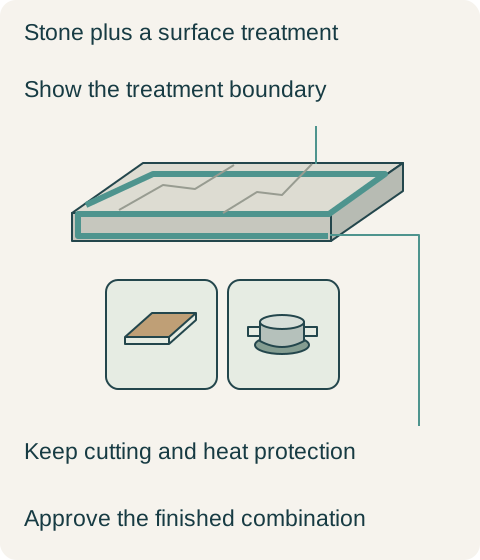
Teaching example Hypothetical purchase scope: the accent line marks the specified top and visible edge treatment. Thickness is exaggerated to identify the boundary; this is not an application detail or performance test.
Read the care sheet alongside the award
The practical comparison concerns the surface you will touch after treatment. A bare slab sample does not demonstrate the completed combination. View a treated sample in the intended finish, alongside the cabinet door and under the room’s planned light. Inspect the edge as well as the broad face. A buyer who chooses a quiet reflection should approve that result after treatment, rather than rely only on the quarry slab’s appearance.
The manufacturer’s currently linked care guide requires cutting boards and hot-pot protection, excludes exterior direct-sun applications and assigns scratch repairs to certified applicators. It also sets indoor UV-exposure conditions. Confirm the applicable care document for the proposed Next Gen installation.
This distinction matters when a sales presentation concentrates on spilled lemon juice. Acid protection addresses a particular concern; it does not complete the household’s decisions about knives, cookware or repairs. Map where food is cut and where a hot pan lands. Then assess whether the treatment package fits that routine. The guide and the selected product documentation should travel with the countertop order, so future service is based on the treated surface actually installed.
Define which surfaces receive the treatment
An island can include its working face, an edge profile, a waterfall side and a separate backsplash. Draw the proposed treatment boundary rather than treating the word countertop as a complete scope. Ask the applicator to identify what is included, how preparation and adjoining materials are handled, and which visible sample represents the result. This is especially useful where the front edge is seen against a contrasting cabinet: an unresolved transition can matter more than an attractive photograph of the broad surface.
A marble island chosen with the treatment included
In a hypothetical remodel, the owners like a particular marble slab but have rejected an untreated sample’s dull acid marks. They also want to keep a subdued finish beside matte cabinet doors. After reviewing a treated sample and the applicable instructions with a certified applicator, they select the marble-plus-treatment package for the indoor island. The accepted drawing identifies the top and visible edge treatment, and the price includes preparation and application.
They keep their cutting board and heat-protection routine and record the professional repair contact supplied with the actual job. They accept the treated sample’s reflection rather than demanding that an unseen result exactly reproduce the raw slab. This is a completed purchase of the represented surface system. It does not predict that the project will never develop a mark, or that a treatment can make a different stone product identical to this sample.
If the same household instead required an untreated stone feel with no additional surface system, this offer would not meet that preference. Nor would the award answer a request to set cookware down without following the supplied precautions. Those are reasons to reconsider the material package, even when its decorative appearance is attractive. Price the selected slab, fabrication and treatment together before comparing it with another finished countertop.
What the award adds to the choice
The KBIS result identifies a named product worth examining; the purchase still rests on its documented application and the finished combination. The Sustainable Standout category does not provide a project-specific calculation of avoided replacements or environmental savings. Keep the news in its proper role: it introduces a concrete alternative, while the sample, scope and care arrangement determine whether that alternative belongs in your kitchen.
Pure White
Cream White
Light Warm Gray
Gray
Navy
Black
Oak Tone
Dark Walnut Tone
Design study These finish studies are design references, not a list of currently orderable colors. Screens and lighting change the appearance; compare a physical sample before choosing.See all finish options →
Borrow the design idea, then test it against your room and cabinet list. A project award does not identify every product or establish how each part performs.
The quarter’s current-activity and near-term readings pointed in different directions. For cabinet businesses, that distinction matters when choosing between preparing for demand and committing to additional inventory.
The sample shows the door frame, a separate center panel, the face frame and the cabinet box. Each component has its own place in this Shaker construction.
Shaker construction: door frame, center panel, face frame and cabinet box. The cutaway helps locate these parts; confirm each material in the specifications for the selected cabinet.
01 / Door frame
The Shaker door has rails and stiles around a separate center panel. The frame and center panel are different components; confirm their materials in the specifications for the selected cabinet.
02 / Face frame
The face frame surrounds the opening at the front of the cabinet box and sits behind the doors. The face frame, door frame and cabinet box are separate parts.
03 / Cabinet box
The sample exposes the cabinet sides, interior surfaces and layered edges. The image does not establish the wood species or material specification of a selected cabinet.