JennAir at KBIS 2026: buying a shell-inlaid appliance accent
The announced Mussel Shell wine-column treatment raises a practical design question: should an appliance disappear into the cabinetry or become a deliberate material feature?
JennAir’s February 12, 2026 KBIS preview named a Nature Squared Mussel Shell wine-column panel for its Daring kitchen. This is a show-design announcement; it does not establish the material’s first launch.
Public sources were reviewed on October 23, 2026. This article examines the material and cabinet-design implications; the announcement does not establish current delivery for a particular order.
An appliance can carry the accent
A decorative appliance front deserves a different decision from matching ordinary cabinet doors. Instead of making the equipment less noticeable, the buyer may want its surface to be part of the room’s character. That can be a sensible use of a special material, provided the household already needs the appliance. Buying wine refrigeration merely to acquire an attractive panel reverses the useful order of decisions: storage function comes first, then the front that belongs to it.
JennAir describes Elements panels as handmade surfaces inlaid with egg or seashell fragments, and warns that its displayed swatches are enlarged rather than shown to scale. This identifies an inlaid material and a limit of the online presentation; it is not approval for a loose decorative sheet on any cabinet.
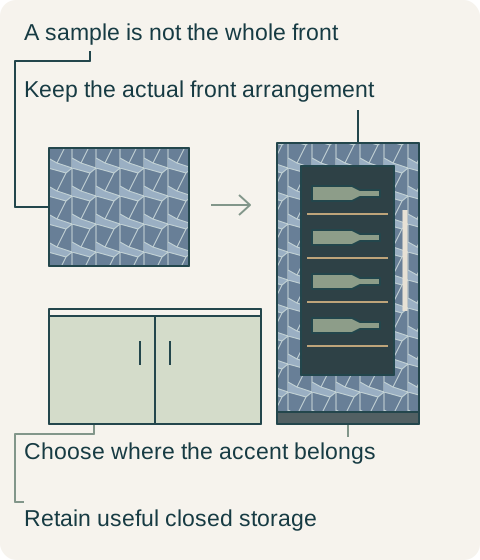
Teaching example Hypothetical wine-alcove elevation: the patterned appliance surround and visible center are considered together, while adjacent storage stays plain and closed. This is a composition study, not JennAir dimensions, an accessory drawing or a reproduction of the KBIS booth.
Judge the visible field, not an enlarged fragment
Start with the actual proposed front layout. Mark where the decorative material appears, where any glass or other opening interrupts it, and where the handle sits. A striking square sample can become a very different composition when distributed around an opening or repeated on tall neighboring equipment. Conversely, a close-up can make the individual fragments seem much larger than they will read from the dining table.
Compare the whole elevation at ordinary viewing distance before discussing small color differences. Include the handles, adjacent cabinet lines and anything visible behind glass. Those elements compete for attention with the inlay. If the desired effect depends on the image looking like an uninterrupted slab, do not approve a different front arrangement simply because its finish carries the same name. The product drawing and the material sample answer different parts of the design.
The surface needs an in-room viewing test
For its Mussel Shell Blue wine panel, JennAir describes angle-dependent color and specifies prompt wiping, using a soft lint-free cloth lightly dampened with lukewarm water when needed, then natural drying.
Hold the appropriate sample vertically in the intended lighting and view it from the route people actually use. Compare it beside the planned cabinet finish and countertop, then step back. A sample that is appealing when tilted toward a window may have a different presence on a fixed front. Keep the direction and location of the approved sample recorded so later discussions do not compare unrelated lighting arrangements.
The visible material also has an edge. Ask to see the offered corner, handle area and transition to the appliance front, rather than assuming a large field photograph explains them. Establish whether the quoted item is a finished compatible panel or material requiring another fabricator’s work. Cutting a decorative panel to improvise a new opening would create a different proposal from the identified accessory; it should not be treated as routine cabinet trimming.
A wine alcove keeps a single special-material feature
In a hypothetical remodel, the owners already have a justified wine-storage requirement and have selected the appliance configuration. They like a shell-inlaid front for the wine alcove but initially pair it with patterned glass doors on the adjacent storage. In a full elevation, the inlay, visible bottles and decorative glass all ask for attention. The small samples had concealed that accumulation.
They select a documented compatible shell-panel package for the wine appliance and change the adjacent storage to plain opaque doors. The glasses remain inside those cabinets, so useful storage is retained while the wine front becomes the intended feature. They approve the actual panel arrangement, including any opening, edge and chosen handle, and accept its particular care routine. The ordinary refrigerator elsewhere keeps its coordinated cabinet front. No additional appliance or wall of matching shell panels is added.
Keep the accessory boundary in the order
Price the appliance, specified panel, handle and required installation as the proposed complete assembly. Identify which supplier is responsible for the decorative front and which party coordinates its fit. The order should preserve the agreed visible material area and surrounding cabinet design, rather than reducing the decision to shell finish. A related accessory for another refrigeration format is not an automatic substitute.
The useful lesson from the show example is that integration can include a deliberate contrast. It does not require every appliance to disappear or every cabinet to repeat a distinctive material. A buyer can choose a special front for a functional appliance, judge it at its actual scale and keep the remaining storage coherent. That is a more precise purchase than adopting a striking texture without deciding where it begins and ends.
Pure White
Cream White
Light Warm Gray
Gray
Navy
Black
Oak Tone
Dark Walnut Tone
Design study These finish studies are design references, not a list of currently orderable colors. Screens and lighting change the appearance; compare a physical sample before choosing.See all finish options →
A leather-textured cabinet insert may be a resin-finished recycled material in a wood frame. Identify the actual surface, support and finished edges before choosing its place in the room.
Dual zone describes temperature control, not the contents each compartment is built to hold. Compare wine racks, beverage shelves and their assigned temperature functions before giving an appliance the cabinet space.
The quarter’s current-activity and near-term readings pointed in different directions. For cabinet businesses, that distinction matters when choosing between preparing for demand and committing to additional inventory.
The sample shows the door frame, a separate center panel, the face frame and the cabinet box. Each component has its own place in this Shaker construction.
Shaker construction: door frame, center panel, face frame and cabinet box. The cutaway helps locate these parts; confirm each material in the specifications for the selected cabinet.
01 / Door frame
The Shaker door has rails and stiles around a separate center panel. The frame and center panel are different components; confirm their materials in the specifications for the selected cabinet.
02 / Face frame
The face frame surrounds the opening at the front of the cabinet box and sits behind the doors. The face frame, door frame and cabinet box are separate parts.
03 / Cabinet box
The sample exposes the cabinet sides, interior surfaces and layered edges. The image does not establish the wood species or material specification of a selected cabinet.