Recycled leather cabinet inserts: choose a finished panel, not an upholstery idea
A leather-textured cabinet insert may be a resin-finished recycled material in a wood frame. Identify the actual surface, support and finished edges before choosing its place in the room.
If you like the look of leather on a cabinet door, first decide what you expect to touch. A firm decorative panel, a padded upholstered surface and a leather-patterned finish are different proposals. A photograph may make all of them look soft. For a recycled leather insert, buy the actual completed door and its stated material construction rather than importing expectations from a leather chair or handbag. The door still has a frame, a reverse and edges that will be visible when it opens.
What recycled leather means in a real cabinet product
Conestoga describes its recycled leather veneer as reprocessed leather remnants finished with resin, offered as double-sided cabinet inserts. That identifies a manufactured leather-containing surface, rather than an intact hide or an unspecified printed leather pattern. It does not describe a padded assembly.
This distinction changes how to compare proposals. If leather content matters to the buyer, a visually similar pattern on another surface is not the same material choice. If the pattern and color are all that matter, there is no need to assume that one composition must be preferred. Keep appearance, material identity and construction as separate questions. The word leather should not conceal a substitution between a firm insert and upholstery with a completely different thickness and edge treatment.
Follow the insert into the frame
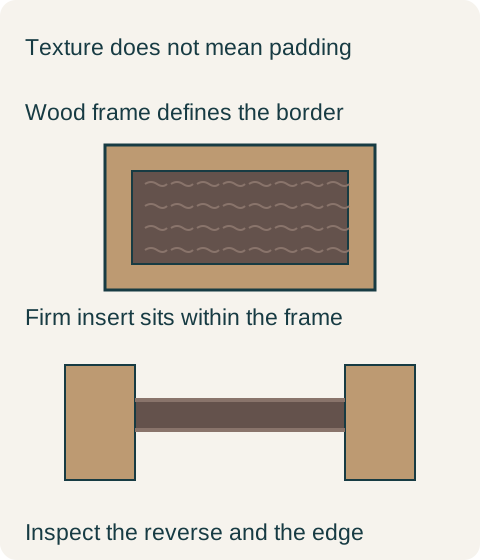
Look at the junction between the textured field and the surrounding rails and stiles. Does the panel sit behind a defined frame edge, and what does that recess look like from an angle? Then open the door and look at the reverse. A surface sample cannot show the full door’s recess, corners or retention. The completed assembly also determines how the hardware is prepared; do not transfer a hinge or screw arrangement from an upholstered example simply because both pictures show leather.
Teaching example Hypothetical framed decorative insert with a section detail. The graphic does not represent leather-grading, padding thickness, a fabrication recipe or a usaKT product.
Conestoga’s CRP-10 example pairs a Hard Maple frame with a named leather-panel treatment and also identifies a corresponding drawer-front design. It illustrates a coordinated framed-door option, not a loose sheet that automatically turns any existing door into that product.
The frame and the insert do not have to share a finish
The visual contrast may be the point of the design. A wood frame can establish the outline while the insert provides a quieter or differently textured center. Judge the combination beside adjacent fronts, including the narrow areas where two door frames meet. Repeating a thick-looking frame across a wide bank can create a stronger grid than the small sample suggests. This is a proportion decision: the material that works well on an accent door may dominate if repeated on every drawer and tall front.
Also identify where fingers will land in ordinary use. If a separate handle is proposed, operate the finished sample with that handle. If the design relies on touching or pulling the panel itself, the contact pattern changes and should be part of the offered assembly. Do not assume a decorative insert is intended to act as a flexible pull. The buyer should be able to see how the door opens without inventing a handling method after installation.
The dining cabinet keeps the leather accent
In a hypothetical project, the owner wants a dark textured center on a dining-storage cabinet but expects a soft upholstered feel. The completed sample reveals a firm recycled leather insert in a wood frame. The owner prefers that defined panel appearance once it is handled and chooses it for the dining doors with separate handles. The adjacent everyday utility drawers retain their existing smooth fronts. The approved choice is a firm framed accent, with its reverse and border shown, rather than an order described only as leather doors.
If softness had remained essential, the sampled insert would have answered the question by being unsuitable. Another construction would need its own complete review. That is a useful reason to handle a representative door: it can eliminate the wrong premise before discussions about color or price become detailed. Avoid accepting an unfamiliar insert and then planning to add padding, wrap its edge or cover its reverse later; those changes create a different front from the one the fabricator prepared.
Keep care tied to the manufactured surface
Use the instructions for the supplied panel and its frame. A product made with leather remnants and a surface finish should not automatically receive the conditioners or treatments used on another leather object. Likewise, a wood-frame care method should not be extended across the insert without compatibility information. Discuss the expected room use as part of selection, especially where routine handling or splashes are part of the brief. A material’s name is not a cleaning recipe or an approval for every location.
Compare the complete front price, including the frame, insert, reverse, hardware preparation and any related drawer design. Retain the exact panel treatment and frame finish separately so a later replacement request identifies both. At delivery, inspect those junctions and the specified handling detail before judging the whole item from its color. The purchase succeeds when the material’s actual feel and construction are the qualities you wanted, with its place in the room chosen deliberately.
Pure White
Cream White
Light Warm Gray
Gray
Navy
Black
Oak Tone
Dark Walnut Tone
Design study These finish studies are design references, not a list of currently orderable colors. Screens and lighting change the appearance; compare a physical sample before choosing.See all finish options →
Compare the actual countertop products, heat-source routine and fabrication proposal. A fired porcelain slab and resin-bound quartz are different materials, but neither label replaces a complete kitchen specification.
The sample shows the door frame, a separate center panel, the face frame and the cabinet box. Each component has its own place in this Shaker construction.
Shaker construction: door frame, center panel, face frame and cabinet box. The cutaway helps locate these parts; confirm each material in the specifications for the selected cabinet.
01 / Door frame
The Shaker door has rails and stiles around a separate center panel. The frame and center panel are different components; confirm their materials in the specifications for the selected cabinet.
02 / Face frame
The face frame surrounds the opening at the front of the cabinet box and sits behind the doors. The face frame, door frame and cabinet box are separate parts.
03 / Cabinet box
The sample exposes the cabinet sides, interior surfaces and layered edges. The image does not establish the wood species or material specification of a selected cabinet.