Does a dual-zone wine cooler also serve as a beverage refrigerator?
Dual zone describes temperature control, not the contents each compartment is built to hold. Compare wine racks, beverage shelves and their assigned temperature functions before giving an appliance the cabinet space.
A dual-zone wine cooler is not automatically a wine-and-beverage refrigerator. Select a wine-only arrangement when both compartments have a real wine assignment. Select a combination when the kitchen needs a dedicated place for everyday cans and bottles as well as wine, and the offered compartments suit those contents. Decide that before reserving the appliance opening: a pair of glass doors and the words dual zone can hide very different purchases.
Temperature zones and storage fittings answer different questions
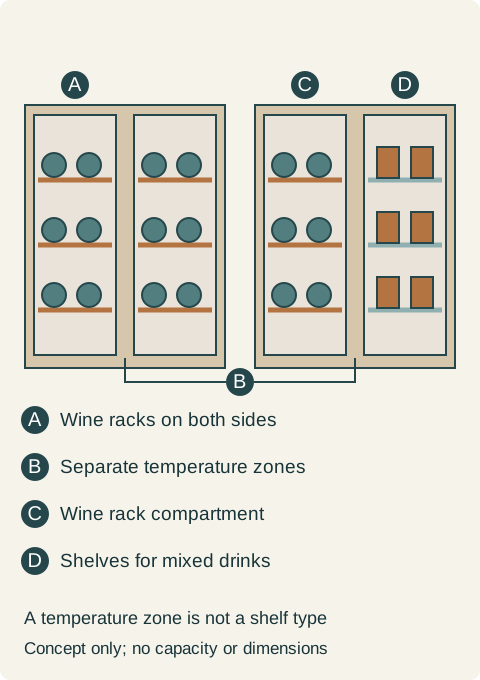
Zephyr's cited French Door Panel Ready Dual Zone Wine Cooler has wine racks on both sides. Its advertised bottle count is based on Bordeaux-style bottles, so other shapes can reduce that count.
The cited Zephyr Wine & Beverage Cooler instead pairs wine racks with adjustable glass beverage shelves. It also gives the beverage side a different temperature range from the wine side. Those are features of this specific configuration, not an assumption to apply to every dual-zone product.
The practical distinction is straightforward. Separate controls describe which temperatures the compartments can maintain; the racks and shelves describe how the objects are supported and retrieved. A lower setting does not turn a wine rack into a flat shelf, and replacing a shelf does not establish a new temperature function. Confirm both parts of the intended assignment rather than treating a marketing category as a complete specification.
The named examples also have different front packages. They illustrate the interior choice, not a direct replacement with identical cabinetry details. Once the preferred arrangement is clear, select the actual model, front and installation package together. Do not transfer an opening or panel drawing from the other example simply because its doors look similar.
Decide what deserves permanent refrigerated space
Separate everyday contents from occasional hosting supplies. A family that reaches for canned sparkling water throughout the week may get more use from beverage shelving than from a second wine compartment. A household keeping different wine groups may have a genuine reason to assign both compartments to bottles. Neither choice is more complete simply because its description contains more features.
Write an actual load list, including the containers that are normally kept at the drink station and the reserve stock stored elsewhere. That distinguishes refrigerated working stock from bulk storage. A party-sized purchase does not necessarily need a permanent chilled home if the household has a workable replenishment routine. Conversely, a very small daily allocation is not honest if the routine depends on refilling it repeatedly and nobody wants that task.
Include any upright containers in the proposed arrangement. An opened bottle with its retained closure, for example, may require a different position from the closed bottle used in a catalog illustration. Follow the appliance and container instructions for the intended use. Do not make the new unit depend on improvised containers balanced between bottle supports or on an unsupported shelf conversion.
Teaching example Conceptual interiors. Left: both compartments are assigned to wine racks. Right: a wine-rack compartment sits beside beverage shelves. The center partitions separate zones; the bottles and cans are symbols, not loading diagrams or capacity claims. Doors and installation details are omitted.
Compare the contents, not the largest printed count
Bottle capacity and can capacity describe different loads; adding the advertised numbers together does not create a useful measure of storage. The shapes, shelf arrangement and access paths matter. A large-format bottle may use space that a narrow bottle leaves available. Moving a shelf for taller containers can change the capacity for the other items assigned to that compartment.
Use the selected manufacturer's loading information and a representative demonstration with the household's containers. Keep the final arrangement recognizable: which racks remain, where shelves sit and which groups occupy them. This is a choice between complete interior layouts, not a competition to make the highest count appear in a quote.
Avoid buying wine capacity as an undefined future aspiration while the current beverage task remains in the main refrigerator. If a collection is genuinely expected to grow, decide which other contents would move and where. Growth that silently displaces all the everyday drinks changes the reason for installing the appliance in this kitchen.
A mixed household chooses the combination
In a hypothetical kitchen, the new appliance is intended to remove routine drink traffic from the main refrigerator. The household keeps a modest group of wine bottles but retrieves cans much more often. It initially favors a dual-zone wine-only model because the divided front looks like a convenient arrangement for both groups.
The interior review changes the choice. Assigning both sides to wine would preserve capacity the household does not need while leaving the cans without their intended shelving. The household selects a wine-and-beverage configuration whose documented interior accepts the planned working stock. It accepts less dedicated wine storage, retains reserve cans in dry pantry storage and chooses temperature settings within the actual model's permitted use for the intended contents.
The surrounding cabinet stays in the proposal for glasses and opening tools. Adding a separate second refrigerator would displace that cabinet without resolving a demonstrated shortage, so the household does not expand the appliance allocation. The complete result is a combination unit plus useful dry storage, not a pair of appliances bought to compensate for the wrong first interior.
If the wine assignment instead filled both compartments and cans already had a convenient home, a wine-only model could be the more appropriate purchase. The decision follows the actual groups and routines. It does not require inventing a wine-storage need to justify a particular door design.
Keep the selected configuration attached to the cabinet plan
After the interior and temperature functions are settled, check the exact product's enclosure, ventilation and door requirements. These remain necessary even when another refrigerator occupied the proposed opening. A change between wine-only, combination and ordinary refrigerator models can change more than the shelves visible behind the door.
Retain the selected interior allocation with the appliance identity and its front package. A later substitution should reopen that allocation, even if the outside width appears unchanged. The number of zones alone cannot confirm equivalent storage. The useful purchase is the appliance that gives the planned drinks appropriate supported homes while leaving the kitchen with the dry storage it still needs.
Pure White
Cream White
Light Warm Gray
Gray
Navy
Black
Oak Tone
Dark Walnut Tone
Design study These finish studies are design references, not a list of currently orderable colors. Screens and lighting change the appearance; compare a physical sample before choosing.See all finish options →
A flush front does not establish a working installation. Confirm enclosure permission, keep the required ventilation opening effective and test the door with the actual bottles and neighboring fronts.
A wine refrigerator can work for daily serving while its racks remain difficult to remove. Verify the selected rack, door position and hand access before fixing a wall or island-end location.
The sample shows the door frame, a separate center panel, the face frame and the cabinet box. Each component has its own place in this Shaker construction.
Shaker construction: door frame, center panel, face frame and cabinet box. The cutaway helps locate these parts; confirm each material in the specifications for the selected cabinet.
01 / Door frame
The Shaker door has rails and stiles around a separate center panel. The frame and center panel are different components; confirm their materials in the specifications for the selected cabinet.
02 / Face frame
The face frame surrounds the opening at the front of the cabinet box and sits behind the doors. The face frame, door frame and cabinet box are separate parts.
03 / Cabinet box
The sample exposes the cabinet sides, interior surfaces and layered edges. The image does not establish the wood species or material specification of a selected cabinet.