Integrated fridge replacement: sliding vs. fixed door systems
A matching cabinet door may be carried by furniture hinges or attached directly to the appliance door. Identify the system before assuming that a replacement fridge can keep the existing front and hardware.
Before replacing an integrated refrigerator, identify how its decorative furniture front is supported and connected. A new appliance fitting the same cabinet opening does not prove that the front, furniture hinges or linking parts can remain. Sliding-link and directly fixed front systems can look similar when closed, yet they create different cabinet work and different reasons a reuse proposal may fail.
Look behind the matching furniture appearance
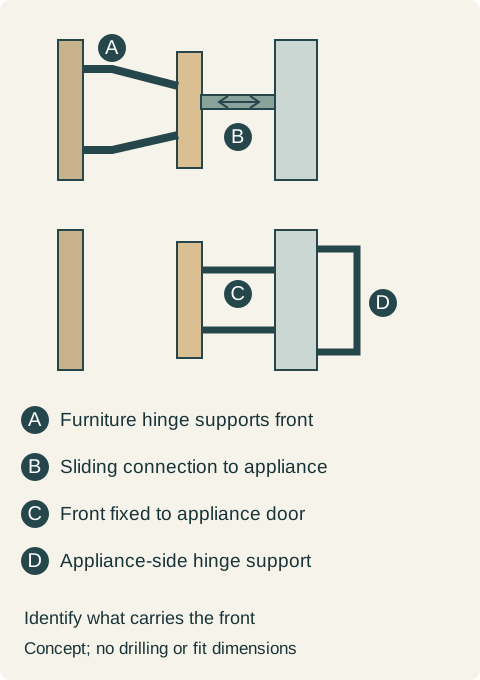
Liebherr's UK explanation distinguishes a furniture-hinged front linked to the refrigerator by sliding rails from a front mounted directly onto the appliance door. It describes the mechanisms; it does not establish that every model or conversion is available in the US.
The first inspection should therefore identify the existing appliance and the visible front connection, without removing or adjusting parts. Photograph the open arrangement and retain the model information. A kitchen-front photograph taken with everything closed records the finish, but leaves the crucial construction hidden.
Do not confuse a sliding connector with a sliding refrigerator door. The buyer is identifying how the outer furniture front and appliance door work together. Nor should fixed door be read as a door that cannot open: it describes the mounting relationship, not an absence of normal door movement.
Keep the front, remount it or remake it
These are separate scopes. Keeping the existing arrangement means the selected replacement expressly supports the documented front system and the retained furniture components meet its requirements. It is not enough that the old and new appliance widths share the same shopping label.
Remounting an existing decorative front means using that particular panel in a different supported attachment arrangement. Its finish may be worth saving, but the panel still needs suitable construction, dimensions, weight and attachment locations. Old hinge recesses and fastener holes belong in the assessment; a decorative face that looks undamaged does not describe the material available on its reverse.
Remaking the front means purchasing new furniture work as part of the appliance change. This may be the sensible route when the selected system cannot accept the old panel. It can also introduce an appearance decision beside the retained doors. A new panel in a similarly named color is not automatically an invisible match to an aged finish.
Ask for these scopes to be distinguished in the proposal. A line reading reuse door could mean leaving everything in place, reworking and remounting the panel, or merely copying its dimensions. Those are materially different purchases.
Teaching example Separated component concepts, not an opening-path drawing. Above, A marks furniture hinges supporting the outer front and B the sliding link to the appliance door. Below, C marks the front fixed to the appliance door and D the appliance-side support. Gaps and component sizes are illustrative, not mounting instructions.
The appliance must accept the actual front assembly
The cited Miele US refrigerator data identifies fixed-door mounting and separate furniture-front weight limits for its refrigerator and freezer sections. It shows that mounting type and the permitted front assembly are model-specific requirements, not details supplied by a generic cabinet-door label.
Keep the entire moving front in the review, including the selected handle and applied decoration. Do not judge its suitability from an unfinished panel blank or assume that the refrigerator and freezer fronts have identical requirements. A divided-looking elevation also needs an actual supported attachment arrangement behind it.
The required hardware should be identified by the selected appliance documentation. Neither adding ordinary furniture hinges to a directly fixed front nor retaining old sliding links establishes an approved conversion. This article explains the purchase distinction; it does not prescribe removing hinges or drilling a new pattern.
After the assembly has been established, review its opening path against adjacent fronts and walls. That remains necessary, but it answers a later question. A door clearing the neighbor does not prove that its weight and attachment are correct, just as correct attachment does not prove that the handle clears the wall.
A lower appliance price can conceal a new front order
Consider a hypothetical replacement proposal for a kitchen with an existing sliding-link arrangement and a decorative front matching the rest of the room. A candidate fridge has the required cabinet envelope, so an early estimate carries over the existing front without further work. The selected candidate actually requires a directly fixed front.
The completed review finds that the old front cannot be accepted for the proposed attachment. The cabinetmaker and appliance installer identify a new suitable front as part of that candidate's scope. The apparent appliance-only replacement has become a refrigerator-plus-front purchase, with a separate finish decision.
The owner compares that complete package with a supplier-verified replacement that retains the supported sliding-link furniture arrangement. Both candidates have been checked for the room and intended storage use. Preserving the existing matched front matters more to this owner than the first candidate's appliance-only price. The owner selects the compatible replacement arrangement and accepts the exact linking components specified for it, rather than demanding reuse of every old hardware piece.
The resulting order retains the matching furniture appearance without pretending that all integrated fridges attach alike. Another owner may prefer the directly fixed candidate and accept a new front. That can be an equally deliberate decision, provided the furniture work and visible finish change are priced and approved as part of the purchase.
Changing the attachment system is not the whole fit review
Retain the installation envelope, ventilation arrangement and connection requirements for the actual replacement. A front-system match cannot compensate for an incompatible cabinet cavity or blocked airflow path. Likewise, an appliance that fits the cavity does not resolve the front system; the two checks have to agree.
For a refrigerator with separate doors or freezer drawers, account for each furniture front individually. Show which existing pieces are retained, which are replaced and which hardware belongs to the appliance package. Do not allow a single note about the main door to silently approve the lower section.
The responsible professionals should establish the supported installation and adjustment procedure. The buyer's role is to understand the resulting furniture scope and verify the intended appearance and ordinary operation at completion. A demonstration with a temporary front should not silently replace acceptance of the specified finished front.
Buy the complete replacement, not an assumed continuation
The useful comparison includes the appliance, compatible attachment parts, any cabinet alterations, front fabrication or reworking, finish work and installation. It also states what is being retained. There is no automatic cost or quality winner based solely on the words sliding or fixed.
Keep the existing system visible until the final replacement is agreed. If a later model substitution changes that system, reopen the furniture scope before delivery. This prevents a fridge that fits the hole from arriving with an unpriced requirement to rebuild the front that made the kitchen look integrated in the first place.
Pure White
Cream White
Light Warm Gray
Gray
Navy
Black
Oak Tone
Dark Walnut Tone
Design study These finish studies are design references, not a list of currently orderable colors. Screens and lighting change the appearance; compare a physical sample before choosing.See all finish options →
A neat closed reveal does not establish opening clearance. Use the selected appliance’s hinge information with the actual panel profile, neighboring fronts and handles.
Document the fixed opening and any deliberately adaptable parts, then test real alternative installation envelopes. Extra space improves options only when the controlling constraints also work.
The sample shows the door frame, a separate center panel, the face frame and the cabinet box. Each component has its own place in this Shaker construction.
Shaker construction: door frame, center panel, face frame and cabinet box. The cutaway helps locate these parts; confirm each material in the specifications for the selected cabinet.
01 / Door frame
The Shaker door has rails and stiles around a separate center panel. The frame and center panel are different components; confirm their materials in the specifications for the selected cabinet.
02 / Face frame
The face frame surrounds the opening at the front of the cabinet box and sits behind the doors. The face frame, door frame and cabinet box are separate parts.
03 / Cabinet box
The sample exposes the cabinet sides, interior surfaces and layered edges. The image does not establish the wood species or material specification of a selected cabinet.