Industrial-style kitchen: decorative metalwork or a complete cabinet system?
A factory-inspired appearance is not a specification for a working kitchen. Compare the metal accents, cabinet enclosure and touched surfaces as one complete purchase.
Choose an industrial-style kitchen by separating the visible metalwork from the cabinet system that must hold and organize your belongings. A photograph may make an open rack, metal table and residential cabinet look interchangeable because they share a dark frame or a rugged surface. They are not the same purchase. Decide what the kitchen must enclose, what may stay exposed and which surfaces you will touch before paying for the industrial appearance.
Draw the actual enclosure behind the metal outline
Trace a proposed unit in section as well as from the front. Does the metal frame surround a finished cabinet box, support an open shelf, or merely decorate the outside? Where are the side, back and bottom of the storage space? These are observable differences, not quality rankings. An open structure can be exactly right for displayed cookware, while a closed cabinet can be better for small packages that the household does not want to arrange as a display.
Dura Supreme’s industrial guide combines exposed architectural character and metal accents with varied cabinet fronts, including Shaker and slab forms. That is a manufacturer’s design vocabulary, not a requirement to expose building services or use a commercial kitchen assembly.
Identify the parts supplied with each option. A convincing render may show a countertop, drawers and a dark frame as one object even when the quotation covers only the frame. Compare the complete assembly, including its storage, top, visible sides and required finishing. Do not assign a load capacity or a suitable countertop attachment simply from the frame’s heavy appearance. Those belong to the selected system’s actual documentation.
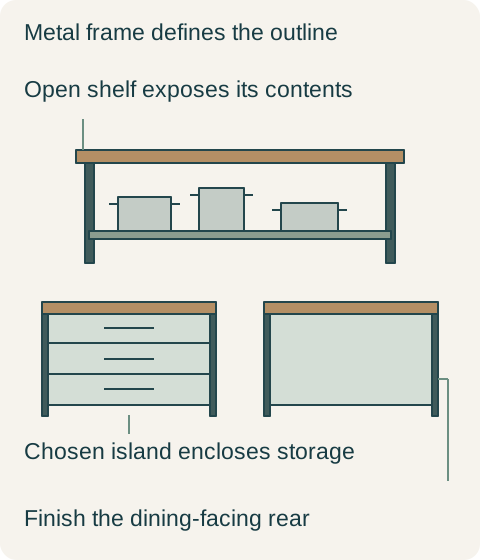
Teaching example Hypothetical purchase comparison: an open framed worktable above; front and rear views of the selected enclosed island below. No structural capacity or commercial rating is implied.
Choose an open frame because you want its contents visible
An open metal worktable may suit a household that wants frequently handled pans within direct reach and likes their appearance. It is a different living arrangement from a run of doors concealing mixed food packages and small tools. Put the real objects on the proposed shelf in the drawing. Then decide whether to buy open storage or a complete enclosed unit. Neither one becomes the better choice merely by being described as industrial.
The shape of the frame also affects the view through the room. A cross-brace can remain visible below an open shelf, while a solid back creates a more continuous surface toward the dining area. Compare that rear view before treating the front photograph as the entire design. A decorative frame wrapped around closed cabinets can provide the desired outline without asking the family to store everything on open shelves.
Separate a rugged look from the surface you touch
A rough-looking finish in a photograph can be a smooth printed surface, a textured coating or an actual irregular material. Those constructions are different purchases. For the proposed cabinet front, feel the surface and inspect the edge, reverse and handle area. Decide where tactile texture belongs. You may want it on a dining-facing feature while preferring a simpler surface on the doors opened throughout cooking.
The same distinction applies to metal. A dark metal appearance does not establish a particular alloy, protective coating or cleaning method. Select the actual finish and its care information. Do not treat intentional-looking unevenness as permission to accept an unfinished edge or a poorly fitted panel. The chosen industrial character should be present in the approved appearance, while the assembled cabinet still has clearly resolved joints and working openings.
Repeat the metal rhythm without making everything identical
Look at the large existing metal lines first, particularly window frames or a visible room divider. Then place the smaller marks: cabinet pulls, shelf brackets and light fittings. They need not all have an identical finish, but each should have a reason to appear. A line of modest dark pulls may connect to the window more effectively than adding several large metal accents that compete for attention.
An exposed stainless appliance can remain part of that composition. Choosing an industrial style does not, by itself, justify replacing a useful appliance with a commercial-looking model. Review the appliance as an actual product with its own installation requirements; the decorative theme cannot supply those requirements. Also test the elevation with normal countertop objects present, so the design does not depend on a permanently empty workspace.
Keep the metal outline, complete the enclosed island
In a hypothetical kitchen purchase, the owners like an island with a dark metal perimeter and a timber-colored top. The initial offer is an open framed worktable. They intend to put mixed food containers and small preparation tools underneath, yet the image they liked shows only a few carefully arranged pans. The visual reference and their storage plan describe different everyday scenes.
They compare a complete enclosed island with the same general metal outline. The new quotation identifies cabinet boxes, useful drawers, the accepted countertop assembly and a finished rear facing the dining area. The dark frame remains a visible accent, while the hand-contact surfaces are finished rather than deliberately rough. The existing window provides the other large metal outline; additional decorative pipe brackets are omitted.
The owners select the enclosed assembly. It costs and functions as a complete cabinet purchase, rather than as an attractive frame that still needs storage parts added. They accept losing the see-through view under the table in exchange for the concealed organization they actually need. The industrial appearance remains in the frame, top relationship and window rhythm, without claiming commercial performance for a residential kitchen.
Review the back, edges and moving parts before approving
View the accepted unit from the dining side and open every relevant storage compartment. Check which metal pieces are part of the supplied assembly and which are optional decoration. Keep the chosen surface, completed edges, rear treatment and opening hardware on the same order. A heavy-looking frame cannot substitute for that information. The finished kitchen should express the industrial character the owners liked while providing the enclosure and operation they deliberately chose.
Pure White
Cream White
Light Warm Gray
Gray
Navy
Black
Oak Tone
Dark Walnut Tone
Design study These finish studies are design references, not a list of currently orderable colors. Screens and lighting change the appearance; compare a physical sample before choosing.See all finish options →
Choose antiqued mirror for the reflected scene and concealed storage you want. Compare the full door group, its patterned surface and the view when it opens before replacing transparent glass.
The sample shows the door frame, a separate center panel, the face frame and the cabinet box. Each component has its own place in this Shaker construction.
Shaker construction: door frame, center panel, face frame and cabinet box. The cutaway helps locate these parts; confirm each material in the specifications for the selected cabinet.
01 / Door frame
The Shaker door has rails and stiles around a separate center panel. The frame and center panel are different components; confirm their materials in the specifications for the selected cabinet.
02 / Face frame
The face frame surrounds the opening at the front of the cabinet box and sits behind the doors. The face frame, door frame and cabinet box are separate parts.
03 / Cabinet box
The sample exposes the cabinet sides, interior surfaces and layered edges. The image does not establish the wood species or material specification of a selected cabinet.