Antiqued mirror cabinet doors: reflected room or visible collection?
Choose antiqued mirror for the reflected scene and concealed storage you want. Compare the full door group, its patterned surface and the view when it opens before replacing transparent glass.
An antiqued mirror cabinet door changes what the furniture presents to the room. Instead of showing plates and shelves behind transparent glass, an opaque mirrored insert presents reflections interrupted by its decorative pattern. Choose it when that combination serves the cabinet’s job. If the purpose is to enjoy a collection through closed doors, the mirror is a different design, even if the framed fronts look similar in a catalog.
Decide which side of the door should supply the scene
Start with the contents. A dining cabinet holding mixed serving equipment, folded linens and spare tableware does not have to become a display. Concealing those objects can be intentional. A cabinet bought to show inherited ceramics has the opposite task. Drawing identical framed doors over both arrangements disguises the decision: the insert determines whether the collection or the surrounding room becomes the visible subject.
Bendheim describes its VintageMirror Classic as opaque and states that its black reverse is not intended for viewing. Those details belong to this named product. Its decorative front is neither a transparent display window nor a finished mirror on both sides.
For a proposed opaque mirror, lighting inside the cabinet should serve access if needed; do not include it merely to illuminate a collection that the closed front conceals. Conversely, a transparent insert needs the contents, shelf edges and interior finish composed together. Compare these complete uses before choosing the more attractive loose glass chip. The mirror should not become an expensive way to discover that the original display brief has been abandoned.
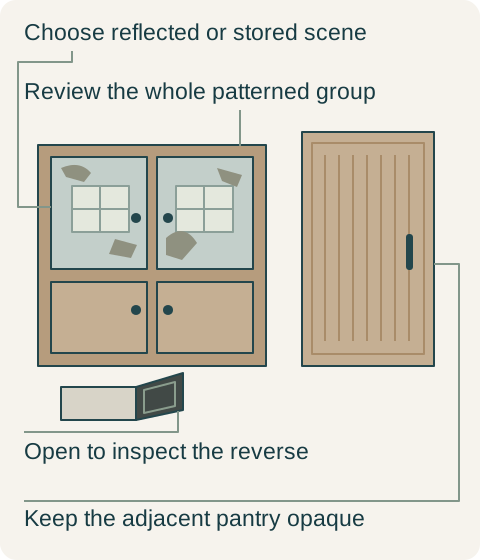
Teaching example Hypothetical dining cabinet: antiqued upper inserts show simplified room reflections, not the plates stored behind them. The open side detail shows a nondecorative reverse; the adjacent pantry stays opaque. Pattern and geometry are explanatory, not a manufacturer product drawing.
Read the reflection from the dining chair
A mirrored front does not choose an attractive subject by itself. View the proposed position while seated at the dining table and while approaching the cabinet. The reflected scene may include a window, artwork, an appliance or the normally occupied preparation counter. The same panel can look restrained from one position and visually busy from another. A frontal rendering with a pale invented reflection cannot settle that relationship.
Use a safely supported representative sample at the intended plane and compare ordinary daytime and evening conditions. Include the lamps and objects that normally remain in the room. For a larger group, a mockup should show the separate door frames and gaps: they divide the reflection into panels. Decide whether that fragmented scene is welcome. Do not assume that adding mirror creates usable space or guarantees a brighter room; evaluate the actual appearance you are buying.
Antique appearance is an agreed pattern, not an age claim
AGC explains that Mirold Morena obtains its antique appearance through controlled oxidation of its silver coating, with individual variation from hand production. This is a named manufacturing example, not evidence that every glass sold as antiqued uses the same process.
Select the amount and distribution of visible pattern you accept. A small swatch can fall in a relatively clear area while a full insert contains a much stronger dark patch. Compare representative areas over the full proposed group, and distinguish a deliberately varied arrangement from a requested continuous pattern. If matching or continuity is important, it must be an offered fabrication arrangement rather than an expectation created by repeating the same sample photograph.
The accepted decorative variation should not become permission to deliver a chipped edge, scratched viewing surface or loose insert. Keep the appearance reference separate from the completed-door condition. Likewise, a newly made antiqued mirror is not automatically a salvaged historic object. If provenance matters to the project, buy that provenance explicitly; do not infer it from mottling, a product name or an old-looking frame.
Open the door before approving the furniture
Review what faces the diner when someone retrieves a serving bowl. The reverse, retainers and edge treatment are part of that moment. If the selected mirror has a nondecorative back, decide with the fabricator how the finished door is supposed to look and operate. Do not improvise an extra lining simply to hide it: any additional assembly belongs in the completed front’s design and weight.
Buy a door system appropriate to the selected insert, including its actual glass construction and retention. A general supplier page about safety glass does not establish that a particular decorative mirror is available in that construction. Have the fabricator identify the accepted combination for this furniture. This article’s material examples do not prescribe a universal thickness, hinge arrangement or do-it-yourself glazing method.
A serving cabinet keeps storage closed and the reflection selective
In a hypothetical dining-room purchase, the owners first request transparent upper doors because they like the framed elevation. Their intended contents are assorted trays and table linens rather than a display collection. When they compare the cabinet at the dining position, ordinary clear mirror produces a reflection of the working kitchen that they find too prominent. A representative antiqued option gives the patterned, less continuous scene they prefer.
They choose antiqued inserts for the dining cabinet’s framed upper doors, with opaque wood lower storage. They decline a proposal to repeat mirror across the adjacent full-height pantry because its much larger reflected field dominates the view. The cabinet maker supplies the complete approved fronts, including the accepted rear appearance when open; the patterned areas are reviewed as a group before fabrication. The owners retain ordinary usable interiors rather than paying for a lit display they no longer want.
That choice trades a clear view of the contents for concealed everyday storage and a deliberate reflected scene. A household wanting to display ceramics should make the opposite choice and keep transparent fronts. Retain the accepted pattern range and door configuration for any later replacement, while recognizing that a replacement should be reviewed alongside the remaining inserts rather than assumed to reproduce their markings exactly.
Pure White
Cream White
Light Warm Gray
Gray
Navy
Black
Oak Tone
Dark Walnut Tone
Design study These finish studies are design references, not a list of currently orderable colors. Screens and lighting change the appearance; compare a physical sample before choosing.See all finish options →
A photograph or illustration can become a cabinet surface, but a print-ready picture and a usable set of doors are different deliverables. Plan both before ordering.
The sample shows the door frame, a separate center panel, the face frame and the cabinet box. Each component has its own place in this Shaker construction.
Shaker construction: door frame, center panel, face frame and cabinet box. The cutaway helps locate these parts; confirm each material in the specifications for the selected cabinet.
01 / Door frame
The Shaker door has rails and stiles around a separate center panel. The frame and center panel are different components; confirm their materials in the specifications for the selected cabinet.
02 / Face frame
The face frame surrounds the opening at the front of the cabinet box and sits behind the doors. The face frame, door frame and cabinet box are separate parts.
03 / Cabinet box
The sample exposes the cabinet sides, interior surfaces and layered edges. The image does not establish the wood species or material specification of a selected cabinet.