Wood leads white in the Houzz kitchen study. Should that change your cabinet order?
Read the actual cabinet-color result before replacing a white kitchen proposal with wood. A survey ranking can prompt a comparison, but the chosen finish still has to work with the room and the order.
A headline about wood cabinets overtaking white can make an otherwise settled kitchen choice feel suddenly wrong. It deserves a closer look, especially before you pay to revise an order. The useful response is to compare a specific wood option with the specific white option you already liked. A leading category in a remodeling survey is not a reason to discard a suitable finish, and it cannot tell you which wood appearance to buy.
Published January 13, 2026. Public information reviewed October 23, 2026; this is not a report of orders placed today.
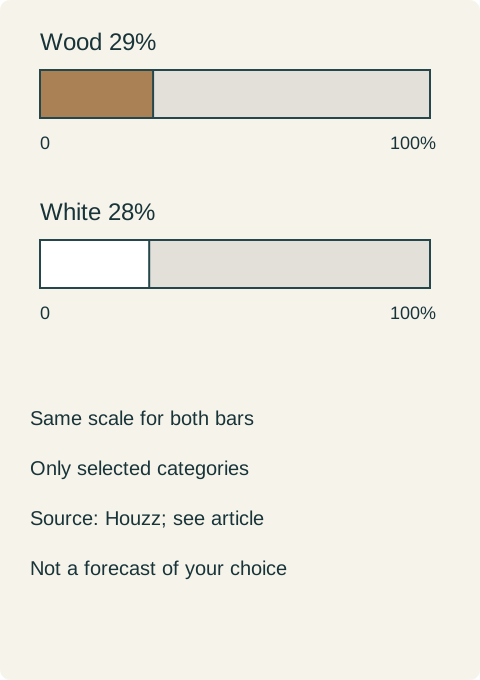
Houzz's 2026 study surveyed 1,780 U.S. homeowner users. Among respondents updating cabinetry in completed, current or planned 2025–26 remodels, wood color reached 29%; white reached 28% (pages 18 and 66).
That is a cabinet-color finding from a defined group of renovating people. It is not a nationwide sales total, a count of completed installations only, or a survey of everyone considering buying a house. The total study sample should not be presented as the exact number answering each individual chart unless that base is provided. Those differences matter when a headline gets repeated without its qualification.
The comparison below keeps both selected categories on the same scale. It does not include every response category. Do not turn it into a two-part pie chart, which would imply that the displayed options exhaust the choices. Nor should the small displayed separation be called a statistically proven advantage between those categories without a test supporting that specific claim.
A color result is not a construction specification
The everyday word wood can do several jobs in a sales conversation. It can refer to an appearance, a surface material, or an entire component. A color chart cannot resolve those meanings for an actual cabinet. When comparing a wood-looking front with a white front, identify the surface and the core separately, then ask what happens at the edge and on the reverse. That remains necessary even when the appearance is popular.
A photograph that attracts you might show a relatively even pale surface; the offered sample might have large contrasting streaks. They can both be described casually as wood, yet produce different rooms. The same is true of whites with different undertones and sheens. Do not let the broad ranking stand in for the more demanding comparison between the actual products available to your project.
Keep the proposed front shape and cabinet layout visible during that comparison. Changing the color, door profile, countertop and lighting at once makes it hard to know which change you prefer. Start with the existing proposal and change one important visual choice. After choosing a direction, resolve the complete combination rather than buying a door sample in isolation.
Diagram Selected cabinet-color responses from the cited Houzz study; identical scales. The chart does not show every category.
Use the news to test an alternative, not to forecast regret
A homeowner may reasonably ask whether a white kitchen will look dated. The report does not establish how that particular room will be perceived in the future. It also does not establish that the owner's present preference is mistaken. The cabinet will be used alongside the retained floor, appliances and furniture, long after the headline has left the screen.
Try a full-height sample or a representative view that shows the actual distribution of wood across the cabinet run. A small wood chip can seem pleasantly warm while an entire wall of strongly patterned doors feels much more active. Conversely, a white proposal can look quiet on a mood board but disconnected beside a floor with a pronounced warm tone. These are observations to make in the room, not qualities that the survey percentage can settle.
Also include the visible ends and any island surface facing the living area. If the alternative depends on a wood finish wrapping around a feature, confirm that those parts are in the proposal. Comparing the complete white order with a wood door-only price would make the change look simpler than it really is. Keep actual scope and actual appearance together.
A proposed white kitchen survives the comparison
Consider a hypothetical owner who has selected a warm white cabinet family for a kitchen with a retained oak floor and a wood dining table. After seeing the wood headline, the owner asks for an alternative using wood on all the new lower cabinets. The designer keeps the same cabinet configuration, working surface and appliances in both views, so this is a meaningful finish comparison.
The wood samples are attractive on their own. In the entrance view, however, the new lower fronts, older floor and dining table create three unrelated wood appearances. The owner also considers concentrating the new wood on a smaller group, but likes the original white run better because it gives the retained furniture a clearer place in the room. The decision is to keep the original cabinet finish, not to buy a token wood accent merely to follow the report.
Another owner with a plain floor and fewer retained wood surfaces could reach the opposite result. In either case, the news has been useful: it introduced an alternative worth testing. It has not supplied a universal answer. Record the actual sample and complete finish allocation that won the comparison, including why the rejected version was less suitable for this room.
Keep the final order stronger than the headline
If you do switch, request a revised complete selection with the changed fronts, visible sides, trim and hardware relationships identified. Confirm what has already been released for production before assuming a color change is still a simple substitution. A supplier's real order status and terms govern that discussion; an editorial article cannot make a change free or available.
Keep the dated report link in the inspiration folder, and the approved product information in the order folder. The first explains why you considered another direction. The second explains what you are buying. That separation allows the article to inform the purchase without making a national trend label do the work of a room-specific decision.
Pure White
Cream White
Light Warm Gray
Gray
Navy
Black
Oak Tone
Dark Walnut Tone
Design study These finish studies are design references, not a list of currently orderable colors. Screens and lighting change the appearance; compare a physical sample before choosing.See all finish options →
A cabinet color that looks warm online can read differently next to your floor. Compare an identified physical sample in the positions and lighting where the cabinets will live.
The sample shows the door frame, a separate center panel, the face frame and the cabinet box. Each component has its own place in this Shaker construction.
Shaker construction: door frame, center panel, face frame and cabinet box. The cutaway helps locate these parts; confirm each material in the specifications for the selected cabinet.
01 / Door frame
The Shaker door has rails and stiles around a separate center panel. The frame and center panel are different components; confirm their materials in the specifications for the selected cabinet.
02 / Face frame
The face frame surrounds the opening at the front of the cabinet box and sits behind the doors. The face frame, door frame and cabinet box are separate parts.
03 / Cabinet box
The sample exposes the cabinet sides, interior surfaces and layered edges. The image does not establish the wood species or material specification of a selected cabinet.