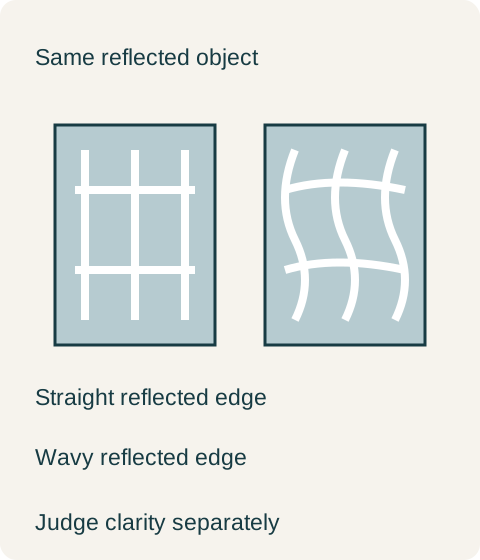
A cabinet door can be glossy and still reflect a wavy image
Compare reflection clarity separately from gloss level. A bright surface can meet a gloss criterion while showing distortion that matters on a long run of fronts.
When choosing high-gloss cabinet fronts, look at the shape and clarity of reflected objects as well as the amount of shine. A glossy door may reflect a bright window but bend or blur its edges. That is a different observation from a door that simply has less gloss. If a clean mirror-like appearance is important, include reflection quality in the sample decision instead of assuming the word high-gloss covers it.
Reflection brightness and image shape are different
BYK-Gardner distinguishes gloss, reflected-image clarity and surface waviness. Its appearance guidance explains how fine structures can blur reflected edges while larger visible structures create light-and-dark patterns often called orange peel. These are optical distinctions, not universal cabinet rejection limits.
A useful comparison places representative completed fronts in the same position relative to a stable light source and a straight-edged reflected object. Compare at the distance and direction relevant to the finished room, and retain a closer view for discussing a particular feature. Moving one sample into a more flattering position while leaving the other beside a strong reflection makes the comparison less useful.
Keep the surface being evaluated separate from temporary film, dirt or an uncertain sample condition. Use the supplier’s permitted preparation for the actual product before comparing the finished face. Do not polish, sand or remove an unfamiliar coating to create a better demonstration. The goal is to judge the offered completed component under a common condition, not to repair the sample during selection.
Teaching example Conceptual comparison of reflections on two glossy fronts. The distorted lines illustrate image shape, not measured flatness, a named product defect or a universal acceptance limit.
A glossy surface can still distort a reflected line
Suppose two hypothetical high-gloss door packages satisfy the agreed gloss criterion and have acceptable color. Viewed in the same proposed location, one visibly bends the reflected edge of a nearby window; the other preserves the straighter reflection the buyer prefers. The buyer chooses the second package and retains that completed sample as the reflection-quality reference. The first package is not described as low gloss. It was rejected for a different visible attribute.
In that hypothetical decision, the approved reference is compared under the agreed viewing condition. It is not a promise of perfect optical flatness under every flashlight angle or magnification. A project that needs an instrumental distortion or image-clarity criterion must define the appropriate method and limit before production. A glossmeter reading alone cannot be retroactively converted into that additional requirement.
The appearance does not identify the cause by itself
A wavy reflection is an observation, not a complete diagnosis. REHAU’s technical guide for RAUVISIO brilliant, for example, describes thermal overload of that adhesive-and-laminate system as a possible cause of orange peel or waviness. That product-specific explanation does not establish the cause of an unidentified cabinet surface.
When an approved front and a delivered front differ, record the material identity, location and comparable reflected object. Separate a pattern that remains with the part from a changing viewing condition. The fabricator can then assess the actual panel and process. Asking whether the observed waviness matches the approved sample is more useful than declaring the entire order defective from an unusually dramatic photograph.
Judge adjacent fronts together as well as individually. A single acceptable door may read differently in a continuous bank if neighboring surfaces produce noticeably different reflections. Keep the sample arrangement and accepted range relevant to the intended grouping. That does not require every natural viewing condition to be identical; it makes the comparison address the finished composition the buyer will see.
The purchase record should distinguish color, gloss level, reflection quality and visible surface defects. A favorable result for one does not close the others. For a buyer seeking a calmer appearance without prominent reflections, an approved lower-sheen package may be a separate design choice. It should be selected as that package, not used to conceal an unresolved difference in the high-gloss order.
Pure White
Cream White
Light Warm Gray
Gray
Navy
Black
Oak Tone
Dark Walnut Tone
Design study These finish studies are design references, not a list of currently orderable colors. Screens and lighting change the appearance; compare a physical sample before choosing.See all finish options →
A color name does not identify a finish system. Compare the decorative surface, the core, the edge and the repair method before choosing a cabinet front.
The sample shows the door frame, a separate center panel, the face frame and the cabinet box. Each component has its own place in this Shaker construction.
Shaker construction: door frame, center panel, face frame and cabinet box. The cutaway helps locate these parts; confirm each material in the specifications for the selected cabinet.
01 / Door frame
The Shaker door has rails and stiles around a separate center panel. The frame and center panel are different components; confirm their materials in the specifications for the selected cabinet.
02 / Face frame
The face frame surrounds the opening at the front of the cabinet box and sits behind the doors. The face frame, door frame and cabinet box are separate parts.
03 / Cabinet box
The sample exposes the cabinet sides, interior surfaces and layered edges. The image does not establish the wood species or material specification of a selected cabinet.