Hickory or oak cabinets: choose the character of the whole kitchen
Hickory can make contrast part of the design; oak offers a different grain vocabulary. Compare the actual species, selection and finish rather than buying either name as a cabinet-quality rating.
Choose hickory when its changing light and dark areas are something you want to see across the kitchen, not a feature you hope the installer will hide. Choose the offered oak alternative when you prefer its finished grain and distribution of color. Neither name settles the quality of the box, coating or hardware. The useful comparison is between complete fronts in the proposed selection and finish, with the character you accept carried through the exposed cabinet parts.
Hickory is a wood group, not a uniform brown
The Hardwood Manufacturers Association groups true hickories and pecan hickories together in commerce, describing light sapwood and brown heartwood. It also notes demanding machining and gluing characteristics. Hard wood therefore still needs careful manufacturing; it is not a shortcut to a well-made cabinet. When a salesperson emphasizes toughness, bring the discussion back to the completed door. A clean profile, sound assembly and appropriate finish remain part of what you are buying.
The same association describes red oak as generally straight-grained with coarse texture and a broad range of stain possibilities. Here, red oak is a defined comparison option, not a substitute label for every oak offered by every cabinetmaker. If the actual alternative is white oak, name it that way and examine its own sample. Moving between oak options while continuing to compare against the same hickory proposal can change the appearance and the quote at once.
KraftMaid distinguishes its Hickory from Rustic Hickory, selecting the latter for additional mineral streaks, tight knots and pecks. That manufacturer example shows why species and character selection deserve separate entries. Wanting pronounced light-and-dark wood does not automatically mean wanting every additional knot or mark in a rustic selection. Equally, a rustic sample is not evidence that the standard selection will look the same. Ask for the option you actually intend to live with, then judge that group.
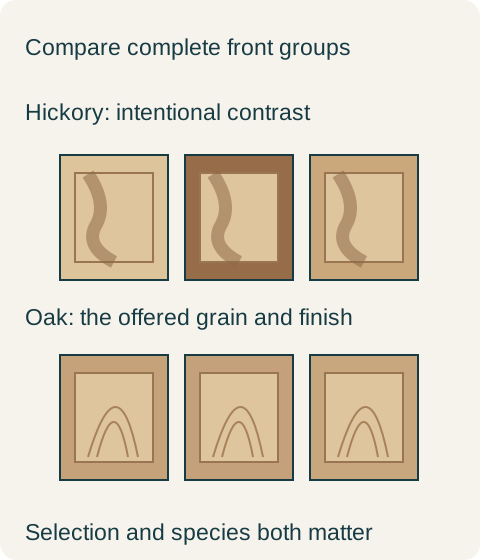
Teaching example Hypothetical finish-group study. The upper group illustrates accepted light/dark contrast; the lower group illustrates a different grain rhythm. These colors are not species identification, a grading rule or an orderable finish range.
A hickory choice can be deliberate rather than accidental
Consider a hypothetical family comparing lightly finished hickory with red oak in the same offered door profile. They want the cabinetry to be the room’s main visual feature and like the hickory group, including its pale and brown areas. They choose the standard hickory selection, while declining the more heavily marked rustic option they were also shown. Their countertop and backsplash choices remain visually quiet. The purchase is hickory with accepted contrast, not a request for the supplier to deliver only the brown sections of the sample.
That choice changes how the group should be evaluated. A dark rail beside a pale panel is not automatically an ordering mistake if it belongs to the agreed selection. But agreeing to natural contrast does not excuse an unrelated damaged edge or a different finish. Keep the physical reference and the component identity together so that a later question can distinguish expected wood character from an actual departure. A broad approval should describe the character accepted, not waive inspection of the delivered work.
Keep the comparison recognizable after staining
A stain can make two species look closer in color while leaving their grain and local contrast visible. Compare the finished alternatives offered for the project, not raw lumber on one side and a dark finished door on the other. If the desired hickory sample is acceptable only after a different coating is imagined over it, the present proposal has not met the preference. Obtain that finished option before choosing, or select the oak proposal already shown in a finish you like.
Look at the front from the place where the whole kitchen will usually be seen. A cabinet beside a busy floor, patterned counter and open shelves contributes to a different composition than the same cabinet against plain surrounding surfaces. There is no rule that hickory belongs only in rustic rooms. The practical question is how much visible activity the household wants. In the hypothetical kitchen, the owners intentionally give the fronts that role; another household can reasonably choose the quieter offered oak group without calling hickory inferior.
Do not buy the species name for hidden components
Keep the visible door selection separate from the cabinet body. A quote for hickory fronts may use other materials for the box, shelves and drawer bottoms. Changing the front species does not demonstrate that those parts changed. This matters when comparing prices: an upgrade that includes different interiors, drawer construction or decorative ends cannot be explained entirely as a wood-species premium. Compare the same cabinet arrangement and component scope before deciding what the additional amount buys.
Evaluate large exposed ends with the fronts if their appearance will sit side by side. The cabinetmaker may use a different surface construction there, and the relationship needs to work as a finished composition. The decision is not improved by demanding that a broad panel imitate the exact pattern of a narrow frame member. It is improved by approving the actual proposed treatment and deciding whether the neighboring parts belong together in the room.
The preferred group is more useful than a hardness contest
A species hardness figure cannot describe coating scratches, door alignment or the support beneath a shelf. Those are different parts of cabinet performance. Select the hickory or oak appearance that works for the room, then evaluate the specified assembly on its own terms. In this comparison, the owners buy standard hickory because they want its character and have accepted the finished group. They do not pay for an invented promise that its name makes every cabinet component stronger.
Pure White
Cream White
Light Warm Gray
Gray
Navy
Black
Oak Tone
Dark Walnut Tone
Design study These finish studies are design references, not a list of currently orderable colors. Screens and lighting change the appearance; compare a physical sample before choosing.See all finish options →
Compare the actual countertop products, heat-source routine and fabrication proposal. A fired porcelain slab and resin-bound quartz are different materials, but neither label replaces a complete kitchen specification.
The sample shows the door frame, a separate center panel, the face frame and the cabinet box. Each component has its own place in this Shaker construction.
Shaker construction: door frame, center panel, face frame and cabinet box. The cutaway helps locate these parts; confirm each material in the specifications for the selected cabinet.
01 / Door frame
The Shaker door has rails and stiles around a separate center panel. The frame and center panel are different components; confirm their materials in the specifications for the selected cabinet.
02 / Face frame
The face frame surrounds the opening at the front of the cabinet box and sits behind the doors. The face frame, door frame and cabinet box are separate parts.
03 / Cabinet box
The sample exposes the cabinet sides, interior surfaces and layered edges. The image does not establish the wood species or material specification of a selected cabinet.