Red oak and white oak can both be appropriate cabinet materials. Choose between the actual finished options in the proposed cabinet series, with the material identity recorded separately from the stain name. A paler door does not by itself prove white oak, and a red oak proposal is not automatically a lower-quality cabinet.
The names do not identify a finished door by color
The Hardwood Manufacturers Association describes red oak as generally similar in appearance to white oak and notes a wide range of stain tones for red oak. Its white oak description includes light-to-dark brown heartwood. AHEC explicitly notes that red oak wood is not always red. These descriptions make color alone a weak basis for accepting or disputing the wood identity in a finished order.
AHEC describes multiple members within each commercial oak group. Consequently, a red oak or white oak designation identifies a material group rather than a promise that every piece has identical color or figure. Ask for that designation in the material schedule; use the completed sample to judge appearance. A photograph or stain swatch should not replace the producer’s material record.
Treat a finish name such as natural oak or white oak tone as a coating description unless the quotation also identifies the underlying wood. The HMA profiles describe staining both groups successfully, so a stained color is not confined to the species suggested by its name. Record wood group and finish code in separate fields. If appearance is the priority, compare both samples under the intended lighting; if white oak itself is required, retain that identity even when another sample looks similar.
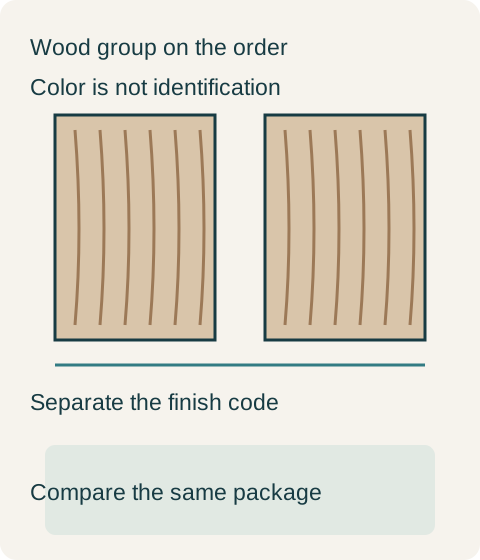
Teaching example Conceptual similar-looking fronts and separate order fields illustrate why appearance, wood identity and finish code should be recorded separately. Not a species-identification chart or actual sample.
A warmer red oak sample can meet the brief better than mixed white oak
Suppose a hypothetical kitchen calls for visibly straight grain and accepts a warm stained tone. A red oak proposal includes selected straight-grained frame stock and a coordinated veneer panel; its finished door sample meets the brief. A white oak alternative has broader mixed figure and no matching selection requirement. The buyer chooses the red oak package, preserving its component selection and finish sample. The decision buys the requested appearance instead of paying for a species name that does not resolve the grain requirement.
That example turns on the specified package, not a general rule that red oak is better value. When a series offers both woods with the same accepted appearance selection, compare the same door model, finish process, cabinet construction and quantity schedule. If one option requires a different door line, an added color-matching process or different companion pieces, show those changes separately from the wood substitution.
Price the same series and the same order
Request paired quotations from the same supplier and quote date. Identify the total change for the complete cabinet order and any separately priced material-selection or finish work. Neither an industry description of timber abundance nor an online species ranking establishes today’s cabinet price. White oak can be the right purchase when its actual sample or specified identity is important; the amount worth paying depends on the offered package, not a universal premium.
Grain selection remains an additional specification, but the detailed distinctions between ray fleck, rift and quarter cuts are addressed in the related guide. Keep this purchase decision focused on which wood group is supplied, which finished appearance is accepted and what changes in the quote. Matching those records makes a later substitution visible even when the replacement has a similar stain color.
Pure White
Cream White
Light Warm Gray
Gray
Navy
Black
Oak Tone
Dark Walnut Tone
Design study These finish studies are design references, not a list of currently orderable colors. Screens and lighting change the appearance; compare a physical sample before choosing.See all finish options →
Oak is a species choice; the visible grain still needs a decision. Compare broad arches, ray fleck and straighter patterns on complete finished fronts.
A painted door, a wood-grain side and a plywood cabinet box can belong to the same cabinet. Here is how to read those parts, what the sample photos actually show, and which details to put on a quote.
The sample shows the door frame, a separate center panel, the face frame and the cabinet box. Each component has its own place in this Shaker construction.
Shaker construction: door frame, center panel, face frame and cabinet box. The cutaway helps locate these parts; confirm each material in the specifications for the selected cabinet.
01 / Door frame
The Shaker door has rails and stiles around a separate center panel. The frame and center panel are different components; confirm their materials in the specifications for the selected cabinet.
02 / Face frame
The face frame surrounds the opening at the front of the cabinet box and sits behind the doors. The face frame, door frame and cabinet box are separate parts.
03 / Cabinet box
The sample exposes the cabinet sides, interior surfaces and layered edges. The image does not establish the wood species or material specification of a selected cabinet.