Hettich’s Illumination update: compare the generation before changing a wood drawer
The SICAM announcement separates a lighting upgrade from replacing the drawer box. Check which generation is actually offered, then decide whether its light and charging routine fit the furniture.
Hettich’s Illumination update gives buyers a reason to examine drawer lighting separately from the drawer box. A useful wood drawer should not be replaced solely because an illuminated showroom sample has metal sides. Equally, the familiar product-family name does not establish that a quoted lighting kit includes the features of the announced generation. Compare the actual kit and completed drawer before choosing the upgrade.
This analysis reviews public manufacturer information observed on October 23, 2026. The announcement discussed below is earlier news; it does not confirm current local inventory or a supply relationship with usaKT.com.
Hettich’s October 1, 2025 SICAM release describes rechargeable Illumination with USB-C charging, no magnet and selectable 2,700 K or 4,000 K light. It announced the new generation for wooden drawers from 2026. These are the release’s stated features and timing.
Wood-drawer lighting itself predates that announcement: Hettich’s US awards page identifies AvanTech YOU Wood Drawer Illumination under its 2024 KBB lighting award. The later release therefore should not be presented as the first possibility of lighting a wood drawer.
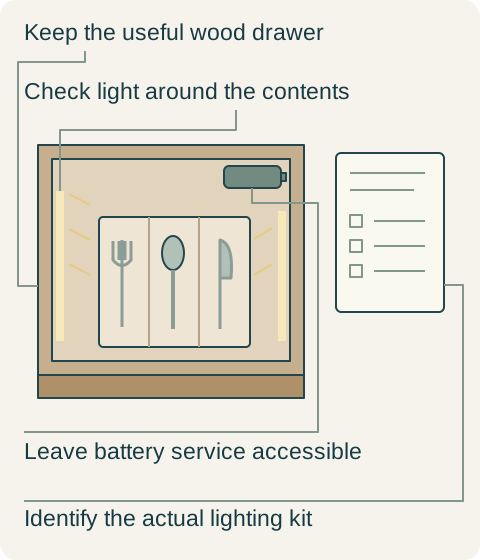
Teaching example Hypothetical wood drawer with side lighting, an organizer and a removable battery location. The separate document symbol represents the offered kit identity. This is not an installation drawing or a depiction of a specific Hettich component layout.
A family name is not a specification
The accessed Hettich regional catalog entry for article 9326927 lists 4,000 K light, a magnet and a micro USB B charging cable. That named entry does not describe the same feature set as the SICAM update. It is not evidence of US stock.
Neither document should overwrite the other. A buyer who wants a particular charging connector or selectable light color needs those features tied to the offered item and instructions. Calling a kit Illumination does not resolve the difference. Nor does a photograph of an illuminated wood drawer establish that the kit for a metal side profile can be attached unchanged to an existing wood box.
Keep the storage you like while evaluating the added light
Place the proposed lighting arrangement on the drawer drawing with its actual organizers and tallest contents. Check the available mounting surfaces, closed clearance and removal route for the battery. A drawer that fits the utensils before lighting is added may need its organizer rearranged afterward. Retaining the box is worthwhile only if the completed arrangement still provides the storage that made the box useful.
Review the light with those contents in place. An attractive line along the side can remain visible while a tall divider shadows the object being sought. Compare from the normal standing position and with the kitchen’s usual lighting, including the evening condition that motivated the purchase. Warm or neutral describes color appearance; it does not by itself demonstrate useful coverage, adequate visibility or a preferred result for every household.
A rechargeable solution also includes a recurring task. Have the supplier show the permitted battery removal and charging procedure on the proposed assembly. Decide where charging will occur and who will do it. Do not turn the phrase no plug into a promise of no charging, or assume the lighting battery is a power source for phones. A drawer-light upgrade and an in-drawer device-charging outlet solve different problems.
The owner keeps the wood box and buys only the useful upgrade
In a hypothetical kitchen, a wood utensil drawer already fits the owners’ preferred organizer. They want better visibility during evening use and initially consider replacing the complete drawer with an illuminated metal system. A supplier instead presents a documented wood-drawer lighting configuration with the charging connection and selectable light color they requested. The demonstration confirms closed clearance, usable illumination and accessible battery removal with their organizer present.
They retain the wood drawer and select that complete lighting configuration. They reject a superficially similar kit whose documented features omit the requested selection, rather than assuming the announcement updates every product sold under the same name. They also keep the kitchen’s general lighting: this local drawer light is not purchased to illuminate the room. Their choice accepts occasional battery handling in exchange for the demonstrated drawer improvement.
For a household unwilling to recharge another item, the same review can end with keeping the unlit drawer and improving the room’s existing lighting instead. The news makes a more specific comparison possible; it does not make an upgrade mandatory. Preserve the offered item identity, compatible wood-drawer arrangement and accepted operation together so the delivered kit corresponds to the features that justified the purchase.
Pure White
Cream White
Light Warm Gray
Gray
Navy
Black
Oak Tone
Dark Walnut Tone
Design study These finish studies are design references, not a list of currently orderable colors. Screens and lighting change the appearance; compare a physical sample before choosing.See all finish options →
Choose the event that should turn a cabinet light on before buying a sensor. Door position, deliberate hand control and timed motion detection serve different routines.
A metal-sided drawer is a coordinated box system; a wood box can run on concealed metal hardware. Decide what should be visible, what must fit and which complete assembly the quote actually supplies.
The quarter’s current-activity and near-term readings pointed in different directions. For cabinet businesses, that distinction matters when choosing between preparing for demand and committing to additional inventory.
The sample shows the door frame, a separate center panel, the face frame and the cabinet box. Each component has its own place in this Shaker construction.
Shaker construction: door frame, center panel, face frame and cabinet box. The cutaway helps locate these parts; confirm each material in the specifications for the selected cabinet.
01 / Door frame
The Shaker door has rails and stiles around a separate center panel. The frame and center panel are different components; confirm their materials in the specifications for the selected cabinet.
02 / Face frame
The face frame surrounds the opening at the front of the cabinet box and sits behind the doors. The face frame, door frame and cabinet box are separate parts.
03 / Cabinet box
The sample exposes the cabinet sides, interior surfaces and layered edges. The image does not establish the wood species or material specification of a selected cabinet.