Metal drawer system or wood drawer box: compare the complete interior
A metal-sided drawer is a coordinated box system; a wood box can run on concealed metal hardware. Decide what should be visible, what must fit and which complete assembly the quote actually supplies.
Choose between a metal drawer system and a wood drawer box by the complete supplied assembly, including the interior you will see when it is open. Metal sides do not mean the whole container is metal, and a wood box does not mean old-fashioned visible slides or the absence of soft closing. Both can sit behind a coordinating decorative front. The useful choice combines the desired appearance with actual storage fit, operating behavior and a clear supply scope.
Two different ways to build the moving container
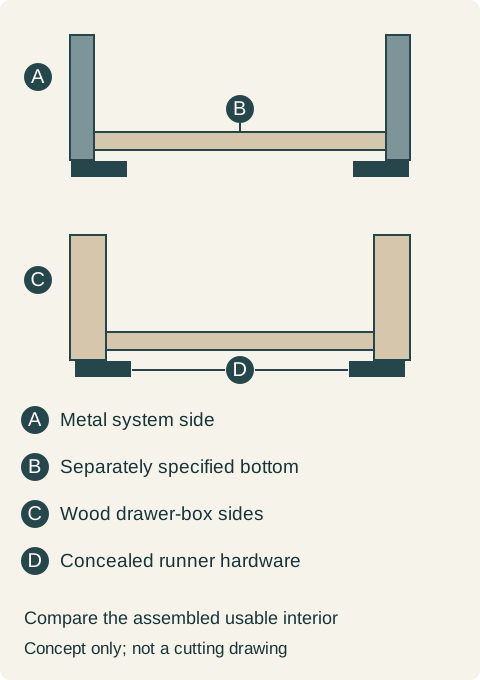
A wood drawer box has a fabricated container whose sides, back, front arrangement and bottom are selected by its maker. The runner system supports and moves that box. Its corner construction may be visually important, but the runner is a separate part of what the buyer receives.
Blum describes MOVENTO as a concealed runner system for wood drawers, with full extension and supported opening or closing technologies. A wood drawer therefore need not expose a side-mounted rail when opened.
A metal box system uses its matched sides and connecting components as part of the drawer construction. The metal side is more than a decorative lining placed inside an otherwise complete wooden container. Changing to that system is not simply changing the color of the runners beneath an unchanged drawer.
Blum's LEGRABOX component sheet separately specifies the drawer bottom, back and front preparation. The named metal system still requires those components to be coordinated; the side material does not identify the entire drawer.
That distinction should be visible in the quote. Ask what material and finish are supplied for the bottom and back, how the chosen front belongs to the assembly, and which hardware family is included. A photo of a beautiful metal side cannot fill in those missing lines.
Separate the kitchen front from the open-drawer appearance
Blum's US LEGRABOX details explicitly allow custom wood fronts. The exterior furniture appearance can therefore differ from the material seen inside this named drawer system.
A traditional-looking cabinet front does not force a wood box, just as a flat modern front does not force a metal interior. Look at the kitchen closed and then open a representative drawer. The contrasting interior may be welcome, or the owner may prefer visible wood and its joinery. That is a legitimate appearance preference without turning either one into a universal quality ranking.
Include shallow utensil drawers and deeper storage drawers in the review. Their sides may differ in height and construction within a system, so a single shallow sample should not be treated as the promised appearance of every drawer. A high decorative front also does not by itself create high containment behind it.
If the open drawer will be visible from an adjoining room, view the side, back and any fitted organizers together. A matching side finish does not mean the bottom or accessory will match it. Decide whether contrast is intentional before accepting a photograph of only the front corner.
Teaching example Conceptual cross-sections with fronts and backs omitted: metal system sides and a separately specified bottom above; wood sides and bottom on concealed runners below. The drawn thicknesses and gaps are not dimensions or evidence of a capacity advantage.
Compare the space occupied by real contents
Slim sides can look spacious, but usable capacity is a result of the complete installation. Cabinet sides, the opening, runners, drawer walls, rear construction and the selected bottom position all matter. Do not convert the apparent difference in side thickness into an automatic gain across the whole kitchen.
Use the same contents and the same cabinet location for both proposals. A utensil tray needs the actual clear footprint; a pot also needs height and a removal route. An existing organizer that fits one interior should be checked anew in the other. Its shape may sit above a joint or against a tapered or raised detail that is invisible in the nominal cabinet width.
Containment is a separate question from total volume. A deep front with low sides may not keep a tall collection arranged as the user expects. A taller side, rail or permitted insert changes that proposal. Compare the assembly that will be delivered, rather than a bare sample for one candidate and a fully organized drawer for the other.
A wood interior can be the deliberate final choice
Consider a hypothetical kitchen where both offered assemblies accommodate the same utensil collection and cookware allocation. Each has documented support for the intended use, and the normal opening and closing trial is acceptable. The metal proposal is not rejected for performance; it simply provides no storage improvement that this household needs.
The owners prefer the visible wood interior. They choose the maker's specified wood boxes on the quoted concealed runners, with the compatible removable utensil trays demonstrated in that interior. The decorative fronts remain the same as in the metal proposal. The purchase preserves an open-drawer appearance they value without giving up the operating features actually included in this particular wood configuration.
They also decline a later substitution to a different box merely described as premium. Any replacement proposal must retain the approved interior fit and actual hardware combination. The original choice was not a request for any object made of wood; it named the supplied box, bottom, runners and organizer arrangement.
Another household may prefer the coordinated metal interior or a particular supported accessory arrangement. That can justify choosing the metal system after the complete fit is compared. Neither outcome needs a claim that dovetails always outperform metal connectors, or that a metal drawer automatically stores more.
Accessories and replacements belong to the chosen assembly
Treat fitted dividers, inner fronts, rails and other system components as identified parts. A removable tray can be compared by its actual fit, while an attached system accessory also needs compatibility with the specified hardware family and configuration. Similar colors and nominal lengths do not establish that relationship.
For an existing kitchen, changing from wood boxes to metal sides may require new drawer components and cabinet coordination. Do not assume the old front attachments or concealed runners can remain. Equally, ordering a new wood box around the old front width is insufficient if it has to engage an existing runner system.
Retain the supplier's instructions for normal removal and service, along with the exact component identity. An adjustment feature is useful only within the supplied assembly; it does not make unrelated fronts or parts interchangeable. This buying review is not an invitation to release clips or dismantle a loaded display drawer.
Compare installed drawers, not hardware cartons
A hardware kit and a finished drawer are different purchase scopes. Clarify who supplies and prepares the bottom, back and decorative front, who assembles the system, and whether the quoted price includes fitting it to the cabinet. The word kit should not hide work or materials that another party still has to provide.
Then compare the same number and types of completed drawers, with the selected organization and opening functions. Price differences may reflect several choices at once; do not attribute the whole difference to metal versus wood. Keep the bottom and assembly load requirements in the specification without borrowing a runner rating as a complete-drawer allowance.
The final order should make the open interior as clear as the closed front. With contents, operating behavior, appearance and supplied components resolved, the buyer can choose either construction for a concrete reason rather than buying the most impressive label.
Pure White
Cream White
Light Warm Gray
Gray
Navy
Black
Oak Tone
Dark Walnut Tone
Design study These finish studies are design references, not a list of currently orderable colors. Screens and lighting change the appearance; compare a physical sample before choosing.See all finish options →
A painted door, a wood-grain side and a plywood cabinet box can belong to the same cabinet. Here is how to read those parts, what the sample photos actually show, and which details to put on a quote.
Dovetails interlock shaped wood; doweled corners connect parts through fitted holes. Judge the corner and the complete drawer separately before paying for a construction label.
The sample shows the door frame, a separate center panel, the face frame and the cabinet box. Each component has its own place in this Shaker construction.
Shaker construction: door frame, center panel, face frame and cabinet box. The cutaway helps locate these parts; confirm each material in the specifications for the selected cabinet.
01 / Door frame
The Shaker door has rails and stiles around a separate center panel. The frame and center panel are different components; confirm their materials in the specifications for the selected cabinet.
02 / Face frame
The face frame surrounds the opening at the front of the cabinet box and sits behind the doors. The face frame, door frame and cabinet box are separate parts.
03 / Cabinet box
The sample exposes the cabinet sides, interior surfaces and layered edges. The image does not establish the wood species or material specification of a selected cabinet.