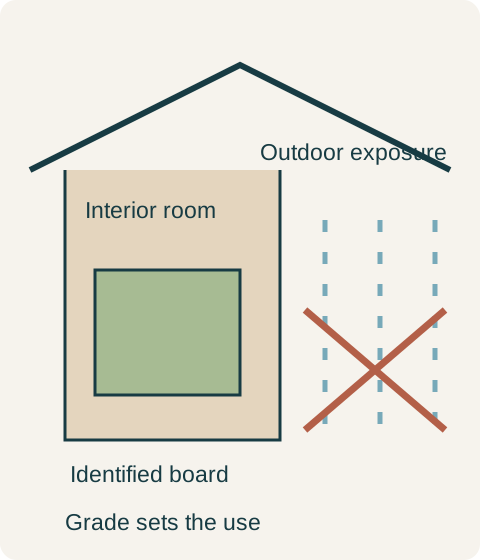
Choose MDF for the environment identified in its product documentation, not by the color visible at a cut edge. A moisture-resistant interior board is not automatically suitable outdoors or for repeated wetting. Before comparing prices, decide whether the component will remain in a protected interior or be exposed outside. Those are different specifications even if the finished doors look alike.
What a named manufacturer actually says
MEDITE identifies MR as an interior humid-condition board, not waterproof or exterior grade. Its FAQ also says the green dye identifies the product rather than providing performance. These statements concern MEDITE MR, not every green panel.
A green edge is an appearance observation. It does not name the mill, product grade, intended exposure or finished construction. An invoice that records only green MDF therefore leaves the relevant question open. Use the actual product designation as the link between the material supplied and the document being evaluated. A generic photograph cannot replace that link, and a dyed sample cannot demonstrate how an assembled door behaves around seams and cutouts.
For selection purposes, describe the exposure in plain terms. A cabinet in an enclosed room, a component repeatedly splashed during washing and a door on an open covered porch are not the same brief. The word covered describes a roof; it does not turn the surrounding environment into a conditioned interior. Also identify any exposed edges or machining after finishing, because a face-only appearance approval does not describe the complete component.
Teaching example Conceptual exposure comparison. A roof does not convert an outdoor cabinet into an interior application; board color is not a performance scale.
A completed choice for an enclosed room and a porch
Imagine a buyer who wants matching doors for an indoor utility cabinet and a covered outdoor serving station. The proposed material is documented as interior MR MDF. The buyer keeps that material under consideration for the indoor cabinet and rejects its transfer to the porch specification. The outdoor portion is changed to a separately documented exterior assembly, or removed from this order until one is defined. The decision does not rely on adding ordinary paint and calling the original board waterproof. Matching appearance remains a design goal, but it no longer overrides the exposure category.
Keep the board identity beside the coating system, edge treatment and component location. If a substitution changes the board but keeps the paint color, review it as a material change. Conversely, a different core color is not by itself proof of inferior performance; establish the product first. This makes the comparison concrete without pretending that a buyer can certify a board by inspecting its edge.
The useful comparison ends with a component assigned to an identified board, exposure and complete finish. If an exterior assembly is required, treat it as its own selection rather than upgrading an interior panel with an adjective. The indoor and outdoor doors may still coordinate visually, but the order now records why their constructions differ.
Pure White
Cream White
Light Warm Gray
Gray
Navy
Black
Oak Tone
Dark Walnut Tone
Design study These finish studies are design references, not a list of currently orderable colors. Screens and lighting change the appearance; compare a physical sample before choosing.See all finish options →
Judge a painted MDF door by its actual profile, finished edges and construction, with a sample that represents the size and details you intend to order.
A painted door, a wood-grain side and a plywood cabinet box can belong to the same cabinet. Here is how to read those parts, what the sample photos actually show, and which details to put on a quote.
A plywood bond label addresses a particular panel and exposure classification. It does not establish the moisture performance of the finish, joints, hardware or complete cabinet.
The sample shows the door frame, a separate center panel, the face frame and the cabinet box. Each component has its own place in this Shaker construction.
Shaker construction: door frame, center panel, face frame and cabinet box. The cutaway helps locate these parts; confirm each material in the specifications for the selected cabinet.
01 / Door frame
The Shaker door has rails and stiles around a separate center panel. The frame and center panel are different components; confirm their materials in the specifications for the selected cabinet.
02 / Face frame
The face frame surrounds the opening at the front of the cabinet box and sits behind the doors. The face frame, door frame and cabinet box are separate parts.
03 / Cabinet box
The sample exposes the cabinet sides, interior surfaces and layered edges. The image does not establish the wood species or material specification of a selected cabinet.