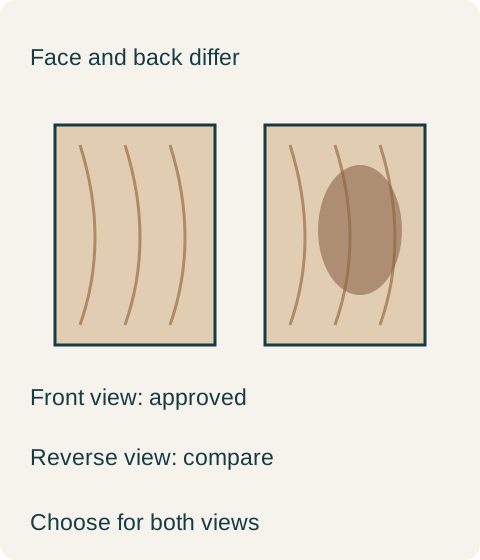
For a furniture divider or cabinet part seen from both sides, specify the appearance required on each side. A hardwood-plywood grade such as A-1 is not a single score for the entire board. Nor does the first designation automatically describe every exposed surface. The useful buying question is which surface will face each viewing position and whether its approved appearance is suitable there.
Columbia Forest Products explains that decorative plywood normally lists face appearance first and back appearance second, using letters and numbers respectively. In A-1, A describes the face and 1 the back. Its guide treats core construction separately.
That notation does not say the back is another A face. The categories have their own criteria. It also does not identify the core species, ply construction or the finished panel’s capability in a particular assembly. Keep those specifications separate so that an attractive face is not used as evidence for an unverified construction claim.
Back is a manufacturing designation, not an instruction to hide that surface. A panel used as a divider may expose its reverse to the room. A cabinet side can show inside an open compartment even if its outward face is the first thing a shopper notices. Map the actual views before deciding where a different appearance is acceptable.
Teaching example Hypothetical appearance comparison. The patch represents a buyer preference, not a defect limit or an illustration of a particular formal grade.
The divider and the concealed panel need different appearances
Suppose a hypothetical project includes a freestanding divider and a wall-facing cabinet panel. The proposed panel has a front sample the buyer likes, but its separately presented reverse has a strong color patch the buyer does not want in the divider’s second view. The buyer assigns that construction to the wall-facing panel, where the reverse will be hidden, and selects a separately approved panel with acceptable appearance on both sides for the divider. The chosen orders state each side’s species, grade or agreed appearance requirement and the selected core.
In this hypothetical choice, the buyer does not reject the first panel as falsely graded merely because its reverse looks different. Compliance with a grade and suitability for a particular visible location are separate questions. The divider needs a different appearance specification; the concealed location does not need to purchase the same visible-surface selection if its full construction remains appropriate.
Use the sample to settle appearance, not to invent a grade
Review both sides of a representative finished sample, identified as face and back. The coating and lighting used for comparison should represent the intended appearance. A small attractive area cannot establish the range allowed across an entire delivery, and a photograph alone should not be used to assign a formal veneer grade.
A proposed change from A-1 to another face/back combination must identify which side changes and where that side is used. It should not be described merely as an equivalent cabinet-grade board. The change might be acceptable for a concealed reverse but unacceptable for the divider, even when the core and thickness stay the same.
The order is complete when its appearance requirements and component orientation agree. Keep the reverse specification with the face specification through fabrication and receiving. This prevents a panel that is perfectly usable in one location from being rotated into a prominent view where its approved appearance was never intended.
Pure White
Cream White
Light Warm Gray
Gray
Navy
Black
Oak Tone
Dark Walnut Tone
Design study These finish studies are design references, not a list of currently orderable colors. Screens and lighting change the appearance; compare a physical sample before choosing.See all finish options →
Hardwood plywood can have a veneer, fiberboard or particleboard core. Choose the core for the actual component, then verify the complete panel and connection details.
The hidden back of a veneered panel is part of its construction. Specify it with the face, core and bonding method before assuming a decorative panel will remain flat.
The sample shows the door frame, a separate center panel, the face frame and the cabinet box. Each component has its own place in this Shaker construction.
Shaker construction: door frame, center panel, face frame and cabinet box. The cutaway helps locate these parts; confirm each material in the specifications for the selected cabinet.
01 / Door frame
The Shaker door has rails and stiles around a separate center panel. The frame and center panel are different components; confirm their materials in the specifications for the selected cabinet.
02 / Face frame
The face frame surrounds the opening at the front of the cabinet box and sits behind the doors. The face frame, door frame and cabinet box are separate parts.
03 / Cabinet box
The sample exposes the cabinet sides, interior surfaces and layered edges. The image does not establish the wood species or material specification of a selected cabinet.