Why a veneered cabinet panel needs a specified back face
The hidden back of a veneered panel is part of its construction. Specify it with the face, core and bonding method before assuming a decorative panel will remain flat.
A hidden back face can matter even when nobody will see it. Veneer, core and backer form a bonded panel, and their responses to manufacturing and moisture affect its shape. Specify the reverse face with the decorative face rather than assuming that an unfinished or cheaper-looking back is irrelevant. Balanced construction concerns the panel through its thickness; it is separate from matching the grain pattern across the front.
A backer is not the back wall of the cabinet
Here, backer means the material bonded to the reverse side of an individual panel. It might be on the wall-facing side of a decorative end panel or the inner face of a slab door. The cabinet's rear closing panel is a different component. Ask for a section through the exact part so that everyone discussing the back means the same surface.
Nor does balanced construction require identical appearance on both sides. A visible face may need a carefully selected veneer while the hidden reverse has a less decorative appearance. The important question is whether the maker has specified compatible materials and a suitable bonded assembly. Columbia's specification notes typical same-species face and back construction while allowing compatible alternatives to be reviewed. That is an assembly question, not permission to substitute any spare sheet.
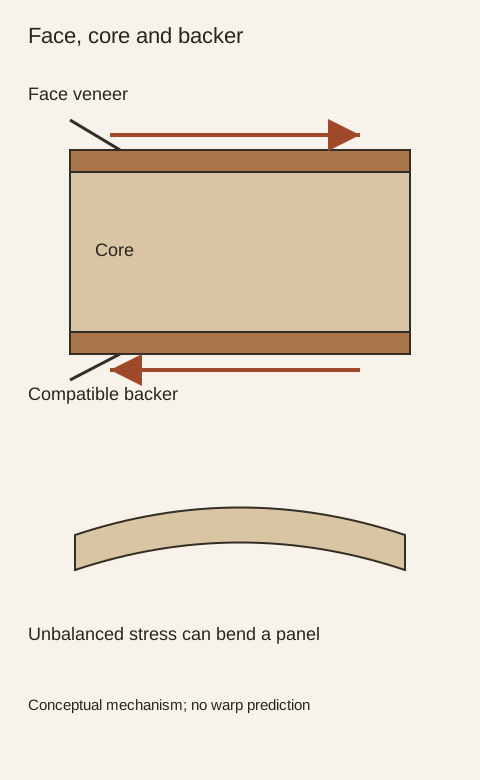
Diagram The arrows represent opposing surface stresses conceptually. The curved section is not a prediction, acceptance tolerance or measurement of a real cabinet part. Prepare and save project notes →
The mechanism is unequal movement
Wood responds to changes in moisture. When layers bonded together want to change dimensions differently, the bond restrains that movement and internal stresses develop. A surface layer can pull on its core rather than moving freely. The USDA discussion of bonded wood explains why moisture differences, grain direction and material compatibility affect the bond and the surrounding wood.
A corresponding reverse layer helps balance the stresses associated with the face. VeneerSupplies explains that back veneer is relevant during adhesive drying as well as later humidity changes. This is a reason to specify the complete layup, not a promise that adding a thin sheet to an already distorted panel will flatten it. Adhesive, surface preparation, pressing and moisture conditions remain part of the manufacturer's work.
The right question is broader than same color or same thickness
Ask what the face and reverse are made from, how they are backed and which core they are bonded to. A raw wood veneer, a paper-backed veneer and a decorative laminate are not interchangeable merely because a ruler shows a similar thickness. Their construction and bonding recommendations can differ. A matching color on the reverse says little about these properties.
Likewise, a thicker core may resist bending without making the surface combination appropriate. A fastening pattern can restrain a panel in some locations without demonstrating that the unrestrained panel is balanced. Keep the proposed panel layup and its attachment detail together. If the supplier changes either one, ask whether the other was reconsidered rather than treating them as independent finish options.
A hypothetical decorative side beside a pantry
Imagine a broad pantry end panel with a wood veneer face toward the room and its reverse close to a wall. A proposed change removes the specified backer because that side will be hidden. The visible design stays the same, but the panel construction changes. Before accepting the change, ask the fabricator whether the revised face, core, reverse and attachment have been assessed together.
There are different possible answers. The maker may supply a tested or otherwise documented alternative panel assembly; the original balanced panel may remain the appropriate selection; or the information may be incomplete. The useful comparison is between identified assemblies, not between a visible surface and an allegedly unnecessary hidden one. This hypothetical case does not establish a minimum thickness or a fastening recipe.
Keep manufacturing balance separate from site conditions
A balanced layup does not cancel all later moisture differences. A panel exposed differently on its opposite faces may still experience unequal conditions. Storage, nearby wet work, local moisture and support can therefore matter to the investigation of a distorted part. Record those conditions plainly without deciding that any one of them must be the cause.
Do not assume that sealing only the visible face will fix the issue. A coating can change moisture exchange, but it is not a substitute for the intended layer construction or an approved repair. Ask for the maker's care and storage instructions for the finished panel. The correct response to an unexplained bow is to identify the part and conditions before changing its reverse, finish or attachment.
Describe the shape before deciding what caused it
If a delivered panel seems curved, photograph it with its label and a view showing the whole part. Record whether it is loose, supported or attached and identify the reference used to observe the curve. A panel pulled against an uneven wall is a different observation from the same panel resting independently. Do not remove an installed panel merely to diagnose it without the responsible installer's review.
Separate a broad bow from a twisted corner, an uneven mounting surface or a door adjusted out of plane. These conditions can resemble each other in a close photograph. Avoid inventing an acceptable gap or forcing a panel flat with extra screws. The applicable product criteria and a review of the actual construction are needed to decide whether adjustment, replacement or further investigation is appropriate.
Approve the hidden construction along with the visible face
Keep the face, core, backer, edge treatment and attachment description in the same record as the approved appearance. If a reverse face changes for a legitimate reason, retain the revised description and the maker's explanation. A decorative sample alone rarely shows enough to preserve that decision. A labeled section drawing makes the relationship between the layers understandable later.
Finish references
Pure White
Cream White
Light Warm Gray
Gray
Navy
Black
Oak Tone
Dark Walnut Tone
Design study These finish studies are design references, not a list of currently orderable colors. Screens and lighting change the appearance; compare a physical sample before choosing.See all finish options →
Hardwood plywood can have a veneer, fiberboard or particleboard core. Choose the core for the actual component, then verify the complete panel and connection details.
Locate and document a painted joint line, distinguish an appearance change from looseness or damage, and request an assessment before filling or repainting.
Identify whether the visible cabinet end is an applied decorative panel, a finished structural side or a different construction option before approving the quote.
The sample shows the door frame, a separate center panel, the face frame and the cabinet box. Each component has its own place in this Shaker construction.
Shaker construction: door frame, center panel, face frame and cabinet box. The cutaway helps locate these parts; confirm each material in the specifications for the selected cabinet.
01 / Door frame
The Shaker door has rails and stiles around a separate center panel. The frame and center panel are different components; confirm their materials in the specifications for the selected cabinet.
02 / Face frame
The face frame surrounds the opening at the front of the cabinet box and sits behind the doors. The face frame, door frame and cabinet box are separate parts.
03 / Cabinet box
The sample exposes the cabinet sides, interior surfaces and layered edges. The image does not establish the wood species or material specification of a selected cabinet.