A hardwood quote in board feet cannot be compared directly with one in square feet. Board feet describe volume; square feet describe area. Thickness connects them. Before looking at the amount payable, identify whether the offer supplies rough lumber, prepared blanks or finished components. A correct volume calculation cannot make those delivery states equivalent.
What the unit measures
Penn State Extension defines a board foot as 144 cubic inches of wood. Its sawn-lumber formula multiplies thickness and width in inches by length in feet, then divides by 12. This definition describes volume, not the count of usable cabinet parts.
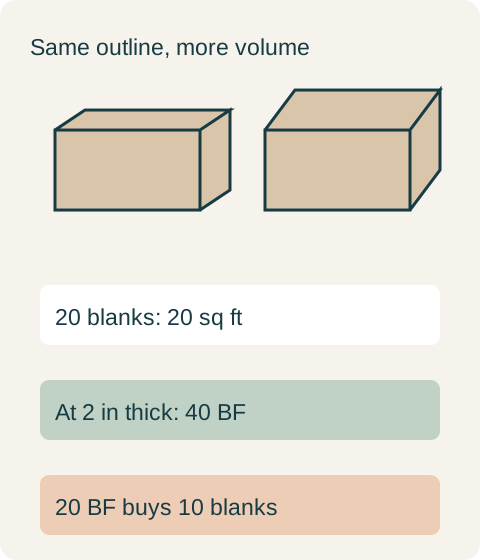
Face area ignores thickness. Holding the outline constant while making a blank thicker increases its volume without increasing the area seen from the front. Conversely, knowing total volume alone does not identify useful widths or lengths. A pile of short narrow pieces can have the same volume as long wide blanks while serving a different cutting list.
Keep the geometric calculation distinct from the seller’s commercial tally. AHEC describes rounding conventions for a bundle tally and distinguishes net tally after kiln drying from gross or green tally before drying. The order must identify its measurement basis. Recalculating surfaced wood from its present dimensions cannot, by itself, show that the agreed invoice tally was wrong.
Teaching example Hypothetical blank quantities, not a cutting-yield guarantee. The outlines are equal; thickness changes volume. Commercial tally conventions must be stated separately.
Face area does not tell you the board footage
Suppose the approved rough-blank list calls for 20 pieces, each 2 inches thick, 6 inches wide and 24 inches long. These hypothetical envelopes already include the fabricator’s chosen machining allowance; they are not finished-part dimensions. Each blank has 1 square foot of face area and 2 board feet of geometric volume. The full list therefore represents 20 square feet of face area and 40 board feet.
In this hypothetical comparison, Offer A supplies those 20 specified blanks and describes them as 20 square feet at the stated thickness. Offer B supplies 20 board feet in the same blank size, which is only 10 blanks. The buyer selects A for the complete list. B could become an equivalent quantity offer only by supplying 40 board feet in the required dimensions. Equal numerical quantities on the cover pages concealed different deliveries.
Quantity still has to arrive in usable shapes
That decision does not turn a geometric minimum into an order for random-width lumber. The hypothetical blanks are already defined by shape and count. If a seller instead supplies random boards, the fabricator must lay out the actual parts, reject unsuitable areas and allow for processing. No universal waste multiplier can be inferred from the volume conversion alone.
For a finished-component order, piece count and finished dimensions may be the more useful acceptance quantities. Raw-material board footage can explain part of the fabrication scope, but it does not replace checks on the delivered components. A buyer who ordered prepared blanks should not receive random boards merely because their stated board footage is equal.
Record the selected offer as the required pieces with their dimensions and delivery condition, alongside any board-foot or area tally used commercially. This preserves the actual decision through receiving: the quantity, shape and processing scope must all match. A unit conversion is valuable precisely because it exposes a missing part of that agreement.
Pure White
Cream White
Light Warm Gray
Gray
Navy
Black
Oak Tone
Dark Walnut Tone
Design study These finish studies are design references, not a list of currently orderable colors. Screens and lighting change the appearance; compare a physical sample before choosing.See all finish options →
A painted door, a wood-grain side and a plywood cabinet box can belong to the same cabinet. Here is how to read those parts, what the sample photos actually show, and which details to put on a quote.
Compare the actual countertop products, heat-source routine and fabrication proposal. A fired porcelain slab and resin-bound quartz are different materials, but neither label replaces a complete kitchen specification.
The sample shows the door frame, a separate center panel, the face frame and the cabinet box. Each component has its own place in this Shaker construction.
Shaker construction: door frame, center panel, face frame and cabinet box. The cutaway helps locate these parts; confirm each material in the specifications for the selected cabinet.
01 / Door frame
The Shaker door has rails and stiles around a separate center panel. The frame and center panel are different components; confirm their materials in the specifications for the selected cabinet.
02 / Face frame
The face frame surrounds the opening at the front of the cabinet box and sits behind the doors. The face frame, door frame and cabinet box are separate parts.
03 / Cabinet box
The sample exposes the cabinet sides, interior surfaces and layered edges. The image does not establish the wood species or material specification of a selected cabinet.