Hardwax oil or clear topcoat for wood cabinets: choose the finish you will live with
A matte cabinet can have a penetrating oil finish or a film-forming clear coat. Compare the completed wood surface, maintenance method and repair expectations before choosing.
Choose a hardwax-oil cabinet finish when the particular finished wood feels right and its maintenance approach suits the household. Choose a clear topcoat when the proposed coated surface better matches the appearance and care you want. Matte appearance alone cannot make that decision: both routes can offer a low sheen. The meaningful purchase is a complete finish on the intended wood, including the way it will be cleaned and repaired, rather than a bottle described as natural or durable.
Similar sheen can conceal different finishes
Rubio Monocoat describes Oil Plus 2C as bonding to raw wood fibers instead of building a surface film. Its standard finish is matte, and worn areas can be refreshed. The company includes cabinetry among the intended interior uses.
General Finishes identifies High Performance as an interior urethane/acrylic topcoat, including a Dead Flat sheen, and recommends the product for demanding uses such as kitchen cabinets. A low-reflection surface therefore need not be an oil finish.
These examples explain why a showroom label needs a second look. Sheen describes how light appears at the surface; it does not identify the complete coating system beneath that appearance. Put the actual proposed samples beside one another, in the same light, and handle them. Decide whether you prefer the way grain, texture and reflections read together. A photograph of pale wood cannot establish what the finished door will feel like, and a low sheen does not erase a color difference between two finishing proposals.
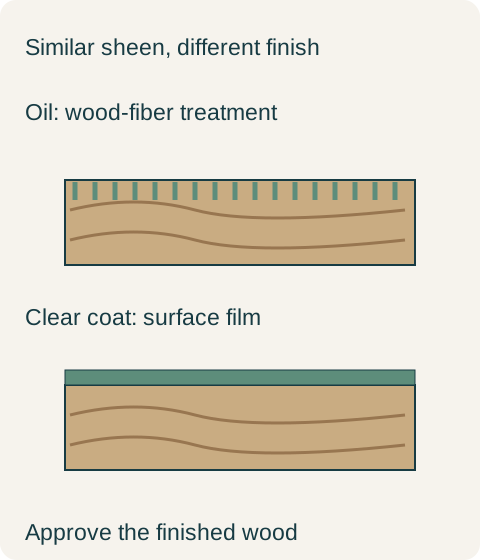
Diagram Conceptual comparison of a specified penetrating oil finish and a clear film finish. The colored layer is exaggerated to explain the distinction; this is not a coating-thickness specification or a universal diagram for every oil product.
A wood-forward kitchen can still choose a clear coat
Consider a hypothetical kitchen with oak fronts and simple metal pulls. The owners initially ask for hardwax oil because they assume every clear topcoat looks glossy. The cabinetmaker presents an oiled oak door and an oak door with the proposed dead-flat clear finish. They prefer the second sample and its stated care arrangement, so they select the clear-coated fronts throughout. They retain the wood species and door construction. Their decision changes the finish package without paying to redesign a cabinet they already like.
The useful distinction in that example is preference supported by the real alternatives. The owners do not reject oil as unsuitable for every kitchen, and they do not conclude that all clear coatings will resemble the sample. Another household may prefer the oiled door and accept its maintenance method. In either case, the final reference should identify the wood, any color treatment and the finishing product or system. Recording only matte oak leaves room for a different finish that satisfies the words but misses the accepted feel.
Repairability should describe a result, not a promise
A refresh method is valuable only if the homeowner is willing to use it or arrange the service. Before placing the order, have the cabinetmaker demonstrate an appropriate repair on an offcut finished with the proposed system. Compare it after the stated finishing process is complete. The question is whether that repaired appearance is acceptable on this wood and color, not whether a technician can make a mark disappear while it is wet. Keep the repair demonstration separate from the main untouched reference.
Do not convert the possibility of local repair into a guarantee that every scratch will blend invisibly. Damage can involve the finish, the color treatment or the wood underneath. A dent changes the surface itself; replacing finish does not reverse its shape. On the clear-coated option, learn whether the offered service treats a spot, refinishes a whole front or replaces the component. Those routes carry different inconvenience. Neither a generic oil label nor a generic polyurethane label tells you which service the cabinetmaker actually provides.
Keep the rest of the cabinetry in the comparison
A finish choice extends beyond the broad center of a sample door. Include exposed side panels, trims and the edges that will be touched in daily use. If one quotation supplies a different finish on those parts, compare that completed group before assuming the kitchen will read as a single set. Different component constructions may also respond differently in appearance. The goal is a coherent proposed combination, not a demand that every piece of wood have an identical grain pattern.
Separate front-finish cost from unrelated upgrades. A quotation that also changes the drawer system, interior construction or end-panel treatment cannot explain its entire difference as the price of oil versus clear coat. Hold the cabinet arrangement and component scope steady, then compare the finishing work and the included care or repair provision. There is no useful universal price ranking when the products, preparation and service differ. A low initial finishing charge can be unattractive to someone who will not carry out the maintenance they agreed to.
Let the care routine fit the actual kitchen
Plan for the people who will clean the cabinets. Hand over the named finish instructions, with the accepted sample and product identification, rather than a vague note saying wipe with wood cleaner. A cleaner suitable for one finished surface should not be assumed suitable for the other. The kitchen in the example is ordered with the chosen dead-flat clear finish and a consistent treatment of the visible companion parts. Its owners get the low-reflection wood appearance they preferred, with a finish they selected knowingly.
Pure White
Cream White
Light Warm Gray
Gray
Navy
Black
Oak Tone
Dark Walnut Tone
Design study These finish studies are design references, not a list of currently orderable colors. Screens and lighting change the appearance; compare a physical sample before choosing.See all finish options →
A color name does not identify a finish system. Compare the decorative surface, the core, the edge and the repair method before choosing a cabinet front.
Compare the actual countertop products, heat-source routine and fabrication proposal. A fired porcelain slab and resin-bound quartz are different materials, but neither label replaces a complete kitchen specification.
The sample shows the door frame, a separate center panel, the face frame and the cabinet box. Each component has its own place in this Shaker construction.
Shaker construction: door frame, center panel, face frame and cabinet box. The cutaway helps locate these parts; confirm each material in the specifications for the selected cabinet.
01 / Door frame
The Shaker door has rails and stiles around a separate center panel. The frame and center panel are different components; confirm their materials in the specifications for the selected cabinet.
02 / Face frame
The face frame surrounds the opening at the front of the cabinet box and sits behind the doors. The face frame, door frame and cabinet box are separate parts.
03 / Cabinet box
The sample exposes the cabinet sides, interior surfaces and layered edges. The image does not establish the wood species or material specification of a selected cabinet.