Hanging cookware pullouts trade drawer stacking for a full hanging envelope
A narrow overhead rail can carry pans whose hanging outlines are much wider and taller. Compare the hook, release movement and lids before replacing a pot drawer.
A hanging cookware pullout can make a selected pan available without removing a stack above it. It also commits vertical space to the entire hanging pan, including the handle. The organizer's narrow rail is not the width or height of the cookware it carries. Compare the complete collection before exchanging a drawer cabinet for this arrangement.
Rev-A-Shelf describes Glideware as a pullout that stores cookware suspended inside the cabinet and brings it forward for access. That establishes the hanging approach; it does not show that every pan or handle fits a particular hook.
Use the intended hook and a cookware hanging point suitable for that use. Trace from the hook to the lowest part of the pan, then across its widest part. A long handle can make a relatively small pan hang much lower than expected. Two adjacent pans can overlap even though the hooks themselves are neatly spaced.
The manufacturer offers different Glideware hook forms, including short, long and back-to-back versions. Those choices change the arrangement. Select them with the actual handles and neighboring pans instead of counting each supplied hook as a guaranteed cookware position.
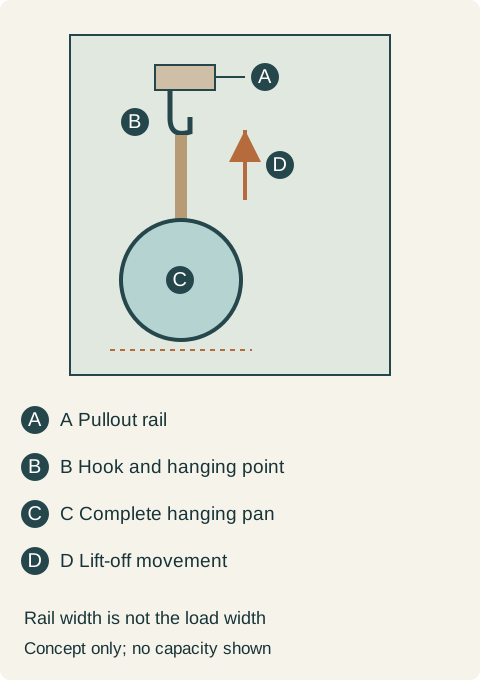
To remove a pan, its hanging point must clear the hook. Include that lift and the hand holding the pan, not only the final pull toward the user. Check the loaded group through the pullout's whole travel and on return; the bodies can meet an opening edge or another item even when the rail moves freely.
Teaching example Conceptual front view: a pan handle hangs from a hook, but its body occupies the space below and beside the narrow rail. Lifting off the hook needs a separate release movement. No load or product dimensions are represented.
Lids and nonhanging pots remain part of the order
A lid does not automatically travel with a hanging pan. Give lids a separate supported location that remains accessible when the rack is out. A pot without a suitable hanging point, or one whose hanging outline does not fit, needs another home. Do not claim that the cookware cabinet is complete after removing those awkward pieces from the comparison.
A mixed collection can justify a mixed solution
The retained frying pans have suitable hanging points and their loaded outlines fit the checked pullout configuration without preventing individual removal. The stockpot does not fit the hanging assignment and remains in a verified base drawer. Lids occupy a separate accessible divider. The plan adopts a hanging pullout for the frying pans while retaining that drawer and lid allocation; it does not replace all pot storage with hooks.
If the proposed new rack would remove the stockpot's only workable drawer, the same plan is rejected until the stockpot has a usable home. One-at-a-time pan access is not enough to justify losing a storage function the household still needs. Keep the loaded rack arrangement, permitted system load and the nonhanging pieces in the same cabinet comparison.
Pure White
Cream White
Light Warm Gray
Gray
Navy
Black
Oak Tone
Dark Walnut Tone
Design study These finish studies are design references, not a list of currently orderable colors. Screens and lighting change the appearance; compare a physical sample before choosing.See all finish options →
Bowl diameters can fit while handles cross or block a neighboring pan. Lay out the complete shapes, then test independent lifting and the return after washing.
Give lids recognizable positions and usable grips. Compare separate slots, shallow storage and lids kept with pots by the actual retrieval and return sequence.
Check the complete pot, lid knob and side grips through the opening and into the user’s hands. A tall interior can hide a lower front obstruction that prevents straightforward removal.
The sample shows the door frame, a separate center panel, the face frame and the cabinet box. Each component has its own place in this Shaker construction.
Shaker construction: door frame, center panel, face frame and cabinet box. The cutaway helps locate these parts; confirm each material in the specifications for the selected cabinet.
01 / Door frame
The Shaker door has rails and stiles around a separate center panel. The frame and center panel are different components; confirm their materials in the specifications for the selected cabinet.
02 / Face frame
The face frame surrounds the opening at the front of the cabinet box and sits behind the doors. The face frame, door frame and cabinet box are separate parts.
03 / Cabinet box
The sample exposes the cabinet sides, interior surfaces and layered edges. The image does not establish the wood species or material specification of a selected cabinet.