Arrange frying pans by their handles and removal order
Bowl diameters can fit while handles cross or block a neighboring pan. Lay out the complete shapes, then test independent lifting and the return after washing.
Lay out a frying-pan drawer using each complete pan, including its handle and any helper grip. Bowl diameter alone can suggest a compact arrangement that becomes awkward when handles cross. The useful layout lets the intended pan be grasped, lifted and returned without an unnecessary sequence of moving other pans. Begin with the household’s actual collection and cooking habits, not an organizer’s advertised pan count.
Capture the whole shape of each pan
On a suitable work surface, trace or represent each pan’s outline with the long handle, helper grip and any part that projects beyond the bowl. Keep the identity of each shape clear. Similar bowl sizes do not imply similar handle lengths, angles or heights. Include the pieces normally stored together, but separate lids if their intended home is elsewhere.
Compare these outlines with the drawer’s actual usable interior after its selected dividers or inserts are included. Use the drawer you will receive, not the cabinet’s nominal width. Mark the front and rear of the drawer so an arrangement tested on a counter does not accidentally reverse the user’s approach when transferred into the kitchen.
Distinguish overlap in plan from usable storage
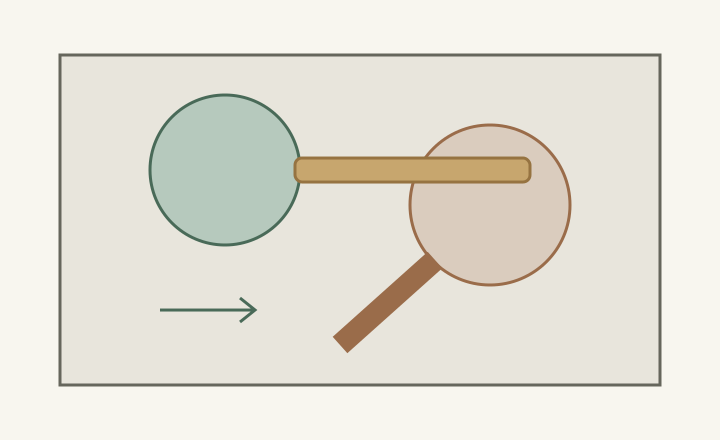
An overhead drawing shows whether a handle crosses another pan’s footprint, but not whether it passes above or below that pan. Check the actual heights and the closed drawer’s available space. An arrangement can be physically possible yet impose a retrieval order: a handle above a neighboring rim may require the upper pan to leave first. Decide whether that order matches ordinary use.
Do not rotate a pan into a diagonal position merely because its outline fits. Follow the handle while the pan is lifted and turned toward the user. The motion may sweep over a divider, catch a neighboring handle or require the user to raise the pan farther before turning. A stationary corner-to-corner fit is only the starting condition.
ABC
Diagram The drawing flags an overlap to investigate in height and movement; it does not declare that the pans can or cannot be stored together. Shapes and the direction marker are hypothetical.
A
Record more than bowl diameter.
B
Check the complete handle and grip.
C
Test the neighboring pan’s independent removal.
Choose access order from what is used together
Identify which pans are used most often and which commonly come out during the same meal. A daily skillet should not be trapped beneath an occasional pan simply because that arrangement looks compact. Conversely, moving a rarely used piece occasionally may be an accepted tradeoff. Make that choice explicit rather than promising that every pan can be removed independently.
Check the person’s grip from the actual opening direction. Pointing all handles toward the front can simplify recognition but may crowd the hand space there. Alternating directions can reduce overlap while putting a frequently used handle at the rear. Compare these consequences with the real drawer extension and user, rather than choosing an orientation as a universal rule.
Test the pan that the attractive arrangement traps
In a hypothetical drawer, the bowl outlines fit neatly side by side. A long handle crosses above the rim of the neighboring pan, which happens to be the one used every morning. To remove that daily pan, the household must first lift the other skillet and find somewhere to put it. The drawer holds the collection, but its access order conflicts with the routine.
Try changing orientation, assigning the occasional pan elsewhere or using a different division of the available space. Recheck the entire movement after each change. Turning the long handle toward the back may free the daily pan while making that skillet harder to grasp. The successful arrangement resolves the priority task without silently creating another problem of equal frequency.
Include the return from washing in the trial
With cold, empty and appropriately prepared pans, rehearse returning the pieces in an ordinary order. Does one have to arrive first for the others to fit? Can the person locate its place without rebuilding the whole arrangement? Check closing only after every handle and grip is within the verified moving space; never force a drawer past a pan to validate a layout.
Save the chosen arrangement with its actual pan inventory and any agreed retrieval sequence. Confirm the drawer system’s suitability for the complete stored load separately; efficient packing does not establish load capacity. Revisit the arrangement after adding a pan or changing an insert. A useful frying-pan drawer preserves the intended access order as well as the ability to fit the collection.
Pure White
Cream White
Light Warm Gray
Gray
Navy
Black
Oak Tone
Dark Walnut Tone
Design study These finish studies are design references, not a list of currently orderable colors. Screens and lighting change the appearance; compare a physical sample before choosing.See all finish options →
Give lids recognizable positions and usable grips. Compare separate slots, shallow storage and lids kept with pots by the actual retrieval and return sequence.
Check the complete pot, lid knob and side grips through the opening and into the user’s hands. A tall interior can hide a lower front obstruction that prevents straightforward removal.
The sample shows the door frame, a separate center panel, the face frame and the cabinet box. Each component has its own place in this Shaker construction.
Shaker construction: door frame, center panel, face frame and cabinet box. The cutaway helps locate these parts; confirm each material in the specifications for the selected cabinet.
01 / Door frame
The Shaker door has rails and stiles around a separate center panel. The frame and center panel are different components; confirm their materials in the specifications for the selected cabinet.
02 / Face frame
The face frame surrounds the opening at the front of the cabinet box and sits behind the doors. The face frame, door frame and cabinet box are separate parts.
03 / Cabinet box
The sample exposes the cabinet sides, interior surfaces and layered edges. The image does not establish the wood species or material specification of a selected cabinet.