

Buying cabinets
A kitchen without a dishwasher: compare the whole handwashing plan before buying cabinets
Omitting the machine can create cabinet storage, but every ordinary dish still needs receiving, washing, drying and putaway space. Test that complete routine against an installed dishwasher.
The decision begins with all the dishes
A kitchen without an installed dishwasher can be a deliberate choice when the household wants to wash its ordinary dishes by hand and the complete room supports that routine. Do not justify it solely by the storage cabinet drawn where the machine would have been. That cabinet is useful only after the receiving, washing, drying and putaway work has a lasting place elsewhere.
Compare both proposals using the same daily dishes and the same people. Handwashing a few items that do not go in a machine is different from accepting the entire ordinary load. The decision belongs before the cabinets are ordered, because both the lower run and the surrounding work surface can change.
Represent the load after an ordinary meal
Make a list of the plates, bowls, cups, utensils and cooking pieces that normally arrive together. Use clean, empty objects for a layout trial. Keep the normal mixed shapes; replacing them with a neat stack can hide how much room they occupy while being received and separated.
On the handwashing plan, locate the arriving dishes without filling the only part of the sink needed to start. Then locate washing and the clean items waiting for the next stage. Decide where the cook's larger piece goes when the ordinary tableware is already present.
This is a room exercise rather than a washing method. The household should follow its actual dish and accessory care instructions. The plan needs to establish that the intended sequence has places to happen without relying on an empty photograph of the kitchen.
Drying continues after washing stops
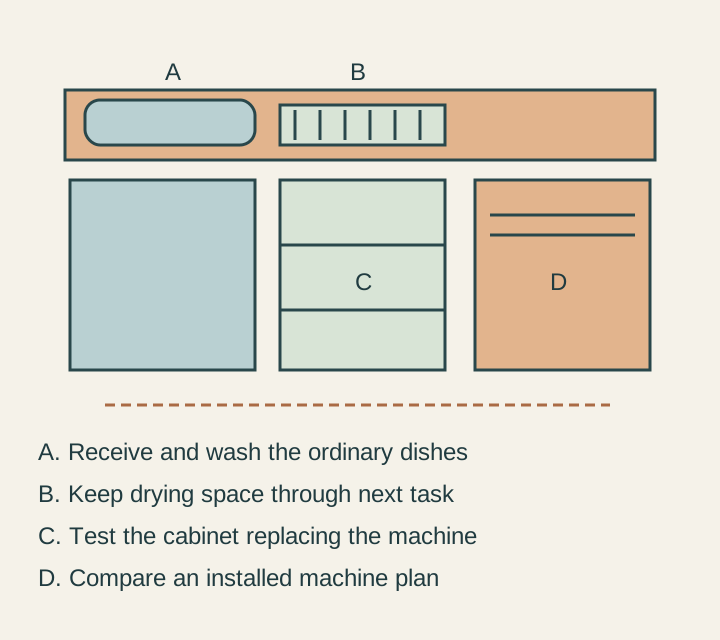
The important surface may remain occupied when another task begins. Show the clean objects in their actual draining arrangement, then place the next preparation board or breakfast activity. If the household normally puts everything away before that next task, decide who does it and whether that is the routine it wants to keep.
A sink-supported rack may preserve some counter while occupying part of the basin. A counter rack may leave the basin available while taking fixed surface. Those are possible components of the handwashing plan, not proof that the plan is resolved.
Also include the rack itself after the dishes have returned to storage. If it stays out, draw it as a persistent object. If it is put away, provide appropriate storage after care and drying. The kitchen should not depend on a wet accessory disappearing into an unexamined cabinet.
Count what the omitted machine really gives back
Draw an actual cabinet in the proposed machine location. Choose its construction and interior, then test the objects intended for it through the opening. An appliance bay width is not the usable interior width of a completed drawer or cabinet.
Ask what that cabinet displaces elsewhere. If it takes the family's large serving pieces, another compartment may become available near the ordinary tableware. If it stores seldom-used objects, its contribution to everyday work may be less than its position suggests.
Retain the cost of the real cabinet, finished fronts, countertop support and any installation changes. Removing a machine from a list is not the same as subtracting its retail price from the completed remodel. The handwashing arrangement can also require a different sink or a retained surface that the machine plan would allocate differently.
Give the machine proposal an equally complete trial
Choose a real candidate and verify the ordinary load with its supported racks and loading instructions. Include pieces that will still be handwashed. The machine alternative does not erase every drying object from the counter.
Represent its open door, the person loading and the return of clean dishes to the selected cabinets. The same useful storage brief should be satisfied, even though the compartment replacing the machine is absent.
ENERGY STAR recommends using the yellow EnergyGuide label to compare model energy use and estimated annual operating costs.
Reading note: ENERGY STAR — Dishwasher buying guidance.
Use actual model information if operating costs matter to this purchase. This room comparison does not establish a universal saving from either routine, or prove how a particular family's water use compares with a label estimate.
Decide whether future conversion is part of the purchase
Some owners want a no-machine kitchen now and the possibility of adding one later. Ask the project team to define the actual future scope: cabinet removal, countertop support, connections, finishes and the requirements of equipment not yet selected.
An accessible removable cabinet may be part of a documented plan, but it is not a promise that any future machine will fit. Do not pay for vague future readiness. Identify the work already included and what a later project would still have to verify.
If future conversion is not being preserved, say so on the plan. The owner can then assess the handwashing choice as the intended long-term kitchen, rather than imagining a free reversal that has not been designed.
A household keeps the cabinet after testing the next morning
Imagine a hypothetical household that already washes all ordinary dishes by hand and prefers to continue. In its first proposal the recovered cabinet looks useful, but the drying arrangement occupies the only preparation surface for the next morning.
The revised plan retains a separate preparation segment and gives the ordinary draining load a defined place. Clean dishes return to checked cabinets without moving stored cookware. The new cabinet accommodates serving pieces that otherwise crowded a nearby compartment.
The owners compare that completed layout with an installed machine proposal, including remaining handwashed items and all cabinet costs. They choose the no-machine plan because it supports their preferred routine and useful storage together.
Another household may find that the same test turns the occupied surface into a repeated obstacle. It should retain the machine location and choose storage elsewhere. The successful choice is the room the household can continue to use after the dishes arrive, not the empty rectangle a machine leaves on a drawing.
Sources & further reading
- ENERGY STAR — Dishwasher buying guidance