

Buying cabinets
Countertop drying rack or sink accessories: where should hand-washed dishes wait?
Compare the ordinary wet load with the next sink task. Keep drying space, usable basin, counter and accessory storage visible before changing the sink base and cabinet order.
Give the wet dishes a place through the next task
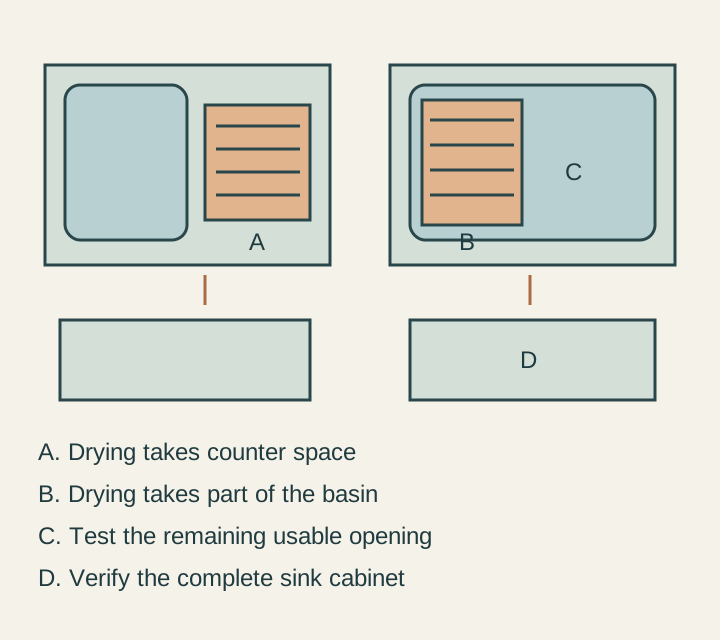
Choose a countertop rack when hand-washed dishes regularly need to remain while someone uses the sink, and the allocated counter area is an acceptable cost. Choose a compatible sink-supported drying arrangement when the ordinary wet load fits and enough of the basin remains usable for what happens next. A clear counter can be valuable, but moving dishes over the sink does not remove their occupied space.
Begin with the pieces actually hand-washed. A household with a dishwasher can still have a recurring group of pots, lids, cups or other items handled separately according to their care instructions. Do not design around a display containing only a few tidy plates if the everyday load is a broad pan and its lid.
Measure the loaded arrangement
Put clean, dry examples of the actual pieces into a suitable inactive trial of the rack. Include the way the selected product is intended to support them. Look at the whole loaded outline, not only the rack's base. Handles and tall pieces can extend into the faucet approach, neighboring counter or cabinet-opening path.
Test taking out a particular item without disturbing a precarious stack. If the load only fits by balancing objects in a way the product does not support, it has not passed. No universal number of slots describes the household's mixture of bowls and cookware.
Keep the cared-for and dried storage positions separate from the wet receiving position. A pan that fits the drying rack still needs its normal cabinet. The rack should not become a permanent substitute for cookware storage unless the household deliberately wants that visible arrangement and the selected product supports it.
A sink accessory belongs to a particular support system
KOHLER describes a colander/drying-rack accessory supported on bowl ledges of selected compatible workstation sinks. That is a defined support relationship, not a universal fit for any similar-looking bowl.
Reading note: KOHLER USA — Workstation accessory set, ledge support and drying accessory.
Identify the exact sink and accessory together. Check how the accessory is supported, moves and is removed under the product's instructions. A claimed external sink width does not establish that its ledges accept another brand's rack. A general bottom protective grid is also not automatically the selected elevated drying arrangement.
If replacing the sink to obtain that support system, count the whole replacement. The bowl, mounting, counter opening, sink-base arrangement and required connections belong in the comparison. An accessory price alone cannot describe a purchase that changes the cabinet run.
Compare what happens while dishes remain
A drying load can outlast the washing task. Walk through the next recurring activity before clearing it away. Someone might need to rinse produce, fill a vessel or wash the large pot that did not fit with the earlier group.
For a sink-supported arrangement, show the remaining opening with the wet pieces still present. The largest useful opening may be different from the total bowl outline. If access requires moving the loaded accessory, identify a supported place for it and the handling that the user accepts. The adjacent counter may still be needed even though the initial promise was a clear counter.
For a countertop rack, keep its entire loaded position visible during the same activity. It may preserve the basin while taking the preferred chopping area. Check that the selected water-collection or drainage arrangement works in the exact position according to its instructions. Do not assume all countertop racks direct water the same way.
Use time honestly
Do not base the choice on an invented drying time or a promise that a different location always dries faster. Instead, use the household's actual sequence and the selected pieces' care requirements. The relevant question is whether the next activity commonly begins before those dishes are put away.
A family that washes a few items after its final kitchen task may accept a sink accessory that occupies most of the opening temporarily. Another family that cooks and washes throughout the evening may need a separate receiving position. Neither should have to clear dishes earlier than its real routine simply to make a rendering work.
If the plan depends on putting every piece away immediately, try that routine before ordering around it. A preference for a clear counter is understandable, but it should not quietly assign extra work to someone who has not agreed to perform it.
Count the counter and cabinet consequences together
Keeping a dedicated counter rack can limit where a tall cabinet or appliance bay is added. Preserve the assigned receiving surface rather than treating it as leftover space that can vanish during later design revisions. Its counter material and the rack's selected arrangement must suit their actual use.
A broader sink may instead consume a wider base and leave less neighboring drawer capacity. Assign the displaced utensils or pans to checked compartments. Do not call the new layout a storage gain solely because the rack no longer sits above the counter.
Now store the accessories when they are not in use. Their actual cared-for condition, thickness and removal path determine the assigned slot or shelf. A narrow decorative gap is not a confirmed storage position. If the rack stays in the sink full time, accept its effect on all the other sink tasks.
Buy the whole cleanup arrangement
Compare the countertop rack, any required collection pieces and retained counter allocation with the actual compatible sink-and-accessory proposal. Include the sink replacement, fabrication, installation and cabinet changes where applicable. Keep unchanged items constant so the accessory does not appear inexpensive by omitting its supporting purchase.
Also compare the ordinary return of clean pieces to their cabinets. A drying position far from the pan drawer can create a new carrying route. That may be acceptable, but it should appear in the completed cleanup plan rather than after installation.
A kitchen protects its open basin
In a hypothetical renovation, the regular hand-washed load includes a wide pan, lid and cups. It fits the chosen sink accessory, but it leaves too little accessible opening for the next ordinary pot. Moving the loaded accessory would require the same adjacent surface that the plan proposed to remove for a tall cabinet.
The household keeps a suitable countertop rack and that receiving surface. It selects the sink around washing rather than enlarging it solely to carry the drying load, and retains the neighboring utensil storage. The visible rack is an accepted part of the finished kitchen.
A different household may find that its modest load leaves the selected basin comfortably usable and that the dry accessory has a real storage position. It can choose the sink-supported arrangement and enjoy the recovered counter. Keep the loaded trial and the next-task trial with the cabinet order; both are needed to show what the choice actually buys.
Sources & further reading
- KOHLER USA — Workstation accessory set, ledge support and drying accessory