Hand-brushed or sprayed cabinet paint: choosing the finished appearance
Fine brush texture can be intentional. Compare completed painted doors, distinguish the final application from the production location, and agree what the finish should look like.
Choose between hand-brushed and sprayed cabinetry by the finished appearance you want to live with, not by assuming that one application method always means better workmanship. A deliberate brushed finish can have subtle directional character. A buyer seeking a visually quiet, uniform surface may prefer a particular sprayed sample. Neither label alone describes the coating’s durability, preparation or completeness.
Hand-finished does not mean every layer was brushed
deVOL describes its Classic English and Real Shaker cabinetry as receiving sprayed coats followed by a hand-painted final coat. It associates the final brush application with a subtle traditional appearance. This is a documented mixed process, not a contradiction.
Separate the visible finishing method from where the work happens. Brushing can occur in a workshop, while spraying can be part of a site-finishing proposal. A factory-made cupboard can therefore have a hand-finished surface. When a quotation simply says hand-painted, ask whether it describes the final coat, all paint application or only local finishing after installation. The answer changes what you will actually see and which work is still included.
Benjamin Moore’s Advance cabinet guide provides both spray and brush methods for the same coating. Its brush method finishes with full strokes along the grain and places doors horizontally for leveling. Application method and paint identity are separate choices.
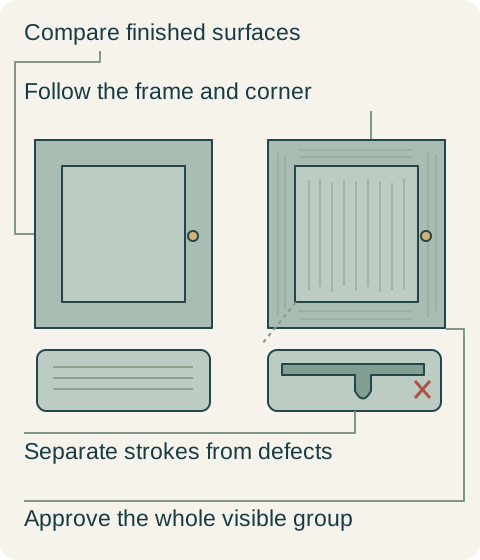
Teaching example Hypothetical comparison of smooth-looking paint and directional brush character. Lines are enlarged for explanation, not a required brush-mark depth, wood grain or a universal ranking of application methods.
Inspect the texture you are buying
Use a completed sample of the proposed finish on the actual door profile. Stand at normal viewing distance first, then look from an angle where the room’s light crosses the surface. On a framed door, follow the broad panel, the narrow frame members and the inside corners separately. Texture that looks pleasant on a broad flat patch may read differently where the brush direction changes around a profile.
Describe what you like in ordinary words: faint directional strokes visible close up, for example, rather than deliberately rough paint. Keep that observation separate from the wood underneath. Grain texture, a shaped profile and paint-application texture are different features, even when they all appear in the same reflected light. Do not order a smooth substrate and expect brushing to reproduce deeply textured timber.
An intentional finish needs limits. A run collected in a corner, a hair trapped in the coating or an obviously missed edge should be discussed as a separate condition, not automatically accepted because the cabinet is hand-painted. Conversely, treating every faint directional line as a defect would reject the appearance you chose. Have the supplier show representative finished pieces and identify the agreed character before approval.
A narrow frame is not the whole kitchen
Compare a wide exposed end with a door and drawer front. These shapes offer different uninterrupted areas for light to reveal the finish. If the proposal uses a brushed final coat on doors but a differently finished end panel, put the pieces beside each other. They may coordinate well, or the change may look accidental. A shared color name cannot decide that appearance question.
Include the edges that become visible when the door opens, and look at the transition around the hardware area. Ask what is delivered finished and what is completed after fitting. Do not assume a final site coat covers every concealed interior or corrects all installation damage. A specific component list is more useful than a broad promise that the painter will finish everything at the end.
A pantry keeps its painted furniture character
In a hypothetical kitchen, the owners choose a painted pantry intended to read as a piece of furniture beside quieter surrounding cabinets. The brushed sample has faint strokes that they like from nearby, but they reject an unrelated sample with heavy paint collected in the inner corners. The distinction is not handmade versus machine-made; it is controlled surface character versus a condition outside their intended appearance.
They approve a representative brushed final finish for the pantry doors, drawer and exposed end, including how it changes direction around the frame. The main cabinet run keeps its already-selected smoother finish, and the pantry stands as a separate group rather than pretending to match it invisibly. The quotation includes the pantry’s complete coating system and any agreed fitting-stage completion. They retain the accepted sample and decline a cheaper alternate that supplies only a color-matched sprayed pantry, because that would remove the texture they deliberately selected.
Do not buy a texture as a repair guarantee
A finish that welcomes visible handwork is not automatically one that can be repaired invisibly. A later touch-up can differ in color, sheen or texture from the surrounding surface. Ask for the chosen cabinet system’s service approach and retain its finish identification. Do not assume any retail paint with a matching color name can reproduce the original coating or that a local brush repair will blend into every sprayed face.
If the final painting happens in the home, establish who finishes it, which surfaces are included, when the finished work is inspected and when the coating instructions allow normal use. Those arrangements belong in the purchase before scheduling the room’s return to service. If the cabinetry arrives fully finished, inspect it in that delivered condition. Either route should end with the specific appearance you approved, rather than leaving hand-painted or spray-finished to carry expectations the sample never established.
Pure White
Cream White
Light Warm Gray
Gray
Navy
Black
Oak Tone
Dark Walnut Tone
Design study These finish studies are design references, not a list of currently orderable colors. Screens and lighting change the appearance; compare a physical sample before choosing.See all finish options →
Waterborne and UV-cured describe different parts of a coating process. Compare finished doors, matching components and replacement options before paying for a finish label.
Choose antiqued mirror for the reflected scene and concealed storage you want. Compare the full door group, its patterned surface and the view when it opens before replacing transparent glass.
The sample shows the door frame, a separate center panel, the face frame and the cabinet box. Each component has its own place in this Shaker construction.
Shaker construction: door frame, center panel, face frame and cabinet box. The cutaway helps locate these parts; confirm each material in the specifications for the selected cabinet.
01 / Door frame
The Shaker door has rails and stiles around a separate center panel. The frame and center panel are different components; confirm their materials in the specifications for the selected cabinet.
02 / Face frame
The face frame surrounds the opening at the front of the cabinet box and sits behind the doors. The face frame, door frame and cabinet box are separate parts.
03 / Cabinet box
The sample exposes the cabinet sides, interior surfaces and layered edges. The image does not establish the wood species or material specification of a selected cabinet.