A touch-up can make a small paint chip less distracting, but the word touch-up does not describe a single result. Adding color, filling a missing spot and restoring a larger finish area are different tasks. Before selecting a product or approving service, identify which change you want and what condition is actually present. The aim is a clearly defined cosmetic improvement, with no assumption that a repaired location will become undetectable from every angle.
Diagram A care illustration does not promise an invisible repair; define the intended color and surface improvement.
Describe the missing area and its surroundings
Record where the chip is: on an exposed edge, a flat face, a profile or a contact point. Show the whole part and a close view in ordinary light. Note whether the surrounding finish appears intact, whether there is a depression or raised edge, and whether another part continues to strike that location. The repair question changes if the cause is still present.
Do not enlarge the chip by picking at its edge to measure how firmly the surrounding coating adheres. A loose area, recurring peeling or a changing panel belongs in a broader assessment. A small visible opening is not automatically a small repair when the condition around it is unstable or the part has also changed shape.
Match the proposed treatment to the defect
KraftMaid's care guide distinguishes adding color with a touch-up pen from filling small cosmetic defects, and directs substantial repairs to professional refinishers. This supports asking what a proposed treatment does, rather than treating every kit as a universal repair for any damaged surface.
If the main issue is a contrasting exposed spot, color correction may be the proposed goal. If material is missing, ask whether the proposal also addresses the depression or only changes its color. Do not assume a paint product creates a level surface, or that a filler automatically matches the factory finish. Confirm the actual cabinet material and the manufacturer's approved approach before applying anything.
Agree on appearance before work begins
Discuss the normal viewing position and the feature that currently draws attention. Is it the light-colored chip, a shadow at the edge or a visible indentation? Ask what improvement the service provider expects and what may remain visible. A useful explanation ties the proposed work to that particular defect rather than promising that all touched-up areas disappear.
Consider a small nick on the lower edge of a painted door. Adding the correct color may reduce its contrast during ordinary use while a close view still reveals its shape. If your expectation is a completely uninterrupted face under strong side lighting, say so before accepting a localized repair. The service provider can then discuss whether that expectation requires a different scope.
Verify the repair product and its limits
Use the cabinet's finish identity and part information to request the appropriate product or service. A familiar color name on a hardware-store container is not confirmation of compatibility. If a supplied kit has no readable label or instructions, ask for identification rather than mixing leftover materials until they look close on the damaged part.
Follow the actual product's application and drying instructions, including whether a separate trial is appropriate. Do not import a timing or technique from another brand's guide. Where the proposed repair involves removing a broad finish area, spraying or rebuilding a damaged profile, obtain an appropriately qualified assessment instead of expanding a small touch-up into an improvised refinishing project.
Evaluate the dry result against the agreed goal
Compare the repaired area after the specified drying process in the lighting and viewing positions discussed beforehand. Record whether the original contrast is reduced and whether texture, edge shape or sheen remain noticeable. Avoid judging only a wet application or an exceptionally close phone photograph; neither alone represents how the part is normally seen.
Keep the product identity and a brief before-and-after record with the cabinet documents. If repeated chips appear at the same contact point, revisit the contact problem instead of repeatedly adding more material. A satisfactory small repair improves the agreed cosmetic issue while leaving the cause, product compatibility and any remaining limitation clear to the person who will maintain it.
Pure White
Cream White
Light Warm Gray
Gray
Navy
Black
Oak Tone
Dark Walnut Tone
Design study These finish studies are design references, not a list of currently orderable colors. Screens and lighting change the appearance; compare a physical sample before choosing.See all finish options →
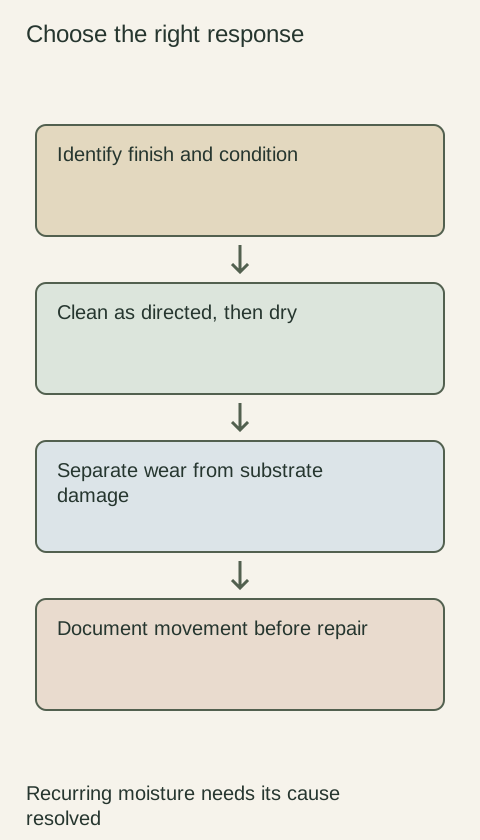
Routine cleaning, a finish touch-up and a moving wood joint need different responses. Identify the surface and condition before applying a cleaner or repair product.
The sample shows the door frame, a separate center panel, the face frame and the cabinet box. Each component has its own place in this Shaker construction.
Shaker construction: door frame, center panel, face frame and cabinet box. The cutaway helps locate these parts; confirm each material in the specifications for the selected cabinet.
01 / Door frame
The Shaker door has rails and stiles around a separate center panel. The frame and center panel are different components; confirm their materials in the specifications for the selected cabinet.
02 / Face frame
The face frame surrounds the opening at the front of the cabinet box and sits behind the doors. The face frame, door frame and cabinet box are separate parts.
03 / Cabinet box
The sample exposes the cabinet sides, interior surfaces and layered edges. The image does not establish the wood species or material specification of a selected cabinet.