Why a plywood upgrade can spoil a glossy laminate cabinet panel
Select the substrate for the finished laminate assembly. Strength in another use does not prevent grain or surface irregularities from showing through a high-gloss face.
Do not automatically replace a specified composite core with plywood beneath a glossy laminate cabinet face. The supporting surface can affect the visible result. For the selected laminate, choose a permitted substrate and assess a completed panel, including its face, edge and back construction. A small loose laminate sample shows the decorative finish; it cannot prove how the bonded component will look. Plywood can suit many cabinet parts while being the wrong substitution for a particular visible panel.
Telegraphing brings the supporting surface into view
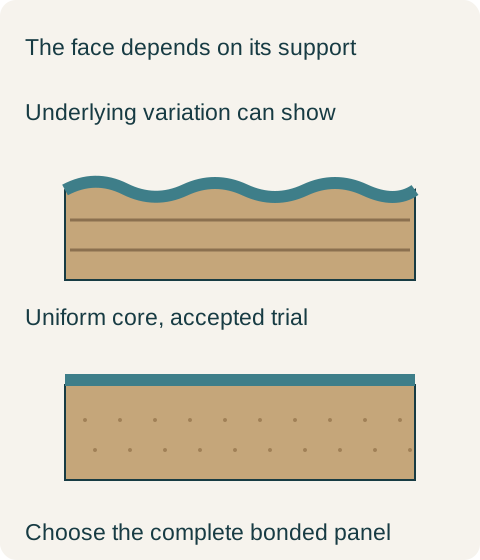
Wilsonart’s substrate bulletin favors smooth, uniform MDF for glossy laminates and explains that plywood grain and density variation can telegraph through higher-gloss faces. This is a substrate-related appearance mechanism, not merely a different amount of shine. The face may remain glossy while revealing irregularities associated with what lies beneath. Looking only at the laminate’s color and gloss designation leaves this part of the assembly unevaluated.
Think of the laminate as a decorative skin bonded to a supporting surface, rather than a rigid cover that automatically erases everything below it. This does not mean every line on a finished panel comes from the core. The construction and production history still matter when diagnosing an actual complaint. For purchasing, however, the possibility is enough to reject a blanket rule that plywood is always the premium choice regardless of the finish applied to it.
The particular laminate can change the permitted core
Wilsonart’s Traceless technical sheet permits reliable particleboard, MDF or plywood with an A-face. That product-specific allowance is why the general appearance warning should not be rewritten as a ban on plywood beneath every laminate. The selected sheet’s requirements and the required appearance must both be satisfied. A core permitted for one product is not automatically approved for another, and permission to use a material does not replace a representative finished appearance sample.
Diagram Conceptual sections exaggerate underlying variation and a smoother alternative. They explain telegraphing, not measured roughness or a claim that every plywood panel fails. A finished sample decides the hypothetical appearance choice.
Keep the approved MDF panel when the plywood trial disappoints
In a hypothetical cabinet project, the selected glossy laminate is approved for the specified MDF substrate. A buyer requests plywood because other cabinet parts use it. The fabricator makes representative samples with the proposed constructions; the plywood version shows visible underlying variation that the buyer dislikes, while the MDF version meets the agreed appearance. The buyer keeps the approved MDF assembly for that exposed panel and withdraws the plywood substitution. The decision does not downgrade unrelated cabinet parts or redefine the laminate as low gloss.
The sample decision should cover the intended component, not a tiny square pressed under unusually favorable conditions. A broad exposed end or tall front presents a larger reflected field than a hand-held chip. Include the relevant edge and backing arrangement in the fabrication sample so the approved result represents the proposed work. The goal is a useful production reference, not a deliberately harsh flashlight test that was never part of the purchase requirement.
A smooth appearance does not verify every structural duty
The chosen core still has to serve the actual component. A decorative applied panel, a shelf and a door are different assemblies. Do not use the glossy sample’s appearance as evidence for an unsupported span, a fastener connection or a hinge load. Those decisions need their own appropriate design information. The hypothetical choice is confined to the specified exposed panel whose complete assembly was reviewed; it does not establish that all panels in the kitchen should use the same material.
Likewise, a request to change thickness is not just another name for improving the substrate. It can alter finished dimensions, edge relationships and the way a component meets adjacent parts. If a proposed remedy changes the build-up, compare it with the accepted drawing before calling it equivalent. The relevant purchase is the finished panel in its location, not an isolated board that seems more substantial when held in the hand.
Do not try to correct an unknown cause from the front
If a delivered panel differs from the approved reference, record the whole component and the visible feature before attempting polishing or sanding. Changing the decorative face may fail to address the underlying cause and can make the condition harder to assess. Ask the fabricator to identify the actual laminate, core and process used. The technical bulletin describes a possible mechanism; it cannot diagnose a photographed wave as plywood telegraphing without that information.
For a new order, compare proposals that name the complete assembly and include the required fabrication. A bare plywood panel price and a finished laminate-on-MDF component price measure different scopes. If a core substitution is being offered, evaluate its effect on the selected surface and on the component’s other requirements before assigning it upgrade status. No universal price premium can decide whether the visible result will satisfy the buyer.
The production reference should survive the substitution discussion
Retain the accepted finished sample with the laminate and substrate identifiers, edge treatment and backing arrangement. The buyer in the example chooses the construction that produces the accepted glossy panel and meets the component requirements. Later material changes should be reviewed against that complete selection, so that an appealing word such as plywood cannot silently replace the result the household actually approved.
Pure White
Cream White
Light Warm Gray
Gray
Navy
Black
Oak Tone
Dark Walnut Tone
Design study These finish studies are design references, not a list of currently orderable colors. Screens and lighting change the appearance; compare a physical sample before choosing.See all finish options →
Compare reflection clarity separately from gloss level. A bright surface can meet a gloss criterion while showing distortion that matters on a long run of fronts.
Compare the actual countertop products, heat-source routine and fabrication proposal. A fired porcelain slab and resin-bound quartz are different materials, but neither label replaces a complete kitchen specification.
The sample shows the door frame, a separate center panel, the face frame and the cabinet box. Each component has its own place in this Shaker construction.
Shaker construction: door frame, center panel, face frame and cabinet box. The cutaway helps locate these parts; confirm each material in the specifications for the selected cabinet.
01 / Door frame
The Shaker door has rails and stiles around a separate center panel. The frame and center panel are different components; confirm their materials in the specifications for the selected cabinet.
02 / Face frame
The face frame surrounds the opening at the front of the cabinet box and sits behind the doors. The face frame, door frame and cabinet box are separate parts.
03 / Cabinet box
The sample exposes the cabinet sides, interior surfaces and layered edges. The image does not establish the wood species or material specification of a selected cabinet.