Fumed-look oak cabinets: reactive coloring or a non-reactive pretreatment?
A fumed color name does not establish a tannin reaction. Choose the coloring process and the completed finish together for the actual cabinet components.
For a gray or fumed-look oak cabinet, decide whether the project calls for a particular coloring process or simply an approved finished appearance. A reactive pretreatment uses something already present in the wood to develop color. A non-reactive pretreatment can imitate that appearance without relying on the same reaction. Either may suit a design, but neither is fully described by smoked oak or fumed gray on a mood board. The useful choice includes the actual wood, the color treatment and the protective finish that follows it.
The wood participates in a reactive color
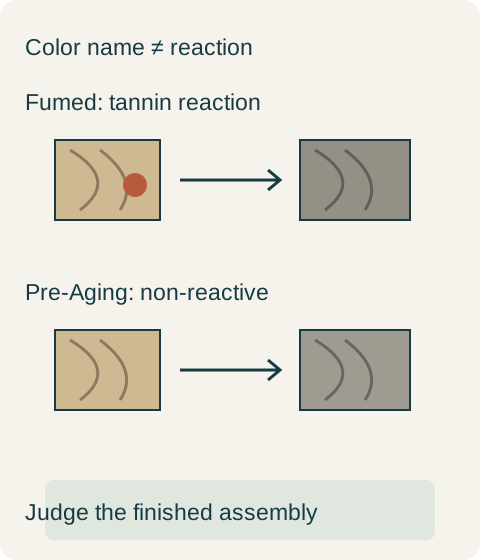
Rubio Monocoat’s comparison explains that its Fumed product chemically reacts with tannins in the wood to turn it gray, and is typically used on high-tannin species such as oak. Its Pre-Aging product imitates reactive-stain effects but does not rely on that chemical reaction. This is a specific comparison within that manufacturer’s range. It establishes a practical distinction: the reactive product develops its result through the wood’s chemistry, rather than merely carrying a color name that will mean the same result on every component.
A cabinet contains more than a single presentation board. An oak frame, a veneered center and a separate end panel can all enter the finishing process as distinct pieces. The inference for production is to assess the parts that will actually sit together, rather than assuming a successful trial on one offcut proves the whole elevation. This is not a claim that every frame and veneer will react differently. It is a reason not to mistake a single result for a guaranteed match across materials selected and processed separately.
A Fumed color can still be non-reactive
The manufacturer’s Pre-Aging color page lists Fumed Light and Fumed Intense, although Pre-Aging is non-reactive. It also identifies the displayed wood as white oak and says the illustrated colors are unfinished: applying a finish changes their appearance. The name therefore describes an effect, not proof of the reactive Fumed process. An unfinished online color is also a different stage from the protected cabinet front the buyer will receive. Specify the product family as well as the shade when the process matters.
Diagram Manufacturer-specific process comparison. A fumed-looking shade can be non-reactive; the completed wood-and-finish assembly determines the accepted cabinet appearance.
Choose the finish that works across the assembled front
In a hypothetical oak cabinet project, the owner wants a restrained gray surface without strong contrast between frame and center. The shop’s actual reactive trial produces a contrast the owner dislikes. A separate non-reactive trial, followed by the intended protective finish on both solid frame stock and veneer, produces an accepted range. The owner chooses that completed non-reactive finish for the cabinet. The approval includes the real materials and their observed range; it does not require the shop to keep a reactive process merely because the design brief originally used the word fumed.
That result is a decision about this hypothetical set of samples, not a promise that non-reactive coloring makes every species identical. It also explains why switching process after approving a bare color sample is risky: the substitute may deliver a different final surface even if the color names look similar. The owner has chosen appearance across the assembled door over allegiance to a particular pretreatment mechanism. Another owner could reasonably choose the reactive trial because its variation is the desired feature. The samples need to make that difference visible before a production run fixes it into many doors.
Non-reactive does not mean independent of the substrate
Rubio’s veneer guidance says Pre-Aging can be used on veneered wood, but veneer quality and type can affect the result. Its species guidance also identifies exceptions among conifers such as pine or fir: resin or pitch pockets may fail to accept pigmentation and leave white flecks. That is more specific than a broad all-wood claim. For the oak cabinet, the veneer note directly supports including the actual veneer in the sample. For a mixed-species design, the conifer exception is a reason not to extend the oak result automatically to every trim piece.
A non-reactive route removes the particular dependency on tannin reaction; it does not remove grain, underlying wood color or component selection from the design. A buyer can preserve an agreed range rather than demand a flat painted appearance from transparent wood coloring. In the hypothetical project, the accepted frame and center remain visibly wood, with variation that the owner likes. If the design instead requires uniform opaque gray, that is a different finish intention. Forcing a translucent aged-wood sample to stand in for an opaque painted target would obscure the actual choice.
Pretreatment is not the protective finish
Rubio identifies Pre-Aging as a pretreatment that does not seal or protect the wood, and its guidance calls for a subsequent protective finishing product. That makes a bare pretreatment sample incomplete for cabinet approval. The finished sample is needed both because protection is a separate function and because the color page expressly says finishing alters the color. The case above uses the intended completed sequence, so its accepted gray is the appearance of the final surface rather than an intermediate stage that disappears when the finish is applied.
For the purchase, retain the agreed process family, shade, actual component samples and completed finish sequence. If a later material substitution introduces a different veneer or species, compare that component in the approved sequence before treating it as equivalent. There is no need to prescribe a chemical recipe to express this decision. The cabinet order can clearly say whether reaction itself is part of the design intent, or whether a non-reactive aged appearance has been accepted. That distinction prevents an appealing color name from making an unspoken manufacturing choice.
Pure White
Cream White
Light Warm Gray
Gray
Navy
Black
Oak Tone
Dark Walnut Tone
Design study These finish studies are design references, not a list of currently orderable colors. Screens and lighting change the appearance; compare a physical sample before choosing.See all finish options →
Compare the actual countertop products, heat-source routine and fabrication proposal. A fired porcelain slab and resin-bound quartz are different materials, but neither label replaces a complete kitchen specification.
The sample shows the door frame, a separate center panel, the face frame and the cabinet box. Each component has its own place in this Shaker construction.
Shaker construction: door frame, center panel, face frame and cabinet box. The cutaway helps locate these parts; confirm each material in the specifications for the selected cabinet.
01 / Door frame
The Shaker door has rails and stiles around a separate center panel. The frame and center panel are different components; confirm their materials in the specifications for the selected cabinet.
02 / Face frame
The face frame surrounds the opening at the front of the cabinet box and sits behind the doors. The face frame, door frame and cabinet box are separate parts.
03 / Cabinet box
The sample exposes the cabinet sides, interior surfaces and layered edges. The image does not establish the wood species or material specification of a selected cabinet.