French-door vs. side-by-side refrigerators: storage and cabinet fit
A wide fresh-food compartment and a tall divided layout solve different storage problems. Compare the containers you actually use, their shelf assignments and the freezer routine before selecting the refrigerator surround.
Choose between a French-door refrigerator and a side-by-side by testing the storage shape, not simply by comparing the total capacity in the listing. A wide refrigerated tray, a group of frozen containers and the bottles that stay in the door all compete for usable places. The better refrigerator is the one whose actual interior supports the household's regular load without sacrificing another necessary group. Make that choice before the surrounding cabinets are finalized.
The dividing line changes what the space can hold
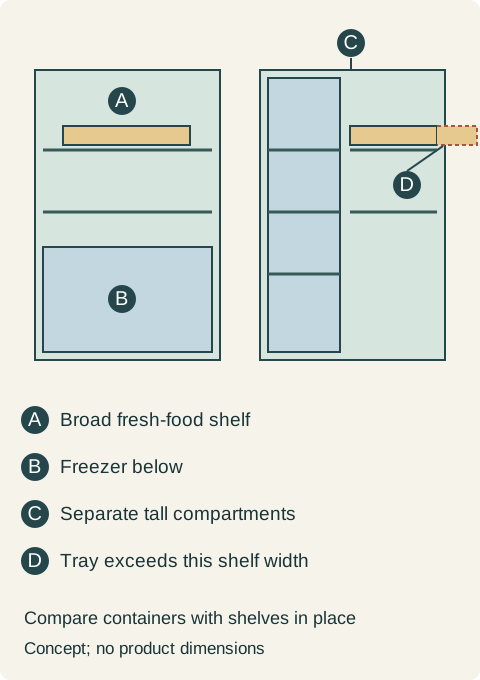
Whirlpool describes the conventional French-door layout as a fresh-food compartment above a lower freezer, while a side-by-side places tall refrigerator and freezer compartments beside each other. That distinction concerns compartment arrangement, not a guaranteed capacity or price advantage.
Start with the objects that are awkward in the current fridge. A serving platter may need breadth. Tall containers need height at the shelf where they will stay. A collection of frozen boxes may need separate visible positions rather than a large undivided space. These are different requirements; adding them to one list of cubic feet hides the conflict.
Include handles, lids and the normal way an item is carried. A bare tray base that fits is not a complete test if the lid used with it does not. Conversely, do not reject a refrigerator because an oversized container used once a year is awkward when a suitable alternative container is already acceptable to the household. Separate routine requirements from preferences that can change.
Compare the regular load together
Test the selected model with its intended bins, shelves and internal equipment present. Place representative empty containers in the arrangements permitted for that appliance. Do not remove an ice-making component, protective cover or other fixed equipment to create a fictitious storage opening. The useful question is whether the household can keep its normal arrangement, not whether a stripped showroom box can swallow a large object.
A wide shelf can be useful for a tray, but the tray still occupies depth and a particular level. See where the regular cartons, produce containers and leftovers go while it is there. If accepting the tray means moving every tall bottle into the same shelf space, the demonstration has not resolved the whole load. Compare the resulting arrangement rather than awarding a pass for one impressive item.
Likewise, a narrow compartment can serve a household well if its regular containers fit and remain easy to identify. Narrow does not automatically mean inadequate. The problem arises when the required object cannot fit in the permitted orientation or when accommodating it consumes positions needed every day. Avoid a universal judgment based on the exterior door style.
Teaching example Compartment concepts with outer doors omitted. Left: A is a broad fresh-food shelf and B a lower freezer. Right: C marks tall separate freezer and fresh-food compartments; D is an illustrative tray too wide for the selected narrow shelf. The tray example is hypothetical, not a dimension or a claim about every model.
Freezer choice is about retrieval as well as volume
Compare how the users locate and retrieve the frozen containers they regularly use. In a lower drawer, include its fitted baskets or dividers and the objects above the desired one. In a tall freezer, include the actual shelf heights and the reach to the intended storage levels. Do not declare one arrangement easier for every person; try the ordinary task with the users who will do it.
A tidy empty basket does not show whether a familiar box will be buried beneath another group. A tall shelf that looks clear in a photograph does not show whether a short user can comfortably retrieve its contents. Put frequently used items in realistic positions and then repeat the task. The point is choosing a layout the household accepts, not assigning a medical or accessibility rating to a refrigerator category.
Whirlpool's buying guide also distinguishes the classic lower-freezer drawer from French-door variants with lower doors or an additional external drawer. The French-door label alone therefore does not settle the freezer layout being purchased.
Inspect the actual candidate. Do not carry an observation about one showroom freezer into a different model merely because both listings use the same family name. Door count, interior division and the locations of ice-making equipment belong to the selected product comparison.
A household chooses the wider fresh-food arrangement
In a hypothetical kitchen renovation, the household regularly chills a covered serving tray before taking it to the dining table. Its frozen-food routine uses a set of compact containers. Both candidate refrigerators have already been found compatible with the proposed room, but the cabinet surround has not yet been ordered.
The side-by-side candidate accepts the ordinary containers, yet the covered tray cannot occupy the selected fresh-food shelf in its usable orientation. Removing a neighboring regular storage assignment would still not create the necessary width. The owners could change the tray and serving routine, but decide that keeping it matters because they use it frequently.
The French-door candidate accepts that tray on a permitted shelf with the everyday containers assigned elsewhere. The owners then test the lower freezer with their compact containers in its supplied arrangement. They accept the access sequence and can retrieve their usual group without removing an unrelated stack. The wide fresh-food result has not been bought by ignoring the freezer.
They select that refrigerator and have the cabinet surround coordinated to its actual installation documents and opening movement. They retain the tray and accepted freezer organization, and decline an extra refrigerator elsewhere in the room. This is a choice for the tested load; it does not establish that every French-door model fits the tray or every side-by-side fails it.
A different load can reverse the result
A household with narrow regular refrigerated containers and frequent use of individually placed frozen items may prefer the tested tall freezer arrangement. If its candidate side-by-side holds the entire load and the users prefer those shelf positions, a wide fresh-food compartment may offer little value to them. There is no reason to buy it solely because it appears more open with the doors displayed.
The comparison should include complete prices for the actual candidates and any different cabinet work. Do not assume a category always costs less. Keep chosen ice and water features in the same comparison so that an unrelated feature difference does not masquerade as the price of a compartment layout.
Finally, confirm the selected refrigerator's closed envelope, ventilation and connection requirements, door paths, internal drawer removal and occupied aisle use. Those checks can reject a candidate that stores the load beautifully. They complement the storage decision rather than replacing it. If a substitution changes the interior or freezer arrangement, repeat the load comparison before accepting the new refrigerator and releasing the final cabinet dimensions.
Pure White
Cream White
Light Warm Gray
Gray
Navy
Black
Oak Tone
Dark Walnut Tone
Design study These finish studies are design references, not a list of currently orderable colors. Screens and lighting change the appearance; compare a physical sample before choosing.See all finish options →
A door can open enough to reach food while leaving an inner drawer difficult to remove. Check the wall, hinge path, door bins and the selected model’s separate use and cleaning tasks.
Door clearance is only the mechanical part of the check. Add the standing position, reaching task, transfer to a counter and route out before judging the aisle usable.
Columns let the fresh and frozen storage brief separate, but their complete installation reservations compete with pantry cabinets and landing space. Compare the whole wall with the same food inventory.
The sample shows the door frame, a separate center panel, the face frame and the cabinet box. Each component has its own place in this Shaker construction.
Shaker construction: door frame, center panel, face frame and cabinet box. The cutaway helps locate these parts; confirm each material in the specifications for the selected cabinet.
01 / Door frame
The Shaker door has rails and stiles around a separate center panel. The frame and center panel are different components; confirm their materials in the specifications for the selected cabinet.
02 / Face frame
The face frame surrounds the opening at the front of the cabinet box and sits behind the doors. The face frame, door frame and cabinet box are separate parts.
03 / Cabinet box
The sample exposes the cabinet sides, interior surfaces and layered edges. The image does not establish the wood species or material specification of a selected cabinet.