Cabinets after a flood: replace the affected units or buy a complete new set?
Make the recovery assessment the starting point for the purchase. Cabinets that can be retained may support a partial order, while a complete replacement is a separate design and budget choice.
Start with what can remain, not with a matching door
After a flood, the right cabinet order is not necessarily a complete replacement, and it is not automatically the few boxes that look worst. First have the flood-recovery team establish which installed materials can be retained and what work must happen around them. Then compare a partial cabinet purchase with a complete new arrangement. A photograph of intact doors cannot settle that first question.
This article addresses the purchase after flood damage, rather than the emergency cleanup. Follow local instructions about access to the building and use qualified recovery professionals for the condition assessment. A cabinet seller can help identify products and prepare a replacement package; that role does not by itself qualify the seller to declare a flooded assembly suitable for reuse.
A cabinet may need removal even when its future is undecided
EPA's flood guidance calls for access to hidden surfaces behind built-in cabinets for drying, and disposal of materials that cannot be cleaned and dried. Removal and the eventual purchase scope therefore need separate decisions.
Ask the recovery contractor to identify the cabinet areas that need access, the units being considered for retention, and any units whose outcome remains unresolved. Give each one a location on the kitchen drawing. An estimate saying remove kitchen cabinets does not tell the cabinet supplier whether those same units are intended to return or whether new units must take their place.
EPA also cautions that floodwater should be assumed contaminated. A dry-looking finish does not answer the recovery question. Do not substitute a repainting proposal for the assessment of the flooded assembly.
Have the recovery and installation teams coordinate any countertop, plumbing and appliance work needed for access. This is a scope discussion, not a removal method. A countertop that appears reusable still needs its own assessment and a feasible plan for the selected cabinet arrangement. Avoid building the purchase budget around an assumed intact removal.
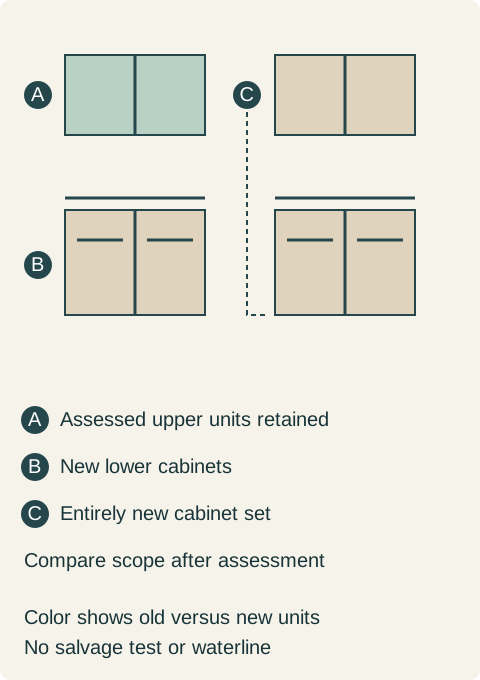
Teaching example Hypothetical purchase alternatives after the recovery assessment: left, A marks upper cabinets assessed for retention and B marks a new lower run; right, C is an entirely new cabinet set. The colors distinguish purchase scope, not contamination levels. No waterline or safe-to-reuse test is shown.
What a partial replacement actually preserves
A partial order starts with an identified group of retained units, not a general promise to save the uppers. Ask the installer to carry their real positions, condition assessment and useful storage into the new plan. Their width, door arrangement and relationship to appliances may limit where the replacement lower cabinets can go. The retained group has value when it still serves the household's kitchen.
Identify the old product where records or labels are available, then ask what matching replacements can actually be ordered. Do not treat a current door with the same style name as an exact match to an older finish. If an exact continuation is unavailable, compare a deliberate contrast with replacing the whole visible group. A partial purchase can be visually coherent without pretending that new and old pieces are identical.
Include the new end panels, fillers, toe-kick treatment and any trim affected by the boundary. An intact wall cabinet does not supply the finished end for a new base cabinet. Nor does buying replacement bases automatically retain the former sink or counter. List those decisions explicitly so the partial proposal describes a complete working kitchen.
When buying the whole set offers something useful
A complete cabinet replacement can be worth pricing when the retained units would preserve a layout the household already struggled with. It can allow a different storage arrangement and a consistent new cabinet specification, subject to the actual room and installation design. Those are possible design benefits, not evidence that every cabinet was damaged by the flood.
Compare the two options at the same level of completion. One should not include counters, end treatments and installation while the other contains only cabinet boxes. Keep flood-recovery work visible in both proposals, and distinguish work that is necessary regardless of cabinet style from work added by the redesign. Replacing more cabinets does not eliminate the building's recovery work.
Keep payment questions separate as well. A contractor's assessment, a cabinet quote and an insurer's decision have different purposes. Obtain any coverage or reimbursement answer from the responsible insurer or program. Do not assume that a preference for matching new uppers establishes coverage for them, or that an unapproved amount can be treated as money already available for the purchase.
A household keeps the useful uppers and replaces the lower run
Consider a hypothetical kitchen where the completed recovery assessment identifies the lower cabinets for replacement and the upper cabinets as suitable for retention. The decision is based on that assessment, not on a waterline drawn across the room. The household still likes the upper storage and the existing appliance positions.
The first completed proposal retains those specific uppers, supplies a new lower run in a deliberately contrasting finish, and includes its exposed ends and finishing pieces. The countertop is included as new in this example after a separate review. The installer checks the rebuilt room and confirms the cabinet and appliance arrangement before the order is released.
The competing proposal replaces the uppers as well, giving the whole room a uniform new cabinet finish and a revised upper-door arrangement. It is a real alternative, but it does not add storage the household needs. After comparing both complete quotes, the owners select the partial replacement. They accept the visible old/new distinction and spend on the lower drawers they will use, rather than replace useful uppers solely to make the purchase look like one new set.
That outcome would change if the assessment did not support keeping the upper units, or if their layout prevented the kitchen the owners needed. A partial order must remain conditional until its retained pieces are established. It is not a way to make an unresolved recovery finding disappear from the budget.
Order against the rebuilt room
Before final purchase, reconcile the retained-unit list with the current room drawing and the actual restoration scope. Wall and floor work may affect the conditions that the cabinet installer measures. Keep preliminary cabinet selections available for planning, but distinguish them from an order released against verified dimensions and an accepted installation plan.
Ask for a clear handoff: which units remain, which are new, which surrounding items are included, and what work must be completed before delivery and installation. The cabinet purchase should follow that resolved scope. Neither a complete new set nor a small replacement order is automatically the prudent choice; the useful purchase is the one that finishes the assessed recovery and gives the household a kitchen it wants to keep.
Pure White
Cream White
Light Warm Gray
Gray
Navy
Black
Oak Tone
Dark Walnut Tone
Design study These finish studies are design references, not a list of currently orderable colors. Screens and lighting change the appearance; compare a physical sample before choosing.See all finish options →
A secondhand kitchen set is a fixed collection of real cabinets. Evaluate their condition, dimensions and finished sides before treating the set as a substitute for a new order.
The sample shows the door frame, a separate center panel, the face frame and the cabinet box. Each component has its own place in this Shaker construction.
Shaker construction: door frame, center panel, face frame and cabinet box. The cutaway helps locate these parts; confirm each material in the specifications for the selected cabinet.
01 / Door frame
The Shaker door has rails and stiles around a separate center panel. The frame and center panel are different components; confirm their materials in the specifications for the selected cabinet.
02 / Face frame
The face frame surrounds the opening at the front of the cabinet box and sits behind the doors. The face frame, door frame and cabinet box are separate parts.
03 / Cabinet box
The sample exposes the cabinet sides, interior surfaces and layered edges. The image does not establish the wood species or material specification of a selected cabinet.