The original cabinet order may stop being an accurate hardware list after parts are replaced. Keep a short history that distinguishes the original component, the replacement ordered and the component actually installed. Connect that history to a precise cabinet location. This prevents a future repair from being based on an outdated model number or an uninstalled spare, and allows the next service person to see which parts still belong to the original arrangement.
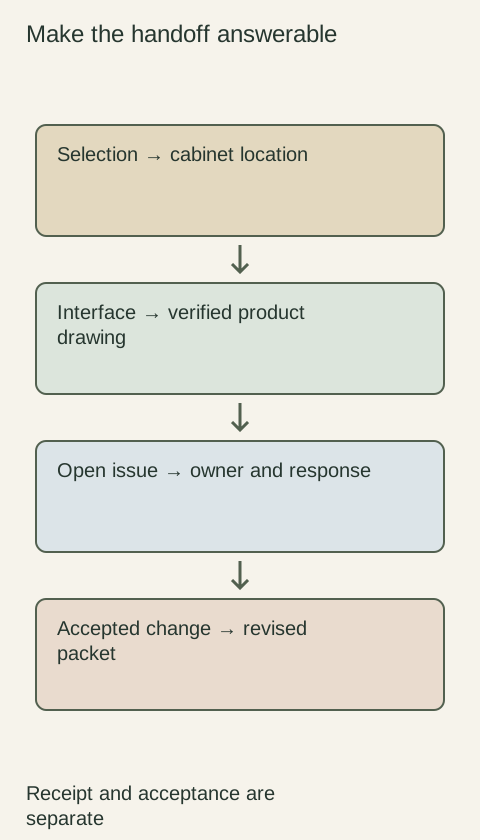
Diagram Connect the confirmed installed part to its location and service history; the diagram does not identify a replacement model.
Give each changed location a clear identity
Describe the affected cabinet and position in words that remain understandable after the installer leaves. An overall photograph with the location marked can help distinguish neighboring drawers or doors. Record the component role as well: hinge, mounting plate, runner, locking device, bumper or another specified part. A note saying new hardware in kitchen is too broad for later ordering.
Where several similar components are present, state which were changed and which were retained. Do not copy a new part number onto the record for every matching-looking cabinet unless they actually received that component. The history should describe the physical installation, including mixed old and new parts where that is the confirmed service result.
Separate visible markings from confirmed ordering identity
Retain photographs of labels or markings, but keep the supplier's confirmed ordering reference in a distinct field. Blum cautions that numbers on its hinges can identify components rather than ordering parts and requests photographs for identification. A visible number is useful evidence, but it should not silently become a verified replacement specification in your record.
Include the source of the confirmed identity, such as the service invoice, part packaging or written supplier response. If two sources disagree, keep the discrepancy open until it is resolved. Do not overwrite the old number with the new one; recording both and their roles preserves the reason a later user might find a different marking on the installed hardware.
Use dates to distinguish events, not infer compatibility
Keep order, receipt and installation dates separate when they differ. The date a spare arrived does not establish that it was fitted. Also distinguish the date a record was written from the date the work occurred. If the actual installation date is uncertain, label it approximate instead of converting a document's creation date into a fact about the cabinet.
Record any model revision stated by the supplier without assuming that a date code is self-explanatory. Ask what the code means if it matters to compatibility. An older original order and a newer service part can both be correct records of different states. The useful question is which state the next purchase must match.
Record substitutions and retained companion parts
Imagine a runner was replaced while the drawer's locking devices were retained, and the supplier confirmed that combination. Save that confirmation with the installed runner identity. A future request should describe the actual combination, not simply repeat the original order or assume everything changed together. Likewise, a spare remaining in a labeled box is inventory, not an installed component.
If the service used a substitute model, retain the written compatibility explanation and any instruction changes. Do not state that the new and old parts are universally interchangeable unless the manufacturer actually establishes that scope. The record concerns this confirmed application. It should show which companion parts, adjustments or installation details were included in the approved service response.
Close the history with the result and next reference
Add who completed the work, what was observed afterward and where the applicable instructions are stored. Record any unresolved issue separately, such as a closing concern still awaiting review. A replacement invoice alone does not prove installation or satisfactory operation. The history becomes useful when it connects the supplied part to the completed work and the actual outcome.
Store the record with the original cabinet documents and keep filenames or folder labels understandable. Before another purchase, read the latest confirmed installed state for that location, not merely the newest file in a folder. Preserve earlier entries as history. This modest record can prevent repeating identification work and keeps a series of repairs from gradually obscuring what the cabinet now contains.
Pure White
Cream White
Light Warm Gray
Gray
Navy
Black
Oak Tone
Dark Walnut Tone
Design study These finish studies are design references, not a list of currently orderable colors. Screens and lighting change the appearance; compare a physical sample before choosing.See all finish options →
Routine cleaning, a finish touch-up and a moving wood joint need different responses. Identify the surface and condition before applying a cleaner or repair product.
The sample shows the door frame, a separate center panel, the face frame and the cabinet box. Each component has its own place in this Shaker construction.
Shaker construction: door frame, center panel, face frame and cabinet box. The cutaway helps locate these parts; confirm each material in the specifications for the selected cabinet.
01 / Door frame
The Shaker door has rails and stiles around a separate center panel. The frame and center panel are different components; confirm their materials in the specifications for the selected cabinet.
02 / Face frame
The face frame surrounds the opening at the front of the cabinet box and sits behind the doors. The face frame, door frame and cabinet box are separate parts.
03 / Cabinet box
The sample exposes the cabinet sides, interior surfaces and layered edges. The image does not establish the wood species or material specification of a selected cabinet.