Flex zones or full-surface induction: which freedom does your cooking need?
A joinable cooking zone and a surface that detects freely positioned cookware are different systems. Compare the same meal, control tasks and complete cabinet installation before paying for more placement freedom.
Choose a cooktop with a joinable induction area when that defined region handles the cookware that needs it and the rest of the surface supports the same meal. Consider a full-surface system when its documented freedom to position cookware solves a recurring arrangement that the bounded zones cannot handle conveniently. Flexible is not a complete technical description. Find out what changes position, what is joined by the controls and what remains limited.
This comparison starts after the household has chosen a visible induction cooktop. It is not a reason to reopen an already settled fuel decision or to install an invisible system beneath a countertop. The purchase question is how the actual induction surface identifies and controls the cookware you will use together.
Joining zones does not turn the whole glass into one unrestricted area
Bosch describes its FlexInduction cooking area as smaller zones that can work independently or combine for larger cookware. That is flexibility within the designated area; it is not a statement that every part of the glass accepts freely placed pans.
Look at the entire layout of the candidate. Identify the joinable area and any other cooking positions, then place the household's cold, empty vessels where the instructions allow. A long vessel that fits the flexible area still leaves a question about the saucepan and skillet needed beside it. The useful result is the complete meal group, not a successful photograph of a single large pan.
Separate a joined control setting from independent control. When you want to change the small saucepan without changing another vessel, can you select the intended zone as expected? When a larger supported vessel uses the combined area, do you understand what the joined setting controls? Have the actual system demonstrated instead of assuming the name flex means every vessel always receives an independent setting.
Do not infer the pattern of heating elements from the decorative lines on the glass. A border tells you where to place cookware only as its instructions explain. It does not prove a continuous heated rectangle or identical temperatures across any pan placed there. Cooking performance still needs suitable cookware and a valid demonstration.
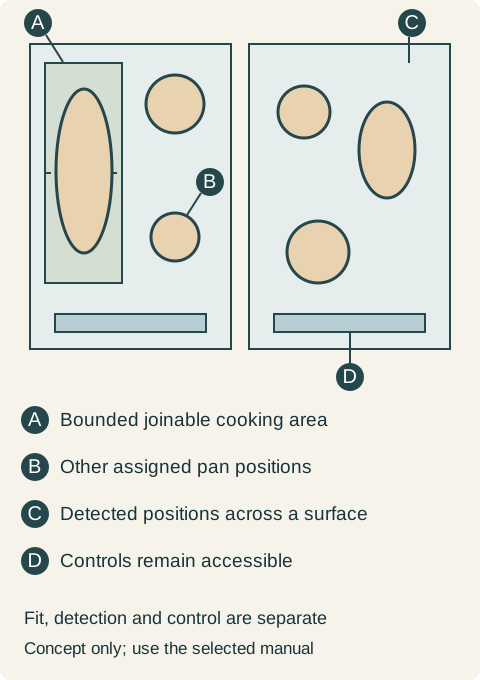
Teaching example Conceptual operating areas, not a coil map or a model-specific loading plan. A shows a bounded pair of zones that may operate separately or together. B shows other positions on that example. C represents a full-surface candidate with detected cookware positions, while D keeps controls outside the illustrated pan area. Shapes do not establish pan compatibility, heating uniformity, simultaneous capacity or installation dimensions.
Full-surface detection also has boundaries
The cited Gaggenau CX full-surface product offers free cookware positioning and individual pot detection, with a maximum of five cookware items. Its broader positioning concept therefore still has a stated simultaneous limit; the word full does not mean unlimited.
Treat the permitted cooking area, cookware requirements and controls as distinct parts of the appliance. An attractive empty glass sheet is not evidence that a pot can cover the display, overhang the edge or operate in every imagined position. Read the particular product's allowed arrangement and have recognition shown with the cookware being considered.
Ask what the display does when a pan is moved to a permitted new position. The owner needs to understand the actual identification and control behavior, not merely watch someone who already knows the appliance operate it quickly. Changing a pan's location and changing its cooking setting are related actions that should remain understandable during the household's meal.
More freedom of position also does not create more physical surface. Pot rims, lids and handles still occupy space. If the normal cookware group cannot share the appliance without blocking each other or the controls, free positioning may only rearrange the same conflict. Test the whole group with its real shapes before expecting detection technology to solve a shortage of room.
Run separate fit and operating trials
An unpowered trial with cool, empty cookware reveals geometry: where the bases and handles sit, whether a lid can be lifted, and whether a hand can reach the controls. It cannot prove induction compatibility, recognition or the cooking behavior of an unusually shaped vessel. Keep those conclusions separate so a successful fit is not mistaken for a complete performance result.
For the operating questions, use a supervised demonstration consistent with the chosen product and cookware instructions. Include the same important vessels rather than substituting a showroom set that happens to demonstrate the feature well. If the needed pan cannot be tested or its support remains unclear, leave that part of the purchase unresolved instead of assuming another pan's result transfers.
Keep the changes in routine visible. Some owners like familiar assigned positions because they know where each pot belongs. Others want to vary the arrangement between meals. Neither preference is wrong. The meaningful question is whether the proposed system makes the owner's repeated control and placement tasks easier to understand and complete.
A bounded flexible area proves sufficient
A hypothetical household's normal meal uses an oval covered vessel, a skillet and small saucepans in changing combinations. The owners initially assume they need full-surface induction because they dislike their old cooktop's arrangement. They compare a bounded flex-zone candidate with a full-surface candidate using their retained cookware and the same preparation routine.
The flex-zone candidate accepts the supported oval vessel in its designated combined area, while the accompanying pans fit the remaining permitted positions. On another routine meal, the smaller vessels use the independent configuration instead. The owners can select and alter the intended controls without moving cookware simply to reach the panel. A supervised demonstration resolves recognition and the cooking tasks that mattered to them.
The full-surface candidate also works and offers additional allowed positions, but those positions do not change a recurring task for this household. In their actual project quotations, the complete full-surface proposal costs more. They choose the bounded flex-zone proposal because it already solves their stated cooking arrangement, accepting that future vessel choices must continue to suit those regions.
Their choice is not a universal ranking of the technologies or their prices. Another household whose important vessel group only works satisfactorily in the demonstrated full-surface arrangement may have a reason to pay for it. The difference must show up in a real meal and its controls, not simply in the appearance of an unmarked glass surface.
Keep the cabinet purchase attached to the exact cooktop
Compare the completed installations once the viable cooking systems are known. An advertised size does not establish a shared countertop opening or identical space below. Have the countertop and cabinet arrangement checked for each exact candidate, including the selected mounting treatment, required equipment space and the storage that actually remains.
Electrical and ventilation coordination belong to the full equipment proposal. This guide does not supply connection ratings or mounting dimensions. If a candidate changes the project scope, price that change with the appliance instead of postponing it until the surrounding drawers have been ordered.
The final order should identify the tested cookware group, supported surface arrangement and precise appliance configuration. A later substitution can change the useful positions even when the nominal width stays the same. Preserve the arrangement that justified the purchase, and repeat the affected comparison if either the cookware or the appliance changes.
Pure White
Cream White
Light Warm Gray
Gray
Navy
Black
Oak Tone
Dark Walnut Tone
Design study These finish studies are design references, not a list of currently orderable colors. Screens and lighting change the appearance; compare a physical sample before choosing.See all finish options →
The appliance price is only part of a gas-to-induction change. Include compatible cookware, the cooking layout, electrical work, the retained countertop and the storage left below before deciding.
An under-countertop cooking system can preserve an uninterrupted surface, but it must be selected with the actual slab, finish, controls and cabinet space. A familiar induction label does not make any existing top compatible.
Choose the supported combination and its interface parts before defining the opening. Product width, finished assembly width and countertop cutout are different measurements.
The sample shows the door frame, a separate center panel, the face frame and the cabinet box. Each component has its own place in this Shaker construction.
Shaker construction: door frame, center panel, face frame and cabinet box. The cutaway helps locate these parts; confirm each material in the specifications for the selected cabinet.
01 / Door frame
The Shaker door has rails and stiles around a separate center panel. The frame and center panel are different components; confirm their materials in the specifications for the selected cabinet.
02 / Face frame
The face frame surrounds the opening at the front of the cabinet box and sits behind the doors. The face frame, door frame and cabinet box are separate parts.
03 / Cabinet box
The sample exposes the cabinet sides, interior surfaces and layered edges. The image does not establish the wood species or material specification of a selected cabinet.