Enameled cast iron or fireclay for a white kitchen sink?
Similar white surfaces can cover different bodies and have different care instructions. Choose the actual glazed fixture, not a generic porcelain label or a promise that every mark is a chip.
Compare enameled cast iron and fireclay as complete glazed sinks. Both can provide the white appearance a homeowner wants, but the body beneath the surface is different and the care instructions are product-specific. A porcelain description on a shopping list is too vague to settle the choice. First identify the offered material and finish, then compare the actual basin, exposed front and permitted care. Do not assume that fireclay always wins on durability, that cast iron cannot be damaged, or that every white sink can be cleaned in the same way.
What is underneath the white surface?
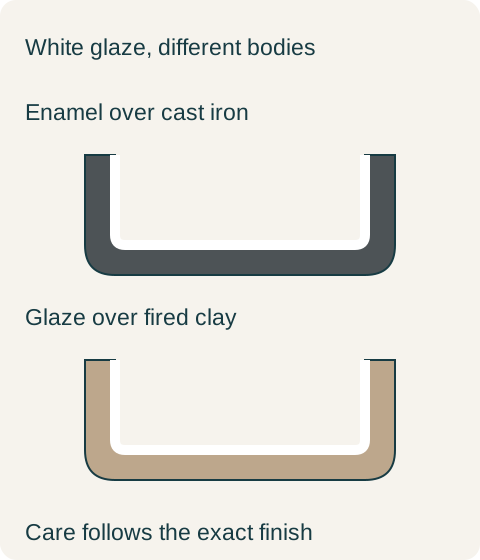
KOHLER describes enameled cast iron as a glass-like coating fused to iron, while fireclay uses fired dense clay with a glaze. This changes the material identity even when the surfaces look similar in a photograph. The homeowner is choosing a body-and-surface combination, not just a shade of white. Keep that identity with the product record so a later substitution does not silently turn one material into another. A matching appearance alone does not establish an equivalent fixture.
Look at the real glazed finish beside the countertop and cabinet paint. The same white label does not tell you whether the reflections, curvature and visible rim work together. A broad apron can read differently from a small bowl sample because it occupies more of the room’s view. This is a reason to inspect the offered shape and finish together, not to invent a universal best white. The preferred sink may be selected for its complete appearance while the alternative remains a sound material for another kitchen.
A dark pot mark is not automatically missing glaze
KOHLER explains that metal transfer from cookware can look like a scratch without penetrating its enamel, and does not recommend abrasive cleaners. A useful purchasing expectation distinguishes a mark on the surface from loss of the surface itself. Do not treat every future dark line as proof that the iron body is exposed. Equally, a photograph of a line is not enough to conclude that all damage is harmless transfer. The selected sink’s care guidance gives the owner a starting point for handling marks without improvising a more aggressive routine.
Diagram Conceptual wall sections of glazed sink materials. The layers are exaggerated for visibility and do not represent product thickness, strength or a method of repairing chips.
A family chooses plain fireclay rather than decorative artwork
In a hypothetical kitchen, the family wants a white glazed sink and prefers a routine using a mild abrasive that is allowed for the shortlisted plain Shaws surface. They compare that complete fireclay model with an enameled cast-iron alternative whose care guidance discourages abrasives. They choose the plain fireclay sink after accepting its bowl, visible finish and installation package. They also decline a decorated-apron alternative because they do not want a separate, gentler care routine for artwork. The choice follows this family’s accepted finish and habits, not a claim that every fireclay sink is stronger.
Shaws permits mild abrasive cleaning on its solid-color surfaces, but specifies non-abrasive care for the softer Gallery artwork on the apron. This is a particularly useful example of why material alone is insufficient. The buyer could remain within the same fireclay family and still change the surface that must be maintained. Keep the decorative finish in the comparison rather than treating it as a purely visual add-on. A household that values the artwork could reasonably accept that different routine instead of choosing the plain sink.
Elkay’s cited fireclay model requires a custom cabinet with an internal support frame. That named requirement does not supply a support design for another fixture. It shows why the installed package belongs in the price comparison. The homeowner should know that the proposed support and cabinet work are included for the selected sink. Choosing the material first does not authorize copying another bowl’s mounting details, nor does a similar exterior width prove that the existing installation can simply be reused.
For the hypothetical kitchen, the accepted installation is part of the fireclay selection. The owners are not buying a heavy-looking object and leaving its accommodation to the delivery day. If the alternative cast-iron sink requires different work, that difference should appear in the complete offer. Compare actual product weights and handling needs when supplied; do not assume every fireclay fixture is lighter or heavier than every cast-iron fixture. Different shapes and dimensions can make a category-level weight comparison misleading.
Compare the fixture the household will actually use
Keep the working basin in view while discussing the white surface. If one proposal changes interior shape, drain position or accessories, acknowledge that change separately. A material comparison can end with a preference for a particular model, but it should not pretend the model’s useful layout is a universal property of its material. In the example, the plain fireclay option meets the family’s working needs as well as its chosen care routine. A less convenient bowl would not become the right choice merely because the surface permits their preferred cleaning method.
The complete purchase includes the agreed sink finish, necessary installation work and the care instructions for that exact surface. Accessories should be selected for that basin rather than added generically because the sink is white. Avoid comparing a bare fixture price with another package that includes items the household actually wants. The family in the example chooses a particular plain glazed sink and declines artwork; those decisions should remain visible if the supplier proposes a replacement model.
Pure White
Cream White
Light Warm Gray
Gray
Navy
Black
Oak Tone
Dark Walnut Tone
Design study These finish studies are design references, not a list of currently orderable colors. Screens and lighting change the appearance; compare a physical sample before choosing.See all finish options →
Match the selected sink to the cabinet interior, front and countertop drawing. Worked examples show why bowl width and nominal cabinet size do not settle the fit.
Compare the largest cookware, tasks that need separate bowls and the drain arrangement below. A lower divider changes how a pan crosses the middle; it does not remove the divider.
Compare the actual countertop products, heat-source routine and fabrication proposal. A fired porcelain slab and resin-bound quartz are different materials, but neither label replaces a complete kitchen specification.
The sample shows the door frame, a separate center panel, the face frame and the cabinet box. Each component has its own place in this Shaker construction.
Shaker construction: door frame, center panel, face frame and cabinet box. The cutaway helps locate these parts; confirm each material in the specifications for the selected cabinet.
01 / Door frame
The Shaker door has rails and stiles around a separate center panel. The frame and center panel are different components; confirm their materials in the specifications for the selected cabinet.
02 / Face frame
The face frame surrounds the opening at the front of the cabinet box and sits behind the doors. The face frame, door frame and cabinet box are separate parts.
03 / Cabinet box
The sample exposes the cabinet sides, interior surfaces and layered edges. The image does not establish the wood species or material specification of a selected cabinet.